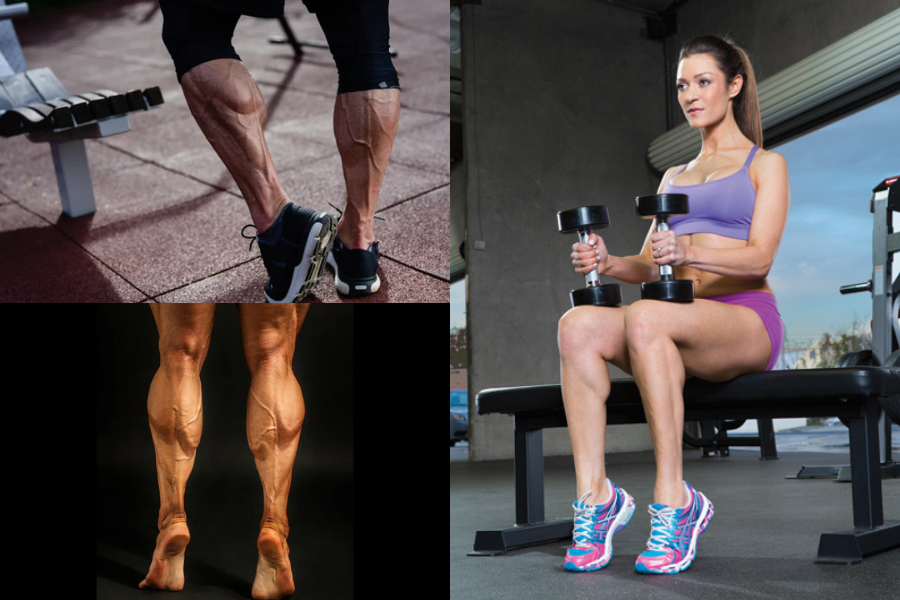
Calves might be a smaller muscle group, but they play a big role in how you move, jump, and even how your legs look in shorts. If you are wondering how to build calf muscles in a way that actually works, the key is a mix of smart training, good technique, and the right fuel from your diet.
Below, you will find simple, effective tips you can start using this week, whether you are new to strength training or trying to break through a stubborn plateau.
Understand your calf muscles
Before you load up the weight stack, it helps to know what you are training. Your calves are mainly made up of two muscles that work together every time you walk, run, or rise up onto your toes.
The gastrocnemius is the larger, more visible muscle that creates the classic “diamond” shape. It helps with plantar flexion, which is pointing your toes down, and it also assists with bending your knee. The soleus sits underneath the gastrocnemius, stabilizes your foot and ankle, and also helps with plantar flexion.
These two muscles do not respond exactly the same way to training. The soleus has a higher percentage of slow twitch fibers and tends to grow best with higher repetitions and longer time under tension. The gastrocnemius has more fast twitch fibers and responds well to heavier loads and moderate rep ranges. When you understand this, you can choose exercises and rep schemes that actually match how your calves are built.
Fuel your calves with muscle building foods
You cannot talk about how to build calf muscles without talking about nutrition. Muscle growth depends on giving your body enough protein, calories, and nutrients to repair and build tissue after you train.
Protein rich foods are especially important. Eggs are often called the gold standard of protein. Each egg gives you about 7 grams of high quality protein plus essential vitamins and minerals that support muscle building throughout your body, including your calves. Wild salmon offers around 20 grams of protein in a 100 gram serving. It also contains omega 3 fatty acids that support muscle health and recovery.
Lean meats can be a practical staple if you eat animal products. Chicken breast for example provides roughly 31 grams of protein and about 4 grams of fat per 100 grams, so it fits easily into a muscle building diet. If you prefer more plant forward meals, adding spinach is a simple way to support your training. Spinach supplies iron and nitrates that promote muscle growth and help cell metabolism, which can make your workouts feel more productive.
You do not need a complicated meal plan to benefit your calves. Focus on:
- Including a source of protein in each meal.
- Adding leafy greens like spinach regularly.
- Choosing fatty fish like wild salmon a few times per week if possible.
- Eating enough total calories so your body has the energy it needs to grow.
Use a full range of motion
If you already do calf raises but rarely feel them deeply, the problem may not be the exercise choice. It is often the range of motion. Your ankle can move through roughly 20 degrees of dorsiflexion, toes pulled up, and about 50 degrees of plantar flexion, toes pointed down. When you cut this movement short, you leave growth on the table.
To build calf muscles effectively, focus on lowering your heels below the level of your toes at the bottom of each rep if your joints allow. Using a raised surface like a step or platform lets you sink into that deeper stretch. At the top of the movement, rise fully onto your toes and pause briefly to feel a strong contraction in the muscle.
Moving slowly and with control matters. Avoid bouncing at the bottom or rushing through the hardest part of the rep. That bounce uses stored elastic energy instead of muscular effort and reduces the stimulus your calves receive. When you train through a long range of motion with steadier reps, your muscles are forced to work instead of relying on momentum.
Choose the right calf exercises
There are many ways to train your calves, but a few basic movements cover most of what you need. You can build an effective routine around a small selection of exercises that you perform consistently.
Standing calf raises are a classic for good reason. They emphasize the gastrocnemius because your knees stay straight. You can do them on a machine, with dumbbells in your hands, or using just bodyweight if you are starting out. Seated calf raises put your knees in a bent position which shifts more work to the soleus. Both are useful when your goal is complete calf development.
You can also use variations to keep your muscles challenged. Leg press calf raises let you load the movement heavily in a supported position. Single leg calf raises help even out strength imbalances between sides. More dynamic options like eccentric calf raises, where you emphasize the slow lowering phase, and tiptoe farmer’s carries can add a different kind of challenge that your calves are not used to.
A solid training week for your calves might include standing calf raises, seated calf raises, and one more variation like eccentric raises or squats into calf raises. That way you are hitting the muscles from slightly different angles and with slightly different demands.
Train with smart sets and reps
Once you know which exercises to do, the next step is deciding how often and how hard to train. For hypertrophy, or muscle growth, research supports doing roughly 6 to 12 or more reps for 4 to 5 sets on your main calf exercises. This gives you enough volume and effort to stimulate change without making the session unmanageable.
Calves are heavily used all day in low intensity activities like walking. Some people log 3,000 to 10,000 steps daily, so your calves are very accustomed to easy work. To grow, they need a stronger signal than they get from everyday movement. That is why high volume sets, focused effort, and a full range of motion are so important.
You do not have to max out the weight stack. In fact, studies suggest that calf muscles that are predominantly slow twitch can grow well with high volume, low to moderate loads, as long as you push close to failure. A practical approach is to pick a load that lets you complete your target rep range with good form and then aim to add a little weight, around 5 to 10 percent, each week as your strength improves.
Adjust knee angle and foot position
One easy way to get more out of the same exercise is to change your joint angles and stance. Knee position has a clear impact on which calf muscle works harder. When your knees are straight, like in a standing calf raise, the gastrocnemius takes more of the load. When your knees are bent, as in a seated calf raise or a squatting calf raise, the soleus does more of the work.
Foot angle also lets you shift emphasis within the gastrocnemius. With your toes pointed slightly outward, you tend to hit the medial, inner, head more. With toes pointed slightly inward, you place more tension on the lateral, outer, head. Feet neutral, pointed straight ahead, spread the work across both.
You do not need to overcomplicate this. A simple way to use it is to perform one set with toes forward, one with toes out, and one with toes in during your standing calf raises. Over the course of a week or a month, that variety helps you train all areas of the muscle and can contribute to a more balanced shape.
Add plyometrics for power and definition
Traditional strength training builds size and base strength, but adding some explosive work can help your calves look and perform better. Plyometric exercises emphasize quick, powerful movements and rely heavily on calf involvement when you push off the ground.
Lunge jumps, for example, challenge stability along with power. You start in a lunge position and then jump to switch legs in the air before landing gently. Jump rope is another accessible option that trains your calves through repeated toe off and landing. When you use a controlled, light landing and stay mostly on the balls of your feet, your calves work hard every second.
These moves can improve strength, coordination, and muscle definition when you combine them with your regular calf raises. Just place them early in your workout when you are fresh, keep the sets relatively short, and focus on good form. That helps you get the benefits without adding too much joint stress.
Train all lower leg muscles
If you only work the back of your lower legs, you may miss a chance to improve both performance and appearance. The tibialis anterior, which runs along the front of your shin, helps lift your foot and plays an important role in ankle stability. Training it can enhance the overall shape of your lower leg and may reduce the risk of shin splints.
Simple exercises like toe raises, where you lift your toes toward your knees while your heels stay on the ground, can engage the tibialis anterior. You can also use light resistance bands to add a bit more load. Including a few sets for this muscle group a couple of times per week rounds out your lower leg training.
When you target the gastrocnemius, soleus, and tibialis anterior together, your calves not only look fuller from multiple angles, but your ankles and feet may feel more stable when you run, jump, or change direction quickly.
Stretch and recover for better growth
Calves often feel tight, especially if you walk a lot, wear certain shoes, or spend long periods sitting. Stretching them fully between sets and after your workout can improve your range of motion and may help with recovery. Many people also find that it enhances the “pump” they feel during training, which can be motivating.
A simple calf stretch uses a wall or step. Place your hands on the wall, step one foot back, keep the heel down, and gently lean forward until you feel a stretch in the back leg. Holding this position between sets for a short period can provide what is sometimes called stretch overload, which some lifters use to encourage growth.
Recovery is about more than stretching though. Sleep, overall nutrition, and avoiding excessive bouncing or jerking movements in your training all play a role. When you perform your reps smoothly, vary your time under tension, and sometimes include partial reps at the end of a set to fully fatigue the muscle, you give your calves a strong growth signal without overly stressing your joints.
Be realistic about genetics and consistency
Calf size has a strong genetic component. Factors like tendon length, muscle insertion points, and fiber composition vary from person to person and across different body types and ethnic backgrounds. For instance, people with higher tendon ratios and more fast twitch dominance may need to hold two or three second pauses during reps to reduce elastic recoil and make the muscle work harder.
You cannot change your genetics, but you can control how consistently and intelligently you train. Instead of comparing your calves to someone else’s, track your own progress. Take measurements, photos, or note performance markers like how much weight you use or how many quality reps you complete.
Aim to train your calves at least twice per week, and up to four times if they are a priority, splitting sessions between movements that favor the gastrocnemius and those that emphasize the soleus. Over time, that focused work, supported by good food and recovery, will help you build the strongest calves your body can achieve.
If you start today with just one exercise, such as a slow, full range standing calf raise, and a small upgrade to your nutrition like adding an extra serving of protein, you will already be on your way to better calf development.