A pair of dumbbells and a little floor space are all you need for effective dumbbell tricep workouts. With the right exercises and a bit of structure, you can build stronger, more defined arms at home or in the gym, without relying on bulky machines or a barbell.
Below, you will learn why your triceps matter so much for arm size and pressing strength, then walk through specific dumbbell moves that target all three heads of the muscle. By the end, you will have a simple framework to build your own tricep routine.
Understand why triceps matter
Your triceps sit on the back of your upper arm and have three heads: long, lateral, and medial. Together, they extend your elbow and play a major role in any pressing movement, such as push ups and bench press.
Research shows the triceps make up significantly more of your upper arm mass than the biceps, in some cases accounting for well over half of total upper arm size compared with roughly one third from the biceps, as summarized by Garage Strength. In practical terms, if you want bigger, stronger looking arms, you cannot ignore tricep training.
Dumbbells are especially useful here. They allow:
- A larger range of motion than many machines
- More muscle activation for stability
- Unilateral work so you can correct left to right imbalances
That extra range and control help you place tension exactly where you want it, which is key for both strength and hypertrophy.
Benefits of dumbbell tricep workouts
Dumbbell tricep workouts are convenient, joint friendly, and easy to scale. If you are not comfortable with barbells or do not have access to a full gym, dumbbells remove those barriers.
A few specific benefits stand out:
You can perform a wide range of movements that isolate the triceps, including lying extensions, overhead work, presses with close grips, and kickbacks. These cover different angles and resistance profiles, so you can train all three tricep heads more completely.
Because each arm holds its own weight, you are less likely to let your stronger side dominate. Over time, that can reduce nagging imbalances and make your pressing more stable overall.
Dumbbells are also easy to store at home. You can keep a small set in a corner and get serious tricep training done without a bench or cable stack. This is especially helpful if you tend to skip accessory work due to time or equipment.
Finally, you can swap out machine work with dumbbells to increase your range of motion and improve flexibility. Over relying on machines and cables can limit how far your joints move under load, which may lead to weaker muscles and an aesthetic imbalance over time. Free weights encourage your shoulders and elbows to move in a more natural path.
Key form tips for safe training
Good form is non negotiable with dumbbell tricep exercises. Poor technique not only reduces how much the triceps actually do, it shifts stress to your shoulders, wrists, and elbows.
Keep these form cues in mind:
- Lock your upper arm in place and move mostly at the elbow for isolation moves like extensions and skull crushers.
- Avoid jerking the weight. Use smooth, controlled reps and pause briefly at the bottom where the stretch is greatest.
- Choose a weight that allows you to feel tension in the triceps rather than in your shoulders or neck.
The Mayo Clinic notes that during a dumbbell triceps extension, you should straighten and bend the elbow slowly so you feel the muscle working and avoid momentum. If you struggle to keep your arm steady, you can use your opposite hand to help maintain the elbow position.
You should also avoid training triceps to failure immediately after heavy chest or shoulder sessions on a regular basis. Since your triceps assist in pressing, they will already be fatigued. Hitting them hard again without adequate rest can hamper recovery and growth. Aim for at least 24 hours between upper body days that heavily involve triceps.
Best dumbbell tricep exercises
You do not need a long list of variations. A focused group of movements that target different functions of the triceps will cover your needs for strength, power, and muscle growth.
Close grip dumbbell bench press
The close grip dumbbell bench press is a staple for building strength. It lets you use nearly as much load as a barbell close grip press while keeping your shoulders in a safer position.
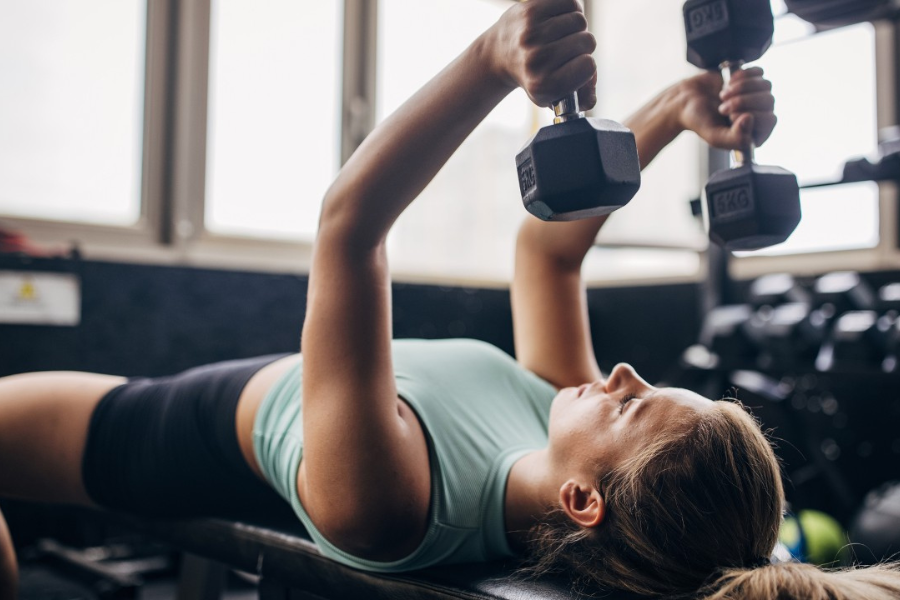
Lie on a bench or the floor with a dumbbell in each hand. Hold the weights above your chest with palms facing each other and your hands close, about shoulder width or slightly narrower. Keep your elbows down and in, not flared out to the sides. Lower the dumbbells until your upper arms reach about parallel to the floor, then press back up, focusing on driving through the triceps.
Pulling the elbows in reduces shoulder torque and funnels more of the work to your triceps. This is a good main lift for a tricep focused day or as an accessory after heavier chest work.
Dumbbell JM press
For power and lockout strength, the dumbbell JM press is an excellent option. It blends a close grip press with a tricep extension.
Start in the same position as the close grip press, with the dumbbells over your chest and elbows tucked. As you lower the weights, think about bending at the elbows and bringing the dumbbells toward your face or upper chest, not straight down. Then drive the weight up by forcefully extending your elbows.
In this movement, your elbows initiate the rep, which encourages explosive acceleration from the triceps. You maintain velocity through much of the lift without having to decelerate as hard as you might with very heavy presses. This makes it useful for athletes who want more pop in their pressing.
Lying dumbbell tricep extension (skull crushers)
Lying dumbbell tricep extensions, often called skull crushers, target the long head of the triceps with a strong stretch, which is ideal for hypertrophy.
Lie on a bench with dumbbells extended over your chest. Keep your upper arms fixed and your elbows pointed roughly toward the ceiling. Slowly bend the elbows, lowering the dumbbells toward the sides of your head or slightly behind it. Pause briefly at the bottom, then extend your arms again, stopping just before you fully straighten.
That short of full lockout helps maintain constant tension on the triceps. The deep stretch at the bottom is what makes this variation particularly effective for muscle growth, so do not rush through it or bounce out of the bottom position.
Dumbbell triceps kickback
If you want to feel your triceps fully contract and shorten, kickbacks are a smart addition to your routine.
Hold a dumbbell in one hand and hinge at the hips until your torso is nearly parallel to the floor. Keep your upper arm pinned along your side with your elbow bent at 90 degrees. From here, straighten your arm by driving the dumbbell back until your arm is fully extended behind you. Squeeze your triceps at the top, then slowly return to the starting position.
The arm position behind your body places the triceps in a shortened, fully contracted state. That makes kickbacks one of the best options for finishing a tricep workout with focused, high rep work.
Overhead dumbbell triceps extension
Overhead movements emphasize the long head of the triceps, which crosses the shoulder joint. Training this head helps with overhead strength and balanced arm development.
You can perform overhead extensions seated or standing, with one or two dumbbells. For a two handed version, hold one dumbbell by the inner plate with both hands and press it overhead. Keep your upper arms close to your ears. Bend at the elbows to lower the weight behind your head, then extend your arms again, stopping before you completely lock out.
Because the long head is stretched at the bottom of the movement, you will feel a different kind of tension versus skull crushers on a bench. As with other extension exercises, keep your movements slow and controlled and prioritize elbow comfort over weight.
Simple dumbbell tricep workout template
To turn these exercises into an effective dumbbell tricep workout, you can follow a straightforward structure that fits neatly into your weekly routine.
Here is one way to organize your session:
- Strength focus
- Close grip dumbbell bench press: 3 to 4 sets of 6 to 8 reps
- Rest 60 to 90 seconds between sets
- Power and lockout
- Dumbbell JM press: 3 sets of 5 to 6 reps
- Focus on controlled but explosive pressing
- Stretch based hypertrophy
- Lying dumbbell tricep extensions: 3 sets of 8 to 12 reps
- Peak contraction finisher
- Dumbbell triceps kickbacks: 2 to 3 sets of 12 to 15 reps
- Overhead dumbbell triceps extensions: 2 sets of 10 to 12 reps
You can perform a routine like this one or two times per week, depending on your overall training split and how much pressing you already do. If you are new to isolation work, start with fewer total sets and focus on feeling the triceps handle the load.
As a general guideline, one hard set of 12 to 15 repetitions of a triceps extension can be enough to effectively work the muscle for beginners, according to Edward R. Laskowski, M.D. at the Mayo Clinic.
That means you do not need marathon sessions. Consistent, well executed sets will do more for your arms than occasional high volume days with rushed form.
Putting it all together
Dumbbell tricep workouts give you a flexible, accessible way to build stronger arms and more powerful presses. By focusing on a few key movements that cover heavy pressing, explosive power, deep stretches, and full contractions, you can train all three heads of the triceps without complicated programming or specialized machines.
Start by adding one or two of these exercises to your current routine, then gradually build toward a dedicated tricep day if your schedule allows. Pay attention to how your elbows feel, keep your form controlled, and give yourself at least a day between hard upper body sessions.
With a simple set of dumbbells and a clear plan, you can unlock stronger, more defined triceps from almost anywhere you train.