A smart glute workout for women does much more than shape your butt. Strong glutes support your spine, stabilize your hips, and power almost every step you take. They also help you sit, stand, and move with less strain on your lower back, which is especially important if you sit for long hours or are planning a pregnancy.
Below, you will learn why your glutes matter so much, how to tell if they are underactive, and how to follow a simple, progressive glute workout for women that you can adapt whether you are a beginner or more advanced.
Why strong glutes matter for women
Your glutes are not just one muscle. They are a team of three:
- Gluteus maximus
- Gluteus medius
- Gluteus minimus
The gluteus maximus is the largest muscle in your entire body and gives your butt most of its shape. The glute medius and minimus sit higher and to the sides and have a huge impact on hip stability, posture, and that lifted, “top shelf” look in the upper glutes.
Everyday benefits you will feel
When your glutes are strong and active, they help you:
- Stand up, sit down, and walk more efficiently
- Climb stairs and hills with less effort
- Stabilize your pelvis so your knees and ankles track better
- Support your spine during lifts, twists, and daily chores
Trainers often describe the glutes as the “gateway of the spine and lower legs” because they link your lower back to your hips and legs. If the glutes are weak, the muscles and joints above and below them are forced to pick up the slack, which can change your walking pattern and throw off your overall balance.
According to strength and conditioning specialist Dana Santas, strong glutes play a key role in stabilizing the pelvis, supporting the spine, and generating power for walking, running, and climbing stairs, all of which is crucial for posture and pain prevention in women. Glute specialist Leigh Weissman also notes that targeted glute training can improve athletic performance by helping you sprint faster, turn more quickly, and enhance balance, while protecting your back, hips, and core.
Why weak glutes cause problems
Long days of sitting are one of the biggest culprits behind weak or “sleepy” glutes. When you sit for hours, your hip flexors get tight and your glutes effectively switch off. Over time, that can:
- Tilt your pelvis forward and compress your lower back
- Make your quads and lower back do more work during workouts
- Reduce your power during running, jumping, or sprinting
Women who sit a lot often notice low back pain or stiffness because inactive glutes let the pelvis shift forward and load the lumbar spine instead of supporting it.
How to tell if your glutes are underactive
You do not need a lab test to see if your glute muscles are lagging behind. Pay attention to these signs during your day and your workouts:
- During squats or lunges you feel everything in your quads or lower back instead of your butt
- Your knees tend to cave inward when you squat or land from a jump
- You struggle to balance on one leg for basic moves like step-ups
- Your hip flexors, quads, or hamstrings feel tight over and over even with stretching
If several of these sound familiar, your glute workout for women should begin with activation and control, not just heavy weights.
How often to train your glutes
For most women, training glutes 2 to 3 times per week hits a sweet spot between progress and recovery.
Glute expert Bret Contreras notes that three glute sessions per week is the most common and effective starting point, though some women do well anywhere between two and six sessions depending on genetics, exercise selection, and total training volume.
As a simple guide:
- Beginners: 2 glute-focused days per week
- Intermediate: 2 to 3 days per week
- Advanced or glute-focused phase: up to 3 days per week, with at least 48 hours between hard sessions for the same muscles
On your off days, prioritize sleep, hydration, walking, and gentle stretching or foam rolling so your muscles have what they need to grow.
A useful rule of thumb: your glute workouts should feel challenging, but you should still recover enough that you can train again in 48 to 72 hours.
Step 1: Activate and warm up your glutes
Before you start heavy squats or deadlifts, you want your glutes fully “awake.” This helps you feel the right muscles working, improves your form, and reduces the chance of lower back strain.
Spend 5 to 10 minutes on this warm-up before each glute workout for women.
Glute bridge
- Lie on your back with knees bent and feet flat, hip width apart
- Press through your heels to lift your hips
- Squeeze your glutes hard at the top, then lower with control
Aim for 2 sets of 10 to 15 slow reps. This move is a go-to activation drill that helps you find the mind muscle connection in your glutes.
Lateral band walk (or bodyweight side steps)
If you have a mini band, place it around your thighs just above the knees. If not, simply step wider.
- Bend your knees slightly and hinge your hips back
- Step sideways, keeping constant tension in your glutes
- Take 8 to 10 steps in one direction, then switch
This targets the glute medius in your upper glutes and wakes up the muscles that stabilize your hips.
Hip mobility moves
Tight hips can block your glutes from firing well. Add 1 or 2 hip mobility drills, like:
- Gentle leg swings front to back and side to side
- Deep bodyweight squat hold, holding on to a sturdy object for support
- Kneeling hip flexor stretch with a light glute squeeze
Focus more on smooth, pain-free motion than intense stretching.
Step 2: Beginner glute workout for women (bodyweight)
If you are just getting started or coming back after a break, begin with bodyweight exercises. They are surprisingly effective when you use slow, controlled movement and really focus on the squeeze.
Do this circuit 2 times per week for 4 to 6 weeks:
- Air squats
- Stand with feet about hip to shoulder width
- Sit your hips back as if you are sitting into a chair
- Keep your chest lifted and knees tracking over your toes
- 3 sets of 10 to 12 reps
- Glute bridges
- Use the same form as in the warm-up
- Pause for 2 seconds at the top on each rep
- 3 sets of 12 to 15 reps
- Split squats
- Take a long step forward and keep your torso tall
- Lower your back knee toward the floor, then push through your front heel to stand
- 2 to 3 sets of 8 to 10 reps per leg
- Curtsy lunges
- From standing, step one foot diagonally behind the other into a “curtsy” position
- Lower into a lunge, then push through the front heel to stand
- 2 sets of 8 to 10 reps per leg
- Single-leg Romanian deadlifts (bodyweight)
- Stand tall and shift your weight onto one leg
- Hinge forward at the hips, letting your back leg extend behind you
- Keep your back flat and think of reaching your hips back
- 2 sets of 8 reps per leg
Rest 45 to 75 seconds between sets. If something hurts in your joints instead of your muscles, shorten your range of motion or slow down the movement.
Step 3: Intermediate workout with dumbbells or bands
Once bodyweight work feels steady and you can complete the reps with good form, it is time to add resistance. This is where your glutes will really start to grow and shape your lower body.
Aim for this glute workout for women 2 to 3 times per week:
- Dumbbell squats
- Hold one or two dumbbells at your sides or at your chest
- Sit your hips back and down, pause briefly at the bottom
- 3 sets of 8 to 10 reps
- Romanian deadlifts (RDLs)
- Hold dumbbells in front of your thighs
- Soften your knees and hinge at the hips, sliding the weights down your legs
- Stop when you feel a strong stretch in your hamstrings, then drive your hips forward and squeeze your glutes
- 3 sets of 8 to 10 reps
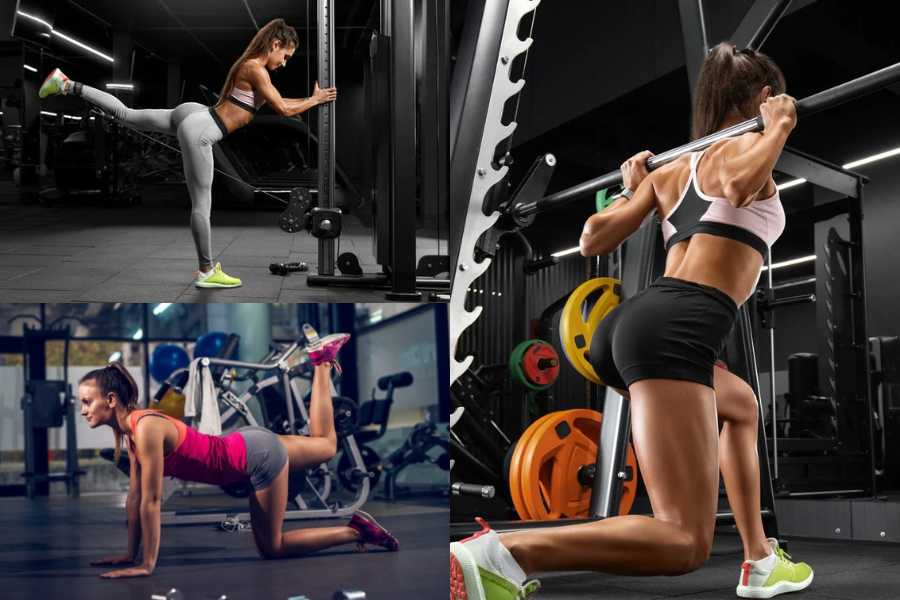
- Reverse lunges
- Step one foot back into a lunge instead of forward
- This tends to put more work in your glutes and less stress on your knees
- 3 sets of 8 to 10 reps per leg
- Elevated glute bridge or hip thrust (shoulders on a bench or sofa)
- Place your upper back on a bench or sturdy sofa, feet flat on the floor
- Drop your hips, then drive up by pushing through your heels and squeezing your glutes
- Add a dumbbell on your hips if comfortable
- 3 sets of 10 to 12 reps
- Banded clam shell or banded side steps
- Loop a resistance band above your knees
- Lying on your side, open and close your knees like a clam shell, or perform side steps in a half squat
- 2 to 3 sets of 12 to 15 reps per side
Move slowly and stay in control, especially at the bottom of each movement. That time under tension is what tells your muscles to adapt.
Step 4: Advanced glute workout for women (barbell focus)
If you are comfortable with lifting mechanics and have access to a gym, you can progress to a more advanced glute routine. This stage uses heavier compound lifts for maximum strength and muscle.
Try this routine 2 to 3 times per week, leaving at least a day between sessions:
- Barbell hip thrusts
- Sit on the floor with your upper back against a bench, barbell over your hips
- Roll the bar into place, plant your feet, and thrust your hips up
- Squeeze your glutes at the top, with your torso forming a straight line from shoulders to knees
- 4 sets of 6 to 8 reps
- Barbell or trap bar deadlifts
- Stand with the bar close to your shins, hinge at the hips, and grip the bar
- Push the floor away and stand tall, keeping the bar close to your body
- 3 sets of 5 to 8 reps
- Bulgarian split squats
- Place your back foot on a bench behind you
- Lower into a lunge on the front leg, then push back up through your heel
- Hold dumbbells for more of a challenge
- 3 sets of 8 to 10 reps per leg
- Walking lunges with dumbbells
- Take a long step forward, lower into a lunge, then step through with the back leg into the next lunge
- Focus on driving off the front heel to engage the glutes
- 2 to 3 sets of 12 to 16 total steps
- Single-leg RDLs with dumbbell or barbell
- As in the beginner version, but with added weight
- Great for targeting upper glutes and improving balance
- 2 to 3 sets of 8 reps per leg
Use weights that feel heavy by the last 2 reps but still allow you to maintain clean form. If your lower back feels like it is doing more work than your glutes, reduce the load and reset your technique.
How to target your upper glutes
If you want more lift and shape at the top of your butt, you will want extra focus on the glute medius and minimus. These muscles are key for hip abduction and pelvic stability.
Great upper glute options include:
- Lateral band walks
- Side plank with hip abduction
- Cable hip abduction
- Dumbbell walking lunges
- Single-leg Romanian deadlifts
Women aiming to grow their upper glutes should train them at least twice per week, and up to three times if you recover well. Many women notice early shape changes in 4 to 8 weeks, with more visible development across 3 to 6 months, depending on training consistency, nutrition, and genetics.
How long it takes to see results
If you are consistent with your glute workouts and get enough protein and rest, you can expect to notice:
- Better glute activation and less quad dominance in 2 to 3 weeks
- Visible shape changes in about 4 to 8 weeks
- More dramatic strength and muscle gains over 3 to 6 months and beyond
Bodyweight glute exercises at home can absolutely build strength and muscle, especially when you apply progressive overload by increasing reps, adding pauses, reducing rest time, or eventually adding resistance bands and weights.
Putting your glute plan together
To make this practical, here is a simple weekly structure you can follow:
- Day 1: Glute workout (Beginner, Intermediate, or Advanced)
- Day 2: Active recovery (walking, mobility, light core work)
- Day 3: Glute workout
- Day 4: Upper body or full body strength
- Day 5: Optional third glute-focused session or conditioning
- Days 6 and 7: Light movement, stretching, rest
Remember that a glute workout for women is not just about aesthetics, although those will come with consistency. Strong glutes mean better posture, less back discomfort, smoother movement, and more confidence in everything from walking up stairs to lifting heavy in the gym.
Start with the version of the plan that matches your current level, pick 2 to 3 exercises to begin with if the full routine feels like too much, and build from there. The first step might simply be adding glute bridges and lateral band walks to your next workout. Over time, those small, steady choices will sculpt both your lower body and the way you move through everyday life.