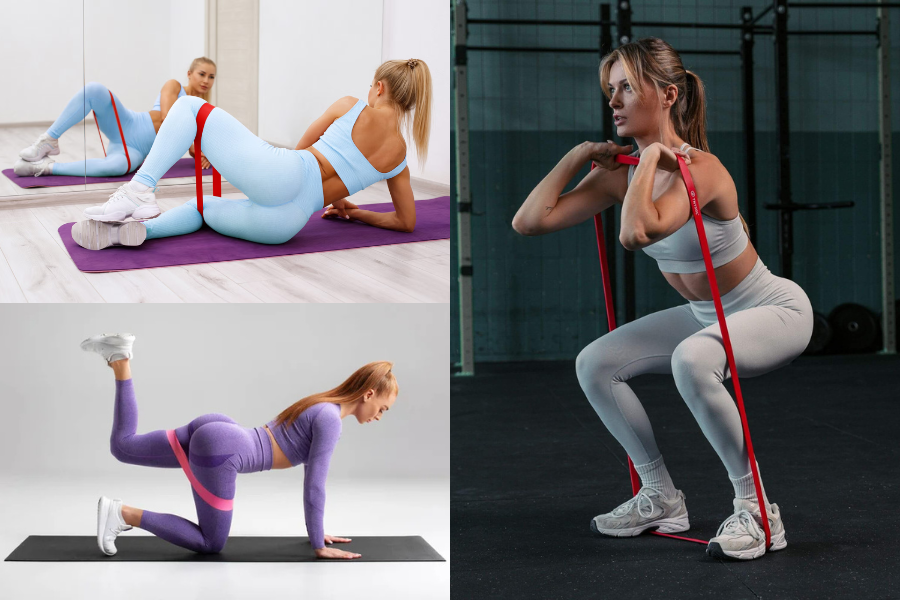
A set of resistance bands and a few square feet of floor space are all you need to start effective glute exercises with resistance bands. You can do these moves at home, in a hotel room, or in a busy gym without waiting for machines, and still build strength, tone, and stability in your hips and lower body.
Below, you will learn how resistance bands work for your glutes, how to position them correctly, and how to put together a simple routine you can actually stick with.
Understand how resistance bands work your glutes
Resistance bands, sometimes called booty bands, glute bands, butt bands, or hip bands, create tension that your muscles have to fight against as you move. That tension stays on your muscles through the entire range of motion, which is ideal for targeting your glutes.
Your glute exercises with resistance bands mainly work three muscles:
- Gluteus maximus controls hip extension and rotation, and gives your butt its shape.
- Gluteus medius helps move your leg out to the side and stabilizes your pelvis.
- Gluteus minimus assists the medius and helps keep your hips level when you walk or run.
Research has shown that elastic bands can deliver strength gains similar to traditional weights when used properly, including for the glute muscles, in a 2019 study on resistance band training and strength outcomes. This means you do not need heavy machines to see progress, especially if you are just starting or training at home.
Because bands are joint friendly and low impact, they are also a useful option if your knees, hips, or lower back do not love heavy loads. The consistent tension helps you activate more muscle fibers and improves blood flow before high intensity workouts, which is why many coaches use banded glute work as part of a warm up before squats, deadlifts, or running.
Choose the right bands and placement
You will see different types of bands marketed for glute work, and you might wonder which you actually need.
Mini loop bands are often the easiest place to start for glute specific training. You typically wear them around your thighs just above the knees, although you can also position them around your ankles or shins to give your gluteus medius more feedback. This small loop provides constant outward tension that your hips must resist every time you step, squat, or lift.
Unlooped resistance bands are more versatile. You can knot them into a loop for lower body moves, or leave them long for standing kickbacks, hip abductions, and even upper body exercises. Smart band systems like LIT Axis are designed to mimic cable machines at home, so you can keep your workouts varied without a room full of equipment.
Placement matters as much as band type. For most glute exercises with resistance bands, aim for:
- Above the kneecap or mid thigh for strong glute activation without excessive strain.
- Just below the knees if you want a little more intensity and feel your hips working harder.
You do not need the heaviest band to get a good workout. If the band is so stiff that your legs barely move, your body will start recruiting other muscles like the tensor fasciae latae (on the outside of your hip) instead of your glutes. If you feel tightness along the outer thigh or side of the hip, drop to a lighter band so your glutes can actually do the work.
Use resistance bands safely and effectively
Before you jump into specific moves, a few technique habits will help every banded glute exercise feel more effective and more comfortable.
First, set your posture. Stand or lie with your ribs stacked over your pelvis, and lightly brace your core so your lower back stays neutral. When you do hip thrusts or bridges, avoid arching your lower back at the top. Think of tucking your tailbone slightly and drawing your front ribs toward your hips to keep the effort in your glutes, not your spine.
Next, build a mind muscle connection. Instead of going through the motions on autopilot, consciously squeeze your glutes before each repetition. This is especially helpful in isolation exercises like banded kickbacks or clamshells, where the goal is to feel the glute burning, not your thighs taking over. Slow, controlled movements keep the muscle under tension longer, which is a key driver of hypertrophy according to a 2012 study in the Journal of Physiology.
Finally, use bands selectively. It is tempting to loop a booty band around your knees for every single exercise, but that can sometimes interfere with big compound lifts. When you place a band around your knees during heavy hip thrusts, leg presses, or Romanian deadlifts, you introduce lateral resistance that competes with the vertical load you need for maximum glute max engagement. This usually forces you to use less weight and can actually limit growth. Reserve the band for targeted work and warm ups, and let your main strength sets focus on moving weight with good form.
Try these five key banded glute exercises
You can mix and match many glute exercises with resistance bands, but these five cover strength, stability, and activation without complicated choreography.
1. Lateral band walk
This move fires up your gluteus medius and minimus, the muscles that help keep your knees from caving in when you squat or run.
- Place a mini band around your thighs just above your knees.
- Stand with feet hip width apart, a soft bend in your knees, and your hips slightly hinged back.
- Keeping your toes facing forward, step one foot out to the side.
- Bring the other foot in, maintaining band tension so your knees do not collapse inward.
- Take 8 to 12 steps in one direction, then reverse.
Focus on small, controlled steps rather than big swings. You want continuous tension on the band, not a loose slingshot effect.
2. Standing glute kickback
This is a simple isolation move that helps you feel your glute max working without loading your spine.
- Loop an unlooped band around a sturdy anchor at ankle height, or use a mini band around both ankles.
- Stand tall holding a wall or chair for balance.
- With a slight bend in your standing leg, extend the working leg straight back behind you.
- Stop when you feel your glute fully contract, not when your lower back starts arching.
- Slowly return to the starting position under control.
Keep your toes pointing straight down and your hips square to the front. Aim for 10 to 15 reps per leg.
3. Squat to lateral leg lift
This combination move builds strength while challenging balance and hip stability.
- Place a band above your knees and stand with your feet shoulder width apart.
- Sit back into a squat, chest up and heels grounded, pushing your knees gently out into the band.
- As you stand, shift weight to one leg and lift the other leg straight out to the side.
- Lower the leg back down and go into your next squat.
- Alternate sides for 8 to 12 reps per leg.
Move slowly so you do not lean excessively to the side during the leg lift. The band will try to pull your knees inward, which is exactly what forces your outer glutes to work harder.
4. High plank leg lifts
This exercise challenges your core and glutes at the same time, serving as a good bridge between core work and leg day.
- Wrap a mini band around your thighs just above your knees.
- Set up in a high plank with your wrists under your shoulders and your body in a straight line.
- Squeeze your glutes and lift one leg a few inches off the floor, keeping it straight.
- Hold for a second, then lower with control and switch sides.
Keep your hips level and avoid letting your lower back sag. If a full plank is too intense, try the same movement from your knees while focusing on tight glutes and a braced core.
5. Banded glute bridge abductions
This variation turns a basic bridge into a powerful glute builder.
- Lie on your back with knees bent and feet hip width apart, band above your knees.
- Press through your heels and squeeze your glutes to lift your hips into a bridge.
- At the top, push your knees outward against the band for a small abduction movement.
- Bring them back to neutral, then slowly lower your hips to the floor.
Think of lifting your hips by squeezing your butt, not by arching your lower back. You can pause for one to two seconds at the top to increase time under tension.
Build a simple resistance band glute workout
You do not need an hour long session to see benefits from glute exercises with resistance bands. A short routine, done consistently, can help with posture, hip stability, and everyday movements like climbing stairs or lifting groceries.
You can try this beginner friendly circuit two or three times per week:
- Lateral band walk, 10 steps each way
- Banded glute bridge abductions, 12 to 15 reps
- Squat to lateral leg lift, 8 to 10 reps per side
- Standing glute kickbacks, 10 to 15 reps per side
- High plank leg lifts, 6 to 10 reps per side
Perform 2 to 3 rounds, resting 45 to 60 seconds between rounds. Start with a light to medium band, and only move up in resistance when you can complete the top end of the rep range with solid form and feel most of the effort in your glutes.
You can also use a shorter version of this circuit as a warm up before heavier lower body sessions. Activating your glutes before squats or deadlifts can improve performance in explosive movements like squat jumps, as shown in research that compared athletes who warmed up with glute exercises to those who did not.
If you are short on time, pick just two exercises, for example, lateral band walks and glute bridge abductions, and do them at the end of your workout. Consistency will matter more than doing every variation in one day.
Keep your bands and progress in good shape
A couple of simple habits will keep your bands safe to use and help you avoid plateaus.
Inspect your bands regularly for cracks or thinning spots, especially around areas that stretch the most. Store them away from extreme temperatures and direct sunlight to prevent the material from degrading. For cleaning, gentle solutions like diluted vinegar or yoga mat cleaner are better than harsh chemicals that can break down the rubber.
For your training, change small variables over time. You can:
- Slow down the lowering phase to increase time under tension
- Add a brief pause at the hardest point of the movement
- Move the band slightly lower on your legs to make exercises harder
- Try single leg versions of bridges or kickbacks when you feel ready
You do not need endless “Instagram exercises” to grow stronger glutes. A handful of well chosen glute exercises with resistance bands, done with attention and gradual progression, will take you much further than constantly chasing novelty.
Start with one or two of the moves you feel most confident about today. Once you can feel your glutes working hard and recovering well, you can build your routine out from there.