A smart glute workout routine does more than build a rounder butt. Strong glutes support your lower back, improve posture, and power everyday movements like climbing stairs or walking uphill. When you structure your training correctly, you get lasting strength and shape instead of short-term soreness.
Below, you will find how to build a glute workout routine that grows muscle, protects your joints, and fits into a normal schedule, not a bodybuilder’s life.
Understand your glute muscles
If you want real results from your glute workout routine, it helps to know what you are training.
You have three main glute muscles: the gluteus maximus, gluteus medius, and gluteus minimus. The gluteus maximus is the largest and gives your hips most of their power for hip extension, like standing up from a chair or driving through your legs in a squat. The gluteus medius and minimus sit higher and deeper at the side of your hips and help with hip stability and rotation, which matters for balance and knee alignment.
When all three work well together, you can run faster, jump higher, and lift heavier, and you also reduce the strain on your lower back and knees.
Set your schedule for real progress
For lasting glute gains, consistency beats intensity. Training your glutes once a week rarely delivers noticeable change. Instead, many experts recommend three focused glute sessions per week.
For example, The Women’s Health Glute Gains Challenge uses a six week glute plan with three strength sessions every week, usually 45 to 60 minutes each, and includes barbell and dumbbell work with options if you do not have a barbell available. Trainer Sandy Brockman notes that three weekly sessions plus being aware of glute engagement in daily life is a realistic sweet spot for growth.
If you are newer to strength training, you might start with two focused glute days, then build to three as your recovery improves. Aim to allow at least one rest or light activity day between heavy lower body sessions so the muscles can repair and grow.
Warm up and activate before you lift
Glutes are powerful but prone to “falling asleep” when you sit a lot. If you jump straight into heavy lifts, your quadriceps or lower back often take over and your glutes do not work as hard as they should.
A good warm up has two parts:
-
General warm up
Start with 5 minutes of light cardio like brisk walking, easy jogging, or cycling. You just want your heart rate up and your muscles warm. -
Glute activation and mobility
Follow with simple moves that switch your glutes on and loosen tight hip flexors. Programs like Bootycamp and guidance from Glute God both emphasize this step so your glutes fire properly from your first heavy rep.
Useful activation drills include:
- Lateral band walks
- Banded glute bridges
- Clamshells
- Standing hip circles
- Leg swings (front to back and side to side)
These lighter, higher rep exercises are not “extra fluff.” They build a stronger mind muscle connection and improve hip mobility so that when you squat, hinge, or thrust, your glutes are ready to drive the movement.
A short activation block before every session can mean the difference between your glute workout routine hitting your backside or just tiring out your thighs.
Choose the right glute exercises
A complete glute workout routine combines heavy compound lifts with targeted isolation moves. This way you strengthen the whole hip area, not just the muscles that show in the mirror.
Big compound lifts for strength and size
Compound exercises use multiple joints and big muscle groups. They deliver the most strength and muscle gains per rep, and they also tend to show very high glute activation in research.
Some of the best compound glute exercises include:
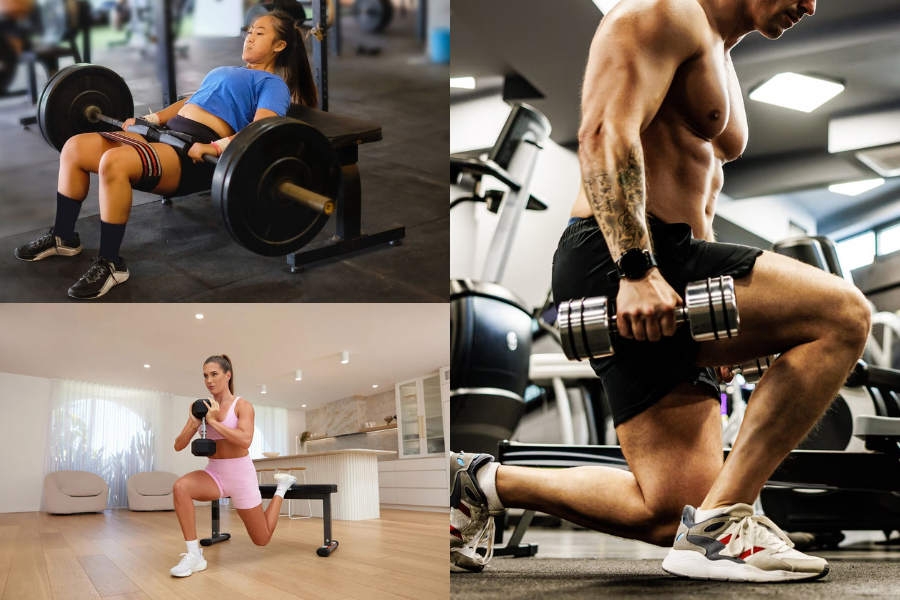
- Barbell hip thrusts
- Back squats
- Front squats
- Bulgarian split squats
- Conventional deadlifts
- Romanian deadlifts
Studies up to 2019 found that many bilateral exercises like squats, deadlifts, lunges, and split squats produce high gluteus maximus activation, often above 60 percent of maximal voluntary contraction. Barbell hip thrusts can reach very high activation levels too, even at moderate loads, especially when you adjust your foot angle or hip position to suit your structure.
Step ups and their variations also stand out. Because you are stabilizing on one leg, they can produce very high gluteus maximus activation, making them a useful choice when you want intensity without loading your spine too heavily.
Isolation and lateral work for full development
Compound lifts are essential, but they do not always hit the glute medius and minimus as directly. Isolation and lateral movements fill that gap and help round out your glute shape and stability.
You can rotate in exercises like:
- Single leg glute bridges or hip thrusts
- Banded side steps or lateral walks
- Clamshells
- Cable or banded kickbacks
- Donkey kicks
- Frog pumps
- Single leg Romanian deadlifts
Glute God highlights adding these types of movements so that you truly train all three glute muscles, not just the largest one.
Use rep ranges and load for growth
How you structure sets, reps, and weights matters as much as which moves you pick.
For glute hypertrophy, or muscle growth, guidelines from Gymshark suggest:
- 8 to 12 reps per set at about 60 to 80 percent of your one rep max (1RM) for most lifts
- 5 sets of 5 reps at about 80 to 90 percent of your 1RM for your heaviest compound exercises, like hip thrusts or back squats
- Lighter, higher rep work with bands or bodyweight at the end of your session for extra activation
You do not need to know your exact 1RM to use this. As a simple check:
- Your working sets for 8 to 12 reps should feel challenging, but you should still move with clean form.
- You should usually have 1 to 2 reps “in the tank” at the end of a set, not total failure.
Rest 60 to 90 seconds between moderate sets, and 2 to 3 minutes between very heavy sets so you can maintain quality.
Build your weekly glute workout routine
You can structure a practical three day glute focused week around this simple pattern:
- Day 1: Heavy thrust or bridge focus
- Day 2: Heavy squat or lunge focus
- Day 3: Heavy hinge or deadlift focus
Here is how a single glute session might look:
- Warm up and activation
- 5 minutes light cardio
- 2 rounds of 15 to 20 reps each: banded glute bridges, lateral band walks, clamshells
- Main strength block
- Barbell hip thrust: 4 sets of 6 to 8 reps
- Bulgarian split squat: 3 sets of 8 to 10 reps per leg
- Romanian deadlift: 3 sets of 8 to 10 reps
- Accessory and isolation work
- Step ups: 3 sets of 10 reps per leg
- Cable or band kickbacks: 3 sets of 12 to 15 reps
- Single leg glute bridge holds: 2 sets of 20 to 30 second holds per leg
- Cool down
- Gentle hip flexor, hamstring, and glute stretches
- Easy walking or light cycling for 3 to 5 minutes if you feel tight
Adjust the exercises across your three weekly sessions so you are not repeating the exact same moves every time, but keep the structure similar so you can measure progress.
Focus on form and range of motion
Glutes grow when you challenge them through a strong, controlled range of motion. Shallow squats, rushed deadlifts, or half rep hip thrusts not only reduce muscle activation but also raise injury risk.
Some practical form cues:
- In squats and split squats, sit your hips back and down, keep your chest lifted, and push your knees in line with your toes.
- In hip thrusts and bridges, tuck your chin slightly, brace your core, and think about driving your hips up by squeezing your glutes, not arching your lower back.
- In deadlifts, hinge at the hips rather than rounding your spine, and keep the bar close to your body.
If your mobility limits your depth, work within a pain free range and add gentle mobility work. Over time, aim for deeper, controlled reps rather than adding weight too quickly.
Bootycamp style programs use coach supervision to correct form and prioritize full range, which is one reason they are so effective. When you train on your own, recording short videos from the side and front can help you self check technique.
Use the mind muscle connection
It might sound strange, but where you put your attention during a lift can change how much a muscle works. Research cited in the European Journal of Sports Science and highlighted by Glute God shows that intentionally focusing on contracting a target muscle can increase its activation.
In practice, this means:
- Think about driving through your heels and squeezing your glutes at the top of every thrust, bridge, or squat.
- Hold the squeeze for about one second before lowering.
- Move with control instead of letting momentum carry the weight.
You can practice this even outside the gym. For example, when you stand up from a chair or climb stairs, consciously push through your heels and feel your glutes do the work instead of your quads.
Apply progressive overload over time
Your glutes will adapt to whatever you repeatedly ask them to do. If the challenge stays the same, your progress eventually stalls. This is where progressive overload comes in.
According to Gymshark, you can introduce overload in several ways:
- Increase the weight on the bar or dumbbells
- Add reps to your sets while keeping form solid
- Add an extra set for key exercises
- Slow the lowering phase of each rep to increase time under tension
- Shorten rest times slightly, while still allowing good performance
Bootycamp style programs track your weights, reps, and intensity to make sure the difficulty increases gradually. You can do the same with a simple training log or app. Aim to improve one small variable most weeks, even if it is just one more rep on your last set.
Respect recovery for lasting results
Muscle does not grow during your workout, it grows when you rest and refuel afterward. If you push heavy glute days back to back without recovery, your performance and progress suffer.
Glute God recommends at least one rest day between heavy sessions. On those days, you can use active recovery like walking, light yoga, or gentle jogging to keep blood flowing without overloading tired muscles.
Other recovery basics:
- Sleep enough, since poor sleep slows muscle repair.
- Eat enough protein and overall calories to support growth.
- Pay attention to soreness patterns. Normal muscle soreness is fine, but sharp joint pain is a sign to adjust form, load, or exercise choice.
If you notice your strength dropping from session to session, or you feel constantly exhausted, pull back your volume or intensity for a week. A small reset often leads to better long term gains than pushing through constant fatigue.
Putting it all together
A perfect glute workout routine is not about doing every trendy exercise you see online. It is about combining:
- Three focused sessions per week
- A proper warm up and glute activation block
- Heavy compound lifts for strength and size
- Smart isolation and lateral work for full development
- Mindful form, full range of motion, and a strong mind muscle connection
- Gradual, tracked progression with enough recovery
Start by choosing one or two of the structures above and commit to them for six weeks, similar to programs like the Women’s Health Glute Gains Challenge. Keep notes, adjust based on how your body responds, and give your routine the chance to work.
Your glutes are built to be strong. With a thoughtful plan and steady effort, they will be.