Glute strength training does more than shape how you look in jeans. When you consistently train your glutes, you build strength, protect your joints, and gradually feel more confident in your body and your workouts. Because the glutes are the largest and one of the most powerful muscle groups in your body, improving them pays off in almost everything you do, from walking up stairs to lifting weights more safely.
Below, you will learn what glute strength training is, why it matters for confidence, and how to create a routine you can stick with.
Understand your glute muscles
Your “glutes” are actually three muscles working together to support your hips and lower body.
The three main glute muscles
The research shows that effective glute strength training needs to target all three muscles, not just the largest one:
- Gluteus maximus: The biggest and most visible muscle. It powers hip extension, for example when you stand up, climb stairs, or drive your hips up in a hip thrust. It is also the largest muscle in your body, which is why training it can help with weight loss and overall strength.
- Gluteus medius: Sits on the outer side of your hip. It helps with hip abduction and internal rotation and plays a key role in balance and pelvic stability.
- Gluteus minimus: The smallest, located under the medius. It also supports hip abduction and internal rotation and helps keep your hips level when you walk or run.
According to both ISSA and Planet Fitness, these three muscles together support lower body movement, posture, and balance, and they reduce stress on the knees and lower back. When you train them evenly, you are not just chasing aesthetics, you are building a foundation for confident, pain free movement.
Why glute strength training boosts confidence
Glute training can change how you feel about your body from the inside out.
Functional strength you can feel
Strong glutes help stabilize your pelvis and spine, which improves posture and makes everyday movements feel smoother. Methodist Physicians Clinic notes that the glutes are essential for hip extension, abduction, and rotation, all of which are important for walking, running, and standing upright with ease.
As your glute strength improves, you may notice that:
- Stairs feel easier.
- Your lower back feels less strained.
- You feel more stable when you squat, lunge, or pick something up.
This sense of control over your body is a powerful confidence builder.
Less pain, more trust in your body
Weak glutes are linked with lower back pain, knee pain, hip pain, and even ankle pain, because your joints lack proper support. Strengthening the glutes can help reduce these issues by stabilizing the pelvis and limiting excessive inward rotation of the femur, which can affect knee tracking.
When pain eases and you move with fewer aches, you naturally start to trust your body more. That trust often carries into the gym, your job, and your daily life.
Visible progress that reinforces self belief
With consistent glute strength training, you can track progress clearly. You might see:
- Heavier weights on hip thrusts or squats.
- More control in single leg exercises.
- Visual changes in muscle definition and shape.
Each small improvement reminds you that your effort is working, which builds self belief session by session.
Common mistakes that hold your glutes back
If you feel like you have been “doing glute exercises” for a while without much progress, you may be running into some of these common issues.
Skipping proper activation
One frequent mistake is jumping straight into heavy lifts without waking up your glutes first. When that happens, your quads or lower back often take over, and the glutes stay relatively quiet.
Glute focused programs like Bootycamp address this by starting every workout with activation drills, such as:
- Band walks
- Clamshells
- Small, targeted pulses
These moves teach your brain to “find” your glutes so they engage fully when you get to bigger lifts.
Only training once a week
Training your glutes just once a week is usually not enough to see meaningful strength or shape changes. Research based recommendations suggest working glutes two or three times per week, with at least one rest day between sessions so the muscles can repair and grow.
If you are consistent with that frequency, you set yourself up for steady, noticeable improvement instead of feeling stuck.
Poor form and half reps
Rushing through reps, using too much weight, or cutting the range of motion short can all reduce glute activation and increase injury risk. Examples include:
- Shallow squats that never reach a depth where the glutes have to work.
- Half rep hip thrusts that stop before full hip extension.
Bootycamp style coaching focuses on full range of motion and technique, so your glutes actually get the stimulus they need every rep.
Ignoring progressive overload
Your glutes will adapt if you keep the challenge the same for weeks. To keep progressing, you need to gradually increase something over time, such as:
- The weight you lift.
- The number of reps.
- The tempo, for example slower lowers or pauses at the top.
Tracking your sessions, like Bootycamp does, helps you see when it is time to nudge the difficulty up instead of coasting.
Going through the motions
If you never think about the muscles you are working, it is easy to let momentum and other muscle groups take over. The research highlights the importance of the mind muscle connection. Slowing down, feeling your glutes squeeze, and controlling both the lifting and lowering phases can significantly improve activation and results.
Best exercises for glute strength training
The good news is that you do not need complicated moves to build strong, confident glutes. A mix of compound lifts and targeted accessories is enough, especially when you focus on form.
Foundational compound moves
ISSA recommends a core group of compound exercises for glute strength training, combined with progressive overload and adequate rest:
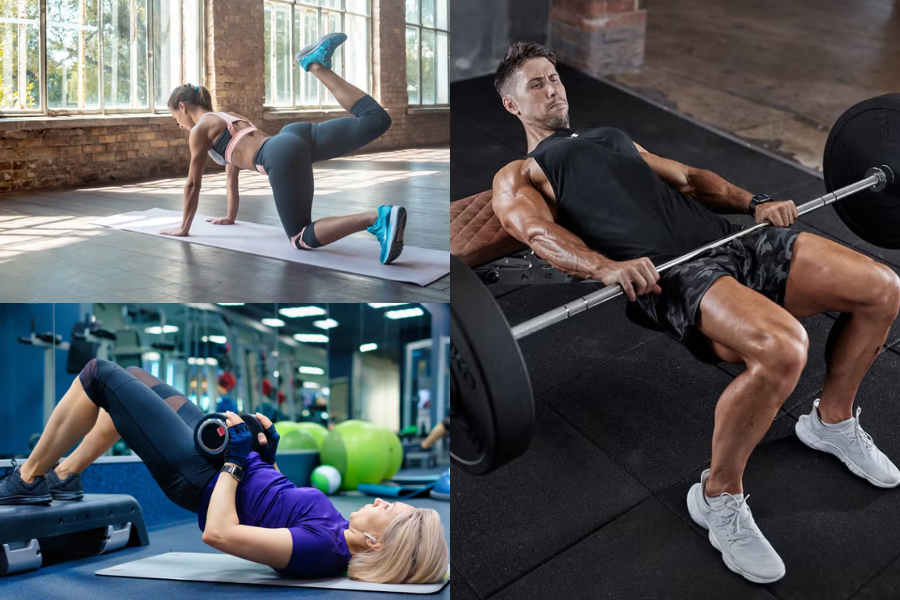
- Hip thrusts: Often considered the most effective exercise for glute growth because they maintain high glute activation throughout the movement and peak at full hip extension. Research notes that squats tend to have lower glute contraction during the lowering phase, while hip thrusts keep the glutes working consistently.
- Squats: Back squats or goblet squats work your glutes, quads, and core together. Deep squats, especially with toes slightly raised, can engage the posterior chain more effectively.
- Romanian deadlifts (RDLs): Target the glutes and hamstrings through hip hinging and controlled stretching.
- Bulgarian split squats: Single leg work that hits the gluteus maximus and also challenges balance and stability.
For hip thrusts in particular, proper setup matters. Position your upper back on a bench, keep your feet flat with your heels slightly closer to your butt than your knees, and maintain abdominal tension so your lower back does not overarch. This setup shortens the hamstrings and encourages the glutes to do more of the work.
Targeted accessory exercises
To reach the glute medius and minimus and improve hip stability, side to side and single leg movements are key. Planet Fitness and other sources recommend beginner friendly options that still work well even as you get stronger:
- Glute bridges and single leg bridges
- Lunges and reverse lunges
- Step ups
- Donkey kicks
- Fire hydrants
- Clamshells
- Side lunges
- Walking band abductions
- Frog pumps
Supine bridges are especially useful because they recruit the entire gluteal region along with your abs and lower back. You can place a small weight on your hips to increase the challenge as you improve.
Using machines and bands wisely
If you train in a gym, machine based exercises can support your glute strength training:
- Seated leg press: Hits glutes, quads, and hamstrings, especially when you use a stance that emphasizes hip extension.
- Seated abduction machine: Targets the glute medius and minimus through hip abduction.
Three sets of 8 to 12 reps with gradually increased resistance is a common starting point for strength and muscle building on these machines.
Resistance bands add intensity to side steps, clamshells, and fire hydrants, which helps train the smaller glute muscles that stabilize your hips and protect your knees.
How often to train your glutes
To build strength and confidence without burning out, focus on consistency and recovery.
Finding your weekly rhythm
Most sources recommend training your glutes:
- Two to three times per week,
- With at least one rest day between sessions for the same muscle group.
You can structure your week in different ways. For example:
- Two full lower body days with heavy glute work.
- One full lower body day plus one shorter “glute focus” session.
What matters most is that you can stick with the plan. Regular effort over months will beat a few intense weeks every time.
Balancing work and recovery
Your glutes need challenges to grow, but they also need time to repair. Make room for:
- Easy walking or light cardio on non strength days.
- Basic stretching and mobility work for hips and hamstrings.
The research notes that mobility and stretching help maintain flexibility and reduce muscle tension while you build strength. Taking care of recovery supports performance and keeps your confidence up, because you are less likely to be sidelined by soreness or nagging pain.
Sample glute strength training session
Use this as a starting point and adjust weights and reps to your level. Focus on control and how the muscles feel rather than racing through the exercises.
- Warm up and activation
- 5 to 10 minutes of light cardio, for example brisk walking or cycling.
- 2 sets each of band walks, clamshells, and glute bridges, 12 to 15 reps, slow and controlled.
- Main strength block
- Hip thrusts: 3 sets of 8 to 12 reps.
- Romanian deadlifts: 3 sets of 8 to 10 reps.
- Bulgarian split squats: 2 or 3 sets of 8 to 10 reps per leg.
- Accessory work
- Walking band abductions: 2 sets of 15 to 20 steps each direction.
- Fire hydrants or donkey kicks: 2 sets of 12 to 15 reps per leg.
- Cool down
- Gentle stretching for glutes, hip flexors, and hamstrings, 20 to 30 seconds per stretch.
If an exercise feels too easy at a given rep range, you can add weight or slow the tempo. If it feels too hard, reduce the load or the number of reps while you master the form.
Consistency plus small, steady increases in challenge is the formula that builds both stronger glutes and stronger confidence over time.
When to seek extra guidance
If you suspect your glutes are weak or you are dealing with pain in your lower back, hips, or knees, it can be smart to get professional input. Physiotherapists and osteopaths can help assess your movement, identify imbalances, and prescribe exercises that fit your body and your history. Some clinics even offer remote consultations for added convenience.
Working with a trainer can also help if you are unsure about your technique or how to apply progressive overload safely. They can monitor your form, adjust exercises, and build a plan that fits your schedule, which often makes it easier to stay consistent.
Bringing it all together
Glute strength training is one of the most efficient ways to build a stronger, more resilient body and a deeper sense of confidence in what you can do. By understanding your glute muscles, avoiding common mistakes, and focusing on a few proven exercises, you give yourself a clear path forward.
Start with one or two sessions per week you can commit to. Pay attention to your form, your mind muscle connection, and how your body feels in everyday movements. Over time, each rep becomes more than just exercise, it becomes a reminder that you are capable of getting stronger, one consistent workout at a time.