A strong quad workout with dumbbells can change the way your entire lower body looks and feels. With just a pair of weights and a bit of floor space, you can build powerful thighs, support your knees, and improve daily movements like walking stairs, standing up from a chair, or sprinting after a bus.
You also do not need a squat rack or leg extension machine to see progress. When you train your quadriceps with dumbbells, each leg has to work on its own, which helps correct imbalances and builds stability as well as strength.
Below, you will learn how your quad muscles work, which dumbbell exercises target each part, and how to put them together into beginner, intermediate, and advanced workouts.
Understand your quad muscles
Before you start any quad workout with dumbbells, it helps to know what you are actually training. Your quadriceps femoris is the four-headed muscle on the front of your thigh. Together, these muscles straighten your knee, help stabilize your kneecap, and support everyday moves like running, walking, jumping, and kicking.
According to Iron Bull Strength, your quad group includes four main muscles at the front of the thigh:
- Vastus lateralis, the outer thigh muscle
- Rectus femoris, the central quad running down the front
- Vastus medialis, the inner thigh, often seen as the teardrop shape by the knee
- Vastus intermedius, which sits underneath the rectus femoris
Each head contributes to leg extension and patella stability. The rectus femoris also assists with hip flexion, so it works hard whenever you squat, lunge, or step up with bent knees and hips.
When you select the right dumbbell exercises, you can emphasize each area for more balanced strength and better looking legs.
Why choose dumbbells for quad training
If you are used to thinking of leg day as time on the barbell or machines, it may surprise you how much you can gain from simple dumbbells.
Benefits of quad workouts with dumbbells
Dumbbell quad exercises like squats, lunges, and step-ups significantly increase leg strength, support joint health, and improve balance. A 2024 dumbbell quad workout guide from Iron Bull Strength notes that these movements are practical for daily activities and suitable for all fitness levels because you can easily adjust the load and range of motion.
Compared with barbell work, dumbbells offer some unique advantages:
- Each side holds its own weight, which reduces the chance that your stronger leg takes over
- Your stabilizing muscles work harder to keep you balanced
- You can train safely at home without a rack or spotter
- Small weight changes are simple, so you can progress steadily
Using dumbbells also challenges your grip strength and upper body. You will feel your hands, forearms, and core working while your quads drive the main movement, something that a leg press machine cannot provide.
Key dumbbell exercises for quads
You can structure a quad workout with dumbbells around a handful of proven moves. Each one can be adjusted for your fitness level by changing the load, tempo, or depth.
Dumbbell squats
Dumbbell squats emphasize the rectus femoris along the front of your thighs, while also involving your glutes and core.
How to do them:
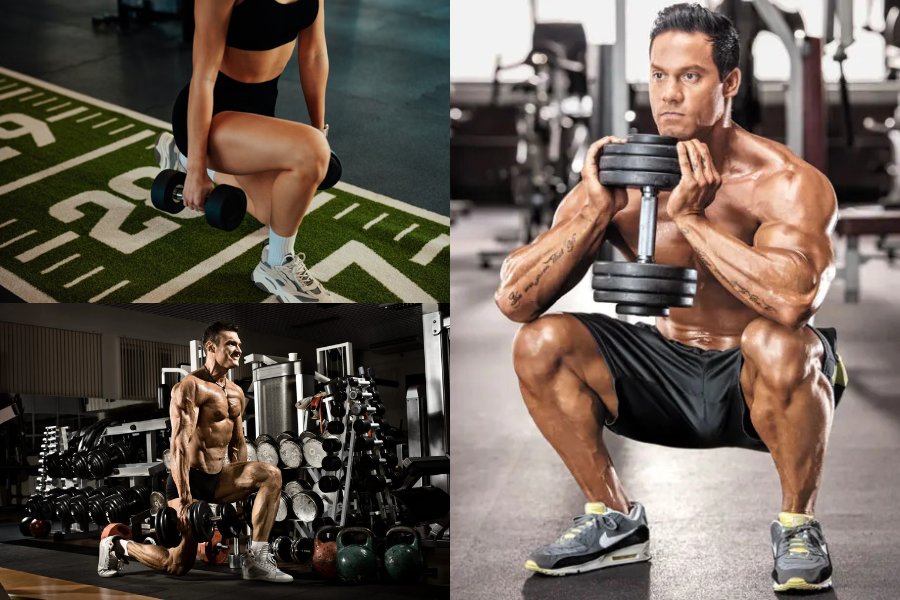
Stand with your feet about hip to shoulder width apart, toes slightly turned out. Hold a dumbbell in each hand at your sides, or hold one heavy dumbbell at your chest in a goblet position. Sit your hips down and back as if you are lowering into a chair. Keep your chest up, knees tracking over your toes, and heels down. Squat until your thighs are at least parallel to the floor, then drive through your feet to stand.
You can make this move more quad focused by taking a slightly narrower stance and staying upright through your torso.
Dumbbell lunges
Lunges shift more load onto each leg individually and strongly target your rectus femoris, especially when you take a longer step and keep your front heel grounded.
How to do them:
Stand tall holding dumbbells at your sides. Step forward with one leg and lower your hips until both knees are bent around 90 degrees. Your back knee should hover just above the floor. Keep your chest lifted and front knee lined up with your middle toes. Push through the front foot to return to standing and then switch legs.
Forward lunges, walking lunges, and reverse lunges all challenge your quads, but reverse lunges tend to be easier on your knees and are great if you are new to the movement.
Front squats and hack squats with dumbbells
If you want to build the outer sweep of your thigh, you can lean into movements that stress the vastus lateralis.
Iron Bull Strength points out that close-stance dumbbell front squats and dumbbell hack squats are particularly effective for the outer quad.
For close-stance front squats, hold dumbbells up at your shoulders and place your feet closer than hip width. Squat down, keeping a very upright torso. The narrow stance increases the demand on your outer quad.
For dumbbell hack squats, stand with your feet slightly in front of your hips and hold dumbbells behind you. Squat by bending your knees and hips while keeping the weights close to your legs. This angle drives more tension into your quads, especially the outer portion.
Split squats and Bulgarian split squats
Split squats and their more advanced cousin, the Bulgarian split squat, strongly engage the vastus medialis, the inner quad muscle that supports knee stability.
To perform a basic dumbbell split squat, stand in a staggered stance with one foot forward, one back, holding dumbbells at your sides. Lower your body straight down, bending both knees, until your back knee nearly touches the ground. Press through your front foot to rise.
Once you are comfortable, you can elevate your back foot on a bench or step to create a Bulgarian split squat. This increases the range of motion and loads the front leg more heavily.
Side lunges and reverse lunges
Side lunges and reverse lunges are excellent for loading the inner quad while also training lateral and backward movement, something many traditional leg machines do not address.
Iron Bull Strength notes that dumbbell split squats, side lunges, and reverse lunges are particularly useful for strengthening the vastus medialis and enhancing both knee stability and thigh appearance.
For a side lunge, step out to the side while keeping your other leg straight. Sink your hips back and bend the stepping knee, then push off that foot to return to center. Keep your toes mostly forward and your chest up.
Step-ups and goblet squats
The vastus intermedius, which lies beneath the rectus femoris, benefits from controlled, repetitive extension work such as dumbbell step-ups, goblet squats, and lunge pulses. These moves build base strength and endurance through the entire front of your thigh.
To do dumbbell step-ups, hold weights at your sides, place one foot on a stable bench or box, and drive through that foot to stand on top. Lower with control and repeat.
Goblet squats are similar to dumbbell squats, but you hold a single dumbbell close to your chest like a goblet. This position keeps you upright and focused on knee flexion and extension, which is ideal for quad development.
Lunge pulses
Lunge pulses are a small but intense variation that really burns the front of your thighs. You start in a lunge and perform short, controlled mini reps without standing all the way up.
Here is how Iron Bull Strength describes them:
Step forward into a partial lunge position, then pulse up and down about 3 inches without fully standing. This keeps constant tension on the quads and is suitable from beginner to advanced routines.
You can hold light dumbbells at your sides for added challenge once you master the bodyweight version.
Sample quad workouts with dumbbells
You can build entire leg days around dumbbells, no machines required. Below are three sample routines you can adapt based on your experience level and available time.
Beginner quad workout
If you are new to strength training, you will start with bodyweight and basic dumbbell patterns to activate all four quad heads safely.
Try the following circuit 2 times per week, resting 60 to 90 seconds between sets:
- Bodyweight squat, 3 sets of 10 to 12 reps
- Goblet squat, 3 sets of 8 to 10 reps
- Reverse lunge, 3 sets of 8 reps per leg
- Dumbbell step-up, 2 to 3 sets of 8 reps per leg
Focus on smooth, controlled movement and full range of motion. Choose a light dumbbell weight that lets you finish your sets with good form and one or two reps left in the tank.
Intermediate quad workout
Once you are comfortable with the basics, you can use supersets to increase intensity without spending much longer in the gym. Iron Bull Strength suggests using combinations of dumbbell exercises to hit all four quad muscles and quickly elevate the challenge.
Perform the following 2 to 3 times per week, leaving at least one rest day between sessions:
- Superset A
- Dumbbell front squat, 3 sets of 8 to 10 reps
- Walking lunge, 3 sets of 10 steps per leg
- Superset B
- Bulgarian split squat, 3 sets of 8 reps per leg
- Side lunge, 3 sets of 8 reps per leg
- Finisher
- Lunge pulses, 2 sets of 20 to 30 seconds per leg
Rest 60 seconds between supersets and 30 to 45 seconds between exercises inside the same superset.
Advanced quad-focused plan
At an advanced level, you can split your training to emphasize inner and outer quads on separate days, or combine a high density circuit with heavier strength sets.
As an example of a demanding leg circuit, Steel Supplements highlights a 15 minute “quad killing” dumbbell workout featured by Men’s Health UK. It uses an AMRAP format, which means you complete as many quality rounds as possible in a set time window.
Here is a simplified version you can try once a week:
Set a timer for 15 minutes and cycle through:
- Dumbbell front squat, 10 reps
- Walking lunge, 20 total steps
- Dumbbell Romanian deadlift, 10 reps
- Farmer’s carry, 20 to 30 meters
- Dumbbell deadlift, 10 reps
Move continuously, resting only as needed and focusing on tight form. This session will work your quads, hamstrings, glutes, core, and grip in a short but intense window.
On other training days, you might run a heavier strength session such as:
- Close-stance dumbbell front squat, 4 sets of 6 to 8 reps
- Dumbbell hack squat, 3 sets of 8 to 10 reps
- Bulgarian split squat, 3 sets of 8 reps per leg
- Lunge pulses, 2 sets of 30 seconds per leg
Use challenging weights that push you, but never at the expense of control.
Safety, recovery, and progression
Quads respond well to effort and frequency, but they also handle a lot of your daily movement. You need to train hard and recover smart.
Pay attention to form first. Keep your knees tracking over your toes and avoid letting them cave inward during squats and lunges. If you feel sharp pain in the front of your knee, scale back the depth or choose a more joint friendly variation, such as a reverse lunge instead of a forward lunge.
Gradually increase your workload by:
- Adding a small amount of weight
- Performing one more rep per set
- Adding an extra set of a key exercise
- Slowing the lowering phase to increase time under tension
Rest and recovery matter even when you are focusing on large, strong muscles like the quads. Research in dumbbell quad training highlights the importance of taking time between sessions for tissue repair, and some sources note that supplementation can help accelerate muscle recovery and support ongoing strength gains.
Listen to your body. Slight soreness is normal, but persistent joint pain or tightness is a sign you should back off, adjust your technique, or consult a professional.
Putting it all together
You do not need a full gym, a leg press, or a heavy barbell to build strong, defined thighs. With a focused quad workout with dumbbells, you can:
- Strengthen all four heads of the quadriceps
- Improve knee stability and joint health
- Build functional power for running, jumping, and daily tasks
- Correct side-to-side imbalances and enhance balance
Start with the beginner routine if you are new, or plug one or two of the intermediate or advanced sessions into your current program. Stay consistent for at least 8 to 12 weeks, gradually increase your weights, and pay attention to your form.
You will feel your legs getting stronger every time you climb stairs, stand up from a chair, or tackle your favorite sport, all from a simple pair of dumbbells and a well planned quad workout.