A low carb diet can change how you feel, but choosing between the paleo diet vs keto can be confusing. Both cut out bread, pasta, and added sugar, and both promise weight loss and better health. Yet the way they work in your body, and how realistic they are to follow long term, is very different.
Below, you will see how paleo and keto compare, where they overlap, and which one might fit your lifestyle and health goals best.
Understand the basics of paleo and keto
Before you pick a side in the paleo diet vs keto debate, it helps to know what each plan is actually asking you to do day to day.
What the paleo diet focuses on
The paleo diet is often called the caveman diet. The idea is that you eat like your pre-agricultural ancestors and skip foods that arrived with modern farming and processing. In practice, that means you fill your plate with:
- Meat and poultry, ideally grass fed or free range
- Fish and seafood
- Eggs
- Vegetables
- Fruits
- Nuts and seeds
You avoid grains, legumes, most dairy, refined sugars, and highly processed foods. The emphasis is on whole, minimally processed ingredients and on overall lifestyle habits like movement and stress management, not on hitting exact macro targets (Healthline).
Because you eat plenty of fiber-rich vegetables and fruits and cut out ultra processed foods, paleo can support weight loss, lower blood pressure, and improve cholesterol and blood sugar markers, which are important for type 2 diabetes and cardiovascular health (WebMD).
What the keto diet focuses on
The ketogenic diet is less about food quality and more about a very specific macronutrient ratio. Your goal is to reach ketosis, a state where your body burns fat instead of carbohydrates for energy.
Typical macros look roughly like:
- Around 60 percent of calories from fat
- Around 30 percent from protein
- Around 10 percent from carbohydrates
This usually means eating fewer than 50 grams of carbs per day, sometimes even less (WebMD)). To get there you focus on high fat foods such as oils, butter, avocado, nuts, seeds, cheese, and fattier cuts of meat, while keeping carbs very low.
Keto was originally used as a medical diet to treat seizures and it can still offer therapeutic benefits. For weight loss, many people see rapid early changes because your body starts using stored fat for fuel (WebMD)). However, it does come with side effects like increased thirst, frequent urination, nausea, metallic taste in the mouth, lower appetite, and trouble sleeping, especially in the beginning (Scripps Health).
Compare what you can and cannot eat
When you compare paleo diet vs keto side by side, some foods show up on both plans, while others clearly belong to only one.
Here is a quick overview you can scan:
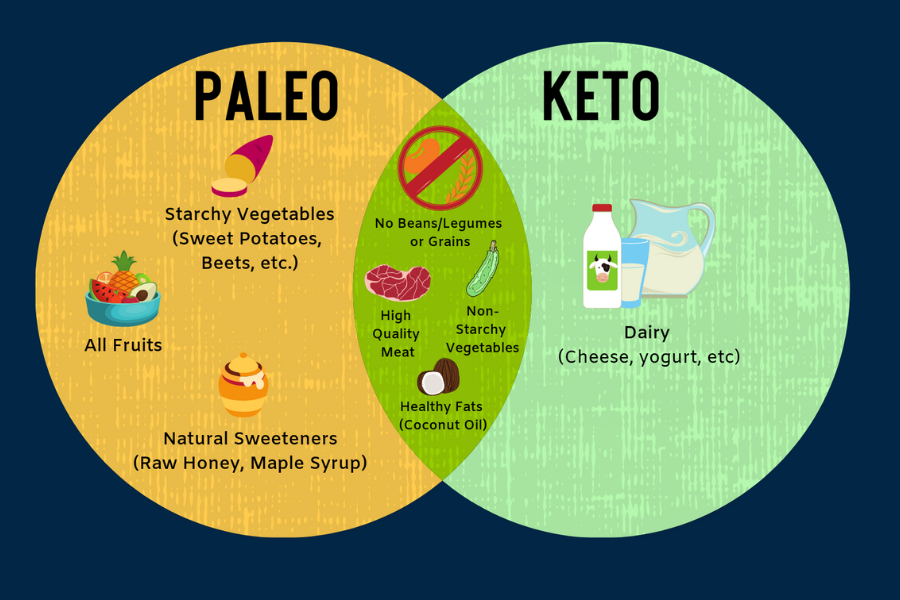
| Food group / item | Paleo | Keto | Why it is allowed or not |
|---|---|---|---|
| Non starchy vegetables | ✔ | ✔ | Low carb, nutrient dense |
| Meat, poultry, fish, eggs | ✔ | ✔ | Protein and healthy fats |
| Nuts and seeds | ✔ | ✔ | Fats and fiber, watch portions on keto |
| Fruits | ✔ | ✖ / limited | Paleo allows, keto restricts most for carbs (Healthline) |
| Starchy vegetables (sweet potatoes) | ✔ | ✖ | Too many carbs for ketosis (MorningStar Family Health Center) |
| Grains and legumes | ✖ | ✖ | Both exclude, though for different reasons |
| Dairy | ✖ | ✔ | Keto allows full fat dairy, paleo does not (MorningStar Family Health Center) |
| Added sugar and refined foods | ✖ | ✖ | Both plans avoid them |
| Natural sweeteners (honey, coconut sugar) | ✔ | ✖ | Paleo allows in moderation, keto limits to non calorie sweeteners (MorningStar Family Health Center) |
Both diets discourage ultra processed foods, which is a big win for your health. The key difference is that paleo is more flexible with whole food carbohydrates like fruit and root vegetables, while keto is very strict to protect ketosis (Healthline).
See how each diet affects weight loss
If you are looking at paleo diet vs keto for weight loss specifically, the good news is that both can help you drop pounds. The more important question is what you can stick with.
How paleo supports weight loss
On paleo, you naturally cut out most calorie dense junk foods and added sugars and replace them with filling protein, fiber, and healthy fats. That shift alone can lower your overall calorie intake without you counting every bite.
Research suggests that people following paleo can lose significant weight, reduce their body mass index and waist size, and improve blood pressure and cholesterol levels that are linked to heart disease (WebMD)). Because you have more food variety, especially from fruits and vegetables, paleo is also considered easier to maintain long term than keto (Healthline).
How keto supports weight loss
Keto often produces faster initial weight loss, partly due to water loss and partly due to your body using stored fat when carbs are very low. Some people also notice their appetite drops once they are in ketosis, which makes it easier to eat less without feeling deprived (Scripps Health).
However, this comes at the cost of a very rigid structure. You track carbohydrates closely and avoid even healthy carb sources such as most fruits and many vegetables. Over time, that level of restriction can be hard to live with socially and mentally.
Experts note that both paleo and keto can promote weight loss and better health because they highlight nutrient dense foods and limit calories, but long term success depends on choosing a way of eating you are willing to maintain indefinitely, not just for a short challenge (Scripps Health).
Think about long‑term health and safety
Weight loss is just one piece of the puzzle. You also want to understand how paleo diet vs keto affects your overall health, nutrient intake, and risk factors.
Potential benefits and concerns with paleo
By focusing on vegetables, fruits, nuts, seeds, eggs, and quality meats, paleo can lower inflammation and support better blood sugar control and cardiovascular health (MorningStar Family Health Center). Many people also report more stable energy and fewer cravings once processed foods are out.
There are a few caveats:
- If you rely heavily on red and processed meat instead of lean options and fish, your saturated fat intake can climb, which may raise cardiovascular risk.
- Cutting grains and legumes might lower your fiber intake if you do not compensate with plenty of vegetables, fruit, and nuts.
- Some people miss dairy as a calcium source, so you need to be intentional about other calcium rich foods.
The American Heart Association looked at 10 popular diets and rated both paleo and keto in their lowest tier for heart health, in part because of higher fat intake without specific limits on saturated fat and because they limit healthy foods like whole grains and legumes (American Heart Association News)). So if you have heart disease or risk factors, it is especially important to talk with your doctor before switching.
Potential benefits and concerns with keto
Keto can be very helpful for certain medical conditions when supervised, such as epilepsy, and can improve blood sugar control and weight for some people (MorningStar Family Health Center). However, the drawbacks are more pronounced:
- Restricting grains and most fruits can lead to low intakes of selenium, magnesium, phosphorus, and vitamins B and C (WebMD)).
- High fat intake may strain your liver, and protein metabolism can stress your kidneys if you already have kidney issues.
- Very low carbs can cause cognitive side effects, such as confusion or irritability, in some people (WebMD)).
- Early on, many experience what is often called the keto flu: thirst, frequent urination, nausea, metallic taste, appetite loss, and sleep problems (Scripps Health).
Keto is also not recommended for certain groups, including pregnant or nursing women, those with advanced kidney disease, and individuals with a history of eating disorders (Scripps Health).
Look at how sustainable each diet feels
When you zoom out from macros and food lists, the real test in the paleo diet vs keto choice is how each one fits into your real life.
What makes paleo more flexible
Paleo does not require tracking macros or testing for ketosis. You can eat at restaurants and social events more easily by choosing grilled meats, salads, vegetables, and fruit, even if the options are not perfectly paleo.
Because you can eat a wide range of vegetables, some fruits, nuts, and seeds, the diet feels less restrictive and more varied. This variety, plus its focus on overall lifestyle, is why many experts view paleo as healthier and easier to maintain long term compared with keto (Healthline).
There are even flexible variations, like the Pegan diet, which is mostly plant based, about 75 percent fruits and vegetables with limited beans, starches, sugar, dairy, and grains, and may offer cardiovascular benefits while still helping with weight loss (Scripps Health).
What makes keto harder to maintain
Keto requires you to be vigilant about carbohydrate intake. That can make everyday situations tricky, such as:
- Sharing a meal with friends
- Traveling
- Attending holidays or special events
You might find yourself turning down foods that are clearly healthy, like berries or sweet potatoes, because they are too high in carbohydrates. Many people eventually drift out of ketosis, which can blunt the benefits while you still feel restricted.
The American Heart Association also notes that both paleo and very low carb or keto diets are highly restrictive, difficult for most people to maintain long term, and not proven to beat less restrictive, heart healthy diets for long term weight management (American Heart Association News).
Match the diet to your health goals
Since there is no one perfect approach, you get the best results by matching paleo or keto, or even a hybrid, to your current health priorities.
According to MorningStar Family Health Center, here is how the options generally line up (MorningStar Family Health Center):
- If your goal is sustainable long term weight loss and becoming a more varied, balanced eater, paleo or a gentle paleo keto hybrid can work well, since you are not counting every gram.
- If you are focused on beating sugar cravings, balancing blood sugar, or exploring brain benefits from ketones, keto or a paleo keto blend might be more appropriate, at least for a period of time.
- If you have a very busy lifestyle and want something that feels realistic, paleo usually wins because you can eat more freely without tracking macros.
Whatever you choose, it is wise to check in with a healthcare professional, especially if you have heart disease, diabetes, kidney or liver issues, or a history of disordered eating.
Decide which approach fits you best
If you feel torn between paleo diet vs keto, step back and consider a few practical questions:
- How much structure can you realistically handle right now?
- Are you willing to track carbs and monitor ketosis, or would you rather follow food quality guidelines and stop there?
- Do you enjoy higher carb whole foods such as fruit and sweet potatoes enough that cutting them would feel like a major loss?
- Do you have medical conditions that make very low carb or high fat eating risky without supervision?
For many people wanting to lose weight and improve health without micromanaging every bite, a well rounded paleo approach, focused on vegetables, lean proteins, healthy fats, and minimal processed foods, is the more sustainable starting point. You can always tighten your carb intake later if you and your healthcare provider feel that a more ketogenic pattern would serve a specific goal.
You do not have to decide for life today. You can experiment for a few months, pay attention to how your body responds, and adjust. The best diet for you is not just the one that looks impressive on paper, it is the one you can live with, enjoy, and maintain while moving toward better health.