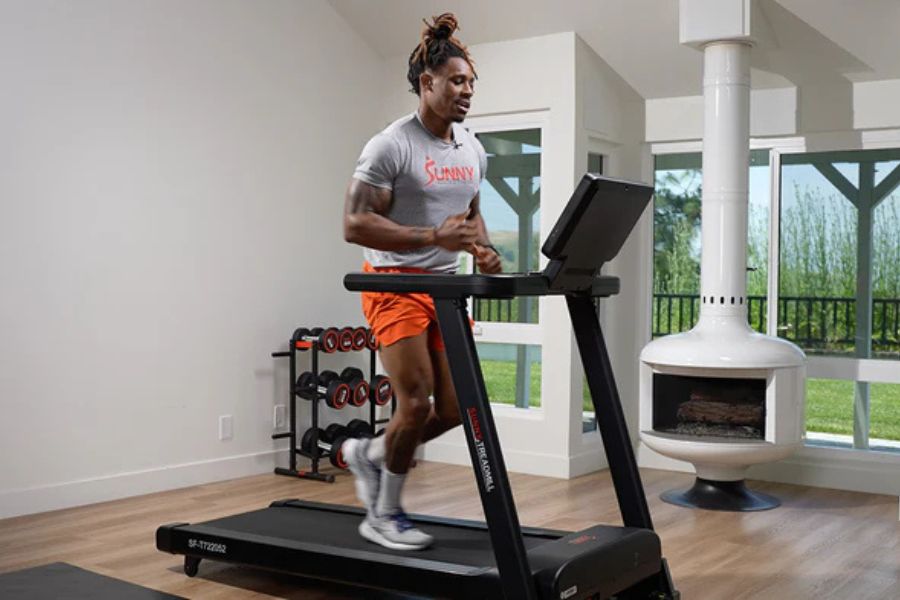
A treadmill can be one of the simplest tools for losing weight, especially if you prefer predictable, weather‑proof workouts. With the right approach, treadmill workouts for weight loss can fit into your daily routine without requiring marathon sessions.
Below, you will find practical ways to use the treadmill for fat loss, sample routines for different fitness levels, and tips to keep your workouts safe and sustainable.
Understand how treadmill workouts help with weight loss
Treadmill workouts help you lose weight by increasing your calorie burn so you can create a calorie deficit. When you consistently burn more calories than you eat, your body turns to stored fat for energy.
Health organizations typically recommend at least 150 minutes per week of moderate aerobic activity, such as brisk treadmill walking at 3 mph or faster, to support weight loss and overall health (Verywell Health). If you prefer to work harder in shorter sessions, 75 minutes per week of vigorous activity like running at 5 mph or more can provide similar benefits (Verywell Health).
Treadmills make this easier because you can control speed, incline, and time precisely. This consistency helps you track calorie burn and progress over weeks and months (RunBundle).
Choose the right workout style for you
You do not need to run to get results. Different styles of treadmill workouts can support weight loss, so you can pick what fits your body, schedule, and preferences.
Steady‑state walking and running
Steady‑state workouts involve moving at a continuous pace for the entire session. For example, you might walk at 3.5 mph for 30 minutes, or jog at 5 mph.
For a 155‑pound person, walking on a treadmill at 3.5 mph for 30 minutes burns about 150 calories (NordicTrack). Running at 6 mph can roughly double that to about 300 calories in 30 minutes, which shows how intensity influences total burn (NordicTrack).
Steady‑state is ideal if you are new to exercise or prefer a more relaxed pace that you can maintain while watching TV or listening to a podcast.
Incline walking for extra burn
Adding incline is one of the most efficient ways to make treadmill workouts for weight loss more effective. Walking uphill recruits more muscle in your glutes, hamstrings, and calves and elevates your heart rate.
Research shows that compared to flat walking, metabolic cost rises by about 52% at a 5% incline and 113% at a 10% incline (NordicTrack). Incline walking also improves cardiovascular health and can help maintain healthy blood pressure (Planet Fitness).
If you do not enjoy running or your joints dislike impact, incline walking gives you strong calorie burn with less pounding.
Interval training and HIIT
High‑intensity interval training, or HIIT, alternates short bursts of hard effort with easier recovery periods. For example, you might run briskly for 30 to 60 seconds, then walk for 60 to 90 seconds, and repeat.
HIIT on a treadmill is an efficient way to reduce body fat and burn calories in less time than steady‑state workouts (Healthline). Interval sessions can also trigger an afterburn effect, known as excess post‑exercise oxygen consumption, so your body continues to burn extra calories after you step off the machine (8fit).
This style of training works well if you are short on time and comfortable with higher intensities.
Try the 12‑3‑30 treadmill workout
The 12‑3‑30 workout became popular on social media because it is simple, structured, and does not involve running. You set the treadmill to a 12% incline, walk at 3 mph, and continue for 30 minutes.
Fitness writers describe this as a low‑impact but intense routine that can help with weight loss and cardiovascular health (Verywell Health). It targets your posterior chain muscles, especially your glutes and hamstrings, and also engages your core (Planet Fitness). Many people like it because they can follow the same simple formula each time, which makes it easier to build a habit.
Beginners are usually advised to ease into this format. For example, you might start with 5% to 8% incline or shorten the time and gradually work up to the full 12‑3‑30 structure over several weeks (Planet Fitness).
Experts also suggest doing 12‑3‑30 at most every other day to avoid overuse stress on your lower back, hamstrings, Achilles tendon, knees, and feet (TODAY). On the in‑between days, you can walk on flat ground, cross‑train, or focus on strength.
Sample treadmill routines you can rotate
You do not have to do the same workout every day to see progress. In fact, changing your treadmill routines regularly can prevent plateaus and keep your body challenged (Healthline). Try rotating these options throughout the week.
Beginner: 30‑minute incline walk
This routine suits you if you are returning to exercise or prefer walking over running.
- Warm up: 5 minutes at 2.5 to 3 mph, 0% incline.
- Main set:
- 5 minutes at 3 to 3.5 mph, 2% incline
- 5 minutes at 3 to 3.5 mph, 4% incline
- 5 minutes at 3 to 3.5 mph, 5% incline
- Cooldown: 10 minutes gradually dropping incline and speed.
This structure gives you about 30 minutes of movement at a moderate intensity that you can do most days, as long as your joints feel good and you listen to your body.
Intermediate: Interval jog and walk
If you are ready to jog, intervals can increase your calorie burn without requiring long runs.
- Warm up: 5 minutes walking at 3 mph.
- Intervals, repeated 6 to 8 times:
- 1 minute jog at 5 to 6 mph, 1% incline
- 2 minutes walk at 3 to 3.5 mph, 0% to 1% incline
- Cooldown: 5 minutes easy walking.
This style resembles the walk‑jog‑run circuits shared in beginner HIIT examples, which you can extend up to 30 minutes for greater calorie burn (8fit).
Advanced: HIIT sprint session
If you are experienced and have no underlying health issues, short sprints can deliver a powerful training effect in a limited time.
- Warm up: 8 to 10 minutes, gradually increasing from 3 to 5 mph.
- Intervals, repeated 8 to 10 times:
- 30 to 60 seconds at a challenging speed, such as 7 to 9 mph
- 60 to 90 seconds slow walk at 2.5 to 3 mph
- Cooldown: 5 to 10 minutes easy walking.
High‑intensity treadmill workouts like this can burn up to 28% more calories than steady walking due to their intensity and afterburn effect (NordicTrack, 8fit). Most people only need a few HIIT sessions per week, with easier days in between.
As your fitness improves, you can make progress by slightly raising incline, speed, or duration or by trimming rest periods rather than jumping straight to very long or very hard workouts at once (PureGym).
How often you can safely use the treadmill
If you enjoy daily movement, it is possible to use the treadmill most days of the week as long as you balance intensity and recovery.
Guidelines suggest these patterns for health and weight loss:
- Moderate activity, such as brisk walking, on most or all days of the week, aiming for at least 30 minutes per day.
- Vigorous sessions, such as running or HIIT, 2 to 4 days per week with easier days between high‑intensity workouts (Verywell Health, PureGym).
You might walk on an incline or flat surface 4 to 6 days per week, then add 1 to 3 days of intervals or higher‑intensity work. Listening to your energy levels, sleep, and joint comfort will help you decide when to push and when to back off.
Combine treadmill workouts with other habits
Treadmill workouts for weight loss work best as part of a bigger plan that includes strength training and nutrition.
Experts recommend pairing treadmill sessions with resistance training to build lean muscle, which supports your metabolism and helps you burn more calories at rest (Healthline). You do not need complicated routines. Two or three total‑body strength workouts per week can be enough.
On the nutrition side, steady progress usually requires a modest daily calorie deficit, often around 500 to 1,000 calories, which can produce 1 to 2 pounds of loss per week when appropriate for your body size and health status (TODAY). Your treadmill sessions contribute part of this deficit, and the rest comes from food choices.
If you are not sure where to start, consider tracking what you eat for a few days and using a treadmill calorie calculator that accounts for your weight, incline, and speed to estimate your burn more precisely (RunBundle).
Stay safe and avoid common mistakes
As you build a consistent routine, a few small adjustments can keep you comfortable and reduce injury risk.
- Warm up before every workout with at least 5 minutes of slower walking.
- Start with manageable speeds and inclines, then increase by about 10% per week at most as your body adapts (Verywell Health).
- Avoid holding onto the handrails during incline walking, which can strain your posture and reduce the effectiveness of the workout.
- Watch for signs of overuse, such as persistent pain in your knees, lower back, or Achilles tendon, especially with steep inclines like 12‑3‑30 (TODAY).
- Cool down gradually so your heart rate and breathing return to normal.
If you have heart issues, joint concerns, are pregnant, or take regular medication, talk with a healthcare professional before starting vigorous intervals or very steep inclines.
Putting it all together
To make treadmill workouts for weight loss part of your everyday life, start with what feels realistic now, then slowly layer on intensity and variety. You might begin with 20 to 30 minutes of brisk walking most days, add a gentle incline, then experiment with short intervals once you feel ready.
Over time, this consistent effort can support sustainable fat loss, better cardiovascular health, and improved energy, all without needing to leave your living room or local gym.