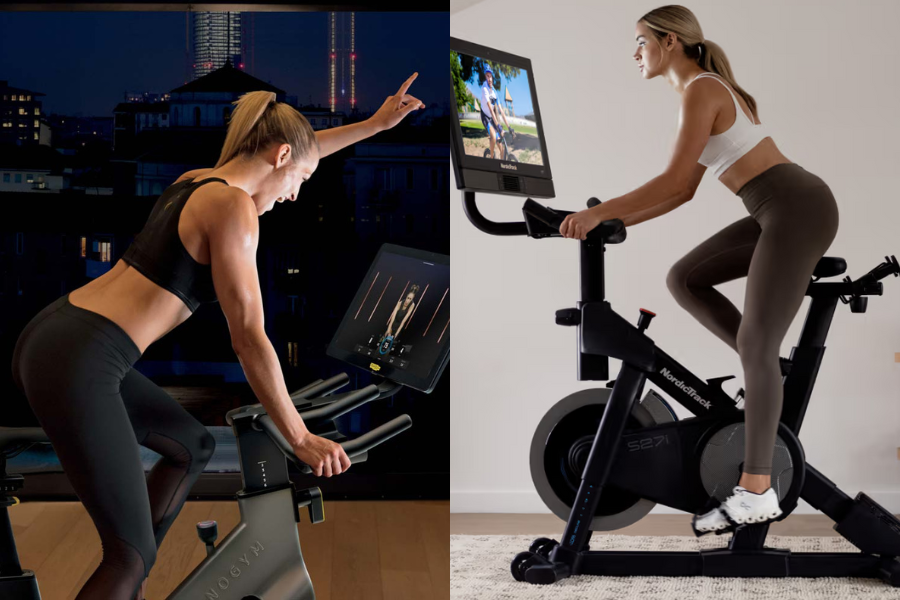
Interval training on an exercise bike is one of the most efficient ways to burn fat, improve your fitness, and make the most of limited workout time. Instead of pedaling at one steady speed, you alternate short bursts of hard effort with easier recovery periods. This simple change can transform your indoor rides into powerful fat burning sessions.
Below, you will learn how interval training works, why it is so effective for fat loss, and how to set up safe, realistic workouts on your exercise bike.
What interval training on an exercise bike actually is
Interval training, often called high intensity interval training (HIIT), is a pattern of work and rest. On an exercise bike, that usually means cycling hard for a set time, then easing off to recover, and repeating this cycle.
During the hard intervals, you ride at a challenging intensity. Research on cycling HIIT often sets the work periods at more than 75 percent of your maximal power or close to 80 to 90 percent of your maximum heart rate (NCBI – MDPI). During the recovery periods, you slow down and reduce resistance so you can catch your breath and prepare for the next effort.
You can structure intervals in many ways, for example 30 seconds hard and 60 seconds easy, or 2 minutes moderate and 1 minute hard. This flexibility lets you match your workout to your current fitness and your goals.
Why intervals burn more fat in less time
When you think about fat burning, you might picture long, steady rides. Steady state cycling does burn calories and builds endurance, but research shows that interval training on an exercise bike can provide similar or greater benefits with less total training time.
Bigger metabolic payoff
High intensity efforts place a larger demand on your muscles, heart, and lungs. In response, your body ramps up energy use not only during the ride but also for hours afterward while it recovers. Studies on sprint and interval cycling have found improvements in skeletal muscle oxidative capacity, insulin sensitivity, and resting fat oxidation, along with reductions in fat mass, even when the total training volume is much lower than steady state training (NCBI – MDPI).
Some commercial protocols use this effect to create very short, focused workouts. For example, a reduced exertion HIIT (REHIT) approach with just 2 x 20 second hard sprints inside a 5 minute session has been shown to trigger strong metabolic adaptations and can burn more calories in 15 minutes than a 30 minute run, because of the prolonged elevated metabolism after exercise (Carolbike).
More calories in the same time
If you already spend 30 to 45 minutes on the bike, intervals can help you burn more calories in that same window. In one clinical trial, a 15 minute fat burn ride with 30 sprints burned an average of 281 calories during and after the workout (Carolbike). That kind of density is helpful when you are trying to create a calorie deficit for weight loss but have a busy schedule.
Other research using 10 intervals of 45 seconds at 80 to 85 percent of maximal heart rate, three times a week for 12 weeks, found decreases in body weight and fat mass in men with overweight or obesity (PubMed). This shows that structured interval cycling can support meaningful fat loss over time when you repeat it consistently.
Health benefits beyond fat burning
Fat loss may be your main goal, but interval training on an exercise bike also improves your overall health and cardiovascular fitness.
Stronger heart and lungs
By repeatedly pushing your heart rate high and then allowing it to drop, you teach your cardiovascular system to respond more efficiently. Interval workouts on the bike, including shorter 20 to 30 second micro intervals, have been shown to increase VO2 max, burn fat, and improve endurance effectively and quickly (Bicycling). According to endurance coach and sport scientist Paul Laursen, just two weeks of interval training can already enhance cycling performance (Bicycling).
Longer term, low volume HIIT protocols, with less than 15 minutes of hard work per session, have been identified as a time efficient way to improve cardiometabolic health and endurance (NCBI – MDPI). This is encouraging if you do not have time or interest in very long rides.
Better endurance and power
Intervals also build muscular endurance and power. Workouts like 40 second efforts with short rests can train your body to recover quickly between surges and improve your ability to sustain strong efforts over time, a pattern sometimes called Flying 40s (Bicycling). Ten second speed intervals help refine your pedal stroke and cadence, which makes you more efficient on every ride (Bicycling).
For higher level fitness, very intense patterns such as Tabata intervals, for example 20 seconds all out followed by 10 seconds easy, improve muscular power and your ability to hold near maximal intensity for long time trials by raising your lactate threshold (Bicycling).
Long term health and longevity
If you are older or simply wondering about safety, there is reassuring evidence. A 5 year randomized controlled trial in older adults that used twice weekly HIIT cycling sessions of 4 x 4 minutes at 85 to 95 percent of peak heart rate found no higher all cause mortality compared with moderate continuous training or following general physical activity guidelines. In fact, the HIIT group showed the lowest mortality rate, which supports its potential longevity benefits when done appropriately (NCBI – MDPI).
There is even emerging research on how interval cycling can interact with your gut microbiota. In a 12 week cycling HIIT program, changes in gut microbiota composition were associated with total and abdominal fat mass loss, although the overall diversity did not change significantly (PubMed). This hints at a deeper connection between regular interval exercise and metabolic health.
How intervals compare to steady cycling
You do not have to choose strictly between interval training on an exercise bike and steady state sessions. Each style has its role, and a mix of both usually works best.
Experts on indoor cycling describe three main approaches:
- Steady state, where you hold a consistent effort for the whole ride
- HIIT, where you alternate hard and easy efforts
- Progressive training, where you gradually increase the workload over time, for example by simulating longer climbs (Shimano)
A common recommendation is to follow something like an 80 / 20 principle. You spend around 80 percent of your time in easier aerobic work below your threshold, and 20 percent in higher intensity intervals (Shimano). This gives you the fat burning and fitness gains of intervals without wearing you down.
Combining steady state sessions with 2 to 3 interval workouts per week can create a hybrid routine that balances calorie burn, recovery, and variety. This balance also helps you avoid plateaus and boredom in a long term weight loss program (Carolbike).
You do not need to ride harder every day to make progress. A better plan is to ride smart a few days a week and recover well in between.
Simple interval workouts you can start today
You do not have to be an athlete to benefit from interval training on an exercise bike. The key is to start at your current level and build up gradually.
1. Beginner interval session
Use this if you are new to intervals or returning after a break.
- Warm up for 5 to 10 minutes at an easy pace with light resistance.
- Ride hard for 20 seconds. You should feel challenged but not completely out of control.
- Pedal easily for 60 to 90 seconds to recover.
- Repeat the work and rest pattern 8 to 10 times.
- Cool down for 5 minutes at a very comfortable pace.
Short 20 to 30 second efforts like these have been shown to improve VO2 max and endurance while remaining manageable for many riders (Bicycling).
2. Fat burning interval ride
When you already tolerate shorter intervals, you can move to slightly longer efforts that raise your heart rate for more extended periods.
- Warm up for 8 to 10 minutes.
- Ride at a strong but sustainable pace for 45 seconds. Aim for about 80 to 85 percent of your maximum heart rate, or a level where speaking full sentences is difficult.
- Recover with light pedaling for 90 seconds.
- Repeat for 8 to 10 intervals.
- Cool down for at least 5 minutes.
A structure very similar to this, performed 3 times per week for 12 weeks, led to reductions in body weight and fat mass in men with overweight or obesity (PubMed). You can adjust the number of intervals and the intensity to match how you feel.
3. Short, time crunched HIIT
On days when you have almost no time, a short, high intensity workout can keep your routine on track.
- Warm up for 5 minutes.
- Sprint as hard as you safely can for 10 to 20 seconds.
- Pedal very gently for 2 to 3 minutes.
- Repeat 2 to 4 times.
- Cool down for 5 minutes.
Protocols that use very brief all out efforts like this, often called sprint interval training (SIT), have shown significant improvements in muscle oxidative capacity, endurance, insulin sensitivity, and fat mass, even when total training volume is up to 90 percent less than traditional moderate intensity training (NCBI – MDPI).
How to progress safely and avoid burnout
Interval training will only help your fat burning and health if you can stick with it. That means paying attention to recovery and making gradual changes.
Start with 1 to 2 interval sessions per week, especially if you usually ride at a steady pace. As your body adapts, you can increase to 2 to 3 interval workouts per week and use easy steady rides or rest days between them. Experts emphasize the importance of listening to your body, not competing with others, and balancing high intensity sessions with lower intensity days for long term success and injury prevention (Shimano).
If you notice persistent fatigue, trouble sleeping, or a drop in performance, scale back. You can reduce the number of intervals, lower the resistance, or add an extra recovery day. Progress can also mean increasing duration at a given resistance, not only cranking the resistance up every time. One rider training on a recumbent bike for long outdoor climbs, for example, gradually raised resistance over several weeks and balanced that with ride duration to build endurance without overdoing it (Reddit).
For most people, a mix of:
- 2 interval rides per week
- 1 to 3 easy or moderate steady rides
- At least 1 full rest day
creates a sustainable rhythm.
Making interval training work for your goals
Interval training on an exercise bike is flexible. You can adapt it based on what you want most right now.
If fat loss is your priority, focus on being consistent with 2 to 3 interval sessions per week, keeping your total weekly activity level high, and pairing your workouts with a modest calorie deficit from your diet. If better fitness is your goal, rotate different interval types, such as short sprints for power and slightly longer efforts for endurance, to train multiple energy systems (Shimano).
The most important step is getting started. Choose one of the simple workouts above, set a realistic schedule for this week, and treat each ride as a chance to learn how your body responds. Over time, small, repeatable efforts on your exercise bike can add up to significant fat loss and better health.