A rowing machine might not look as flashy as a treadmill or bike, but rowing workouts at home can quietly overhaul your fitness. You get cardio, strength work, and stress relief in one low‑impact session, without leaving your living room.
Below, you will see how home rowing helps with weight loss, builds muscle, and protects your joints, along with simple tips to get started safely.
Why rowing is so effective for home workouts
When you row, you are not just working your arms. A proper stroke uses your legs, core, back, and upper body in a smooth, repeated sequence. According to the Cleveland Clinic, rowing provides a low‑impact, full‑body workout that builds both strength and stamina while reducing stress on your joints, which makes it ideal for home workouts (Cleveland Clinic).
Healthline notes that about 65 to 75 percent of the effort in a rowing stroke comes from your legs, and 25 to 35 percent from your upper body, which means your major muscle groups are all getting attention at once (Healthline). You get both aerobic training and strength benefits in a single session.
Because many home rowing machines are foldable and relatively lightweight, they fit well in small spaces or garage gyms. You can slide one against a wall or into a corner once you are done, then pull it back out when you are ready to train again (Healthline).
How rowing at home supports weight loss
If you want to lose weight, you need an activity that burns a meaningful number of calories without beating up your joints. Rowing workouts at home check both boxes.
Healthline reports that a person who weighs about 155 pounds can burn around 369 calories in 30 minutes of vigorous rowing on a machine (Healthline). Other research cited by Red Beard Sailing suggests that extreme rowing can burn up to 500 calories in half an hour, which makes it a very efficient choice for fat loss and muscle building together (Red Beard Sailing).
Because you are using so many muscles at once, your heart rate climbs quickly. The effort feels similar to running, but with far less pounding on your knees and hips. The Cleveland Clinic notes that rowing offers cardiovascular benefits that are comparable to running, yet is easier on your joints, which helps you stay consistent over time (Cleveland Clinic).
If you like structure, you can aim for around 20 minutes of moderate rowing per day to build cardiovascular fitness and strength. This target comes from CDC guidelines shared by the Cleveland Clinic, and you can adjust up or down based on your current stamina and schedule (Cleveland Clinic).
Key health benefits beyond weight loss
Rowing workouts at home do more than shrink your waistline. They support your overall health in several important ways.
First, they improve cardiovascular fitness and muscle endurance. Short bursts of high intensity can have a big impact. Healthline notes that high‑intensity interval training sessions on a rowing machine that last under 15 minutes can significantly improve fitness and heart health when you perform them consistently (Healthline).
Second, rowing is gentle on your joints. Since the movement is low‑impact, you can burn a lot of calories without the jarring forces that come with activities like running. Healthline explains that this makes rowing a solid option for active recovery days and for some people with early osteoarthritis, as long as your doctor agrees it is safe for you (Healthline).
Finally, rowing can help with stress relief. The repetitive rhythm of the stroke encourages steady breathing and gives you a simple movement pattern to focus on, which often feels calming after a busy day. Over time, better cardiovascular health, stronger muscles, and a regular outlet for stress all add up to a big improvement in how you feel day to day.
How to use a rowing machine safely at home
To get the most from rowing workouts at home, form matters. Good technique protects you from back and shoulder pain and makes each stroke more efficient.
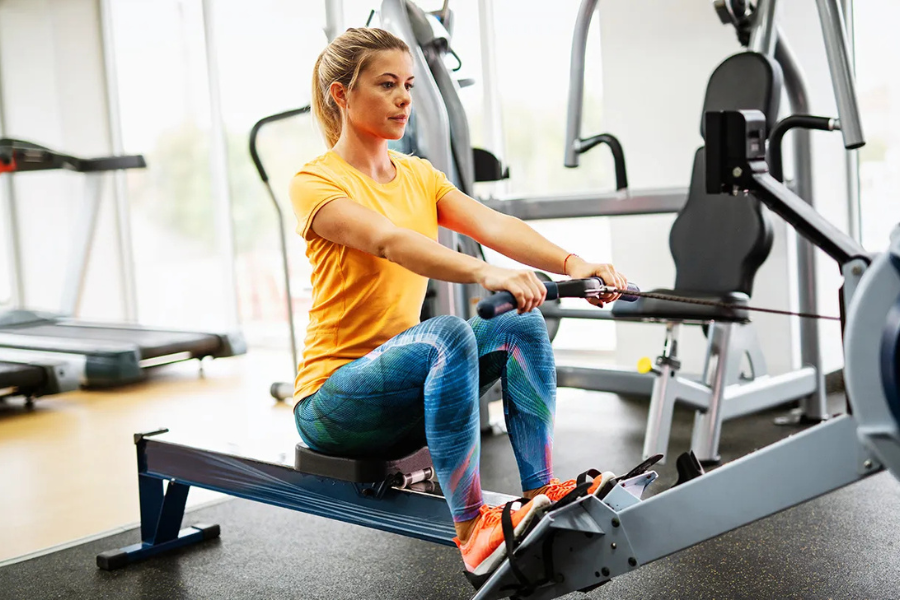
The Cleveland Clinic breaks the rowing stroke into four basic parts: catch, drive, finish, and recovery (Cleveland Clinic). Men’s Health describes the sequence like this (Men’s Health):
- Start with your knees bent, shins vertical, arms straight, and torso leaning slightly forward from the hips.
- Begin the drive by pressing through your heels and extending your legs while your arms stay straight.
- As your legs finish extending, lean back slightly at the hips and pull the handle toward your sternum.
- For the recovery, extend your arms first, then hinge your torso forward, and finally bend your knees to slide back to the start.
This sequence, legs then body then arms on the drive, and the reverse on the way back, keeps the movement smooth and reduces the chance that you will overload your lower back.
Take a few minutes at the beginning of each workout to move slowly and check in with your form. If something feels off, reduce the resistance and shorten your stroke until you feel more confident in the motion.
Sample rowing workouts you can do at home
You do not need a complicated training plan to benefit from home rowing. A few simple workouts can cover most of your needs.
For beginners, try an easy steady row. Start with 5 to 10 minutes at a conversational pace, where you can still talk in short sentences. Over a few weeks, you can extend this to 20 minutes as your stamina improves. This type of steady work aligns with the moderate intensity the CDC and Cleveland Clinic recommend for general fitness (Cleveland Clinic).
Once you are comfortable, you can experiment with intervals. For example, alternate 1 minute of stronger rowing with 1 minute very easy for 10 to 15 minutes. Healthline notes that even brief HIIT style sessions like this can significantly boost cardiovascular fitness and muscle endurance when done regularly (Healthline).
Men’s Health also highlights more advanced formats, such as EMOM (every minute on the minute) workouts and metabolic circuits that pair rowing with movements like kettlebell swings, burpees, or core exercises (Men’s Health). If you enjoy variety, you can row for calories or distance, then hop off for a bodyweight movement, and repeat for 15 to 20 minutes.
If you are new to exercise or have any chronic health issues, check with your doctor before starting higher intensity intervals.
Adapting rowing workouts to your fitness level
One of the strengths of rowing workouts at home is how easy they are to scale. Men’s Health explains that beginners can adjust calorie or rep targets in interval formats, while advanced users keep the same targets but push harder for each effort (Men’s Health).
If you are just getting started, you might:
- Lower the resistance on the machine.
- Row for time, such as 5 to 10 minutes, instead of chasing a specific distance.
- Focus on slow, controlled strokes that feel smooth rather than powerful.
As you get stronger, you can:
- Increase resistance slightly, while keeping your stroke controlled.
- Add a few minutes to your total time each week.
- Include 1 or 2 short interval blocks in the middle of your workout.
You do not need to overhaul your entire routine at once. Small, steady progress keeps your body adapting without feeling overwhelmed.
Rowing alternatives if you do not own a machine
If you like the idea of rowing but do not have a machine yet, there are ways to mimic the movement or get similar benefits with other tools.
Red Beard Sailing points to resistance bands as an affordable and flexible option. By anchoring a band to a sturdy door and performing rowing pulls, you can work your back and arms and adjust the resistance by stepping closer or further away, usually for less than one hundred dollars (Red Beard Sailing).
For strength, classic moves like bent‑over barbell rows or inverted rows under a bar or sturdy table target many of the same muscles, including your lats and traps (Red Beard Sailing).
If your main goal is cardio, ellipticals and stationary bikes offer accessible, low‑impact options. Red Beard Sailing notes that an elliptical feels closer to rowing in terms of whole‑body engagement, while a stationary bike is one of the most widely available choices for home use (Red Beard Sailing).
You can always transition to a rowing machine later if you decide you enjoy this style of training and want the full experience.
Bringing it all together
Rowing workouts at home give you a rare combination of benefits. You can burn a high number of calories, strengthen your whole body, and improve your heart health, all with one low‑impact movement that suits small spaces.
If you are curious, start simple. Try 5 to 10 minutes at an easy pace, pay attention to your form, and see how you feel afterward. As the motion becomes familiar, you can gradually add time or intensity until rowing is a rewarding part of your weekly routine.