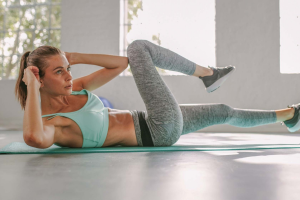
A toned stomach is about more than looks. When you build a strong core with the best ab exercises, you support your spine, improve posture, move more easily in daily life, and set yourself up for better performance in any workout you do.
You also do not need a lot of space or equipment. With a few smart moves and a simple plan, you can train your abs safely at home in about 10 to 15 minutes.
Understand what your “abs” actually are
When you think about ab workouts, you might picture crunches or sit-ups. In reality, your core is a group of muscles that wrap around your midsection and support your entire body.
Your main abdominal muscles include four key groups that work together to move and stabilize your torso. Around them, you have muscles in your lower back, hips, and pelvis that also count as core muscles. When you target all of these, you get better balance, stability, and posture, which makes everyday activities like walking, lifting, and even sitting at your desk feel easier.
You also cannot truly isolate “upper” and “lower” abs. What you feel as lower ab work is often your hip flexors helping out, although you can focus more on the rectus abdominis versus your obliques and transverse abdominis.
The takeaway: aim to train your entire core, not just what you see in the mirror.
The best beginner-friendly ab circuit
If you are just getting started, a short, structured routine can help you build core strength without stressing your neck or back. A beginner-friendly circuit created by NASM-certified trainer Maricris Lapaix uses five simple moves that focus on control and form instead of speed:
- Dead bug
- Glute bridge
- Bird dog
- Bear plank with knee taps
- Modified side plank
You perform each exercise for 30 to 45 seconds, rest for 15 seconds, then move to the next one. Start with a single round, which takes about 7 minutes. As you get stronger, work up to four rounds for a complete core session.
Because this routine teaches your body to stabilize, it is ideal if you are new to ab training or coming back after a break. The goal is smooth, controlled repetitions rather than racing a timer.
How to do each key exercise
Below is a simple guide for each of the best ab exercises in this circuit, with form cues and beginner-friendly tips.
Dead bug
Dead bugs train your deep core to keep your spine stable while your arms and legs move.
- Lie on your back with arms straight up toward the ceiling.
- Bend your hips and knees to 90 degrees so your shins are parallel to the floor.
- Brace your abs as if you are preparing for a gentle poke in the stomach.
- Slowly lower your right arm and left leg toward the floor while keeping your lower back lightly pressed into the mat.
- Return to the starting position and switch sides.
Move slowly. If your lower back starts to arch off the floor, shorten the range of motion until you can maintain contact with the mat.
Glute bridge
The glute bridge, also called a back bridge or bridge, trains many core muscles at once, including your glutes, hamstrings, and deep abdominals.
- Lie on your back with knees bent and feet flat, hip-width apart.
- Place your arms at your sides, palms down.
- Press through your heels and squeeze your glutes to lift your hips until your body forms a straight line from shoulders to knees.
- Pause for a second at the top, keeping your ribs down and abs engaged.
- Lower your hips with control.
If you feel this mostly in your lower back, focus on driving through your heels and tightening your glutes at the top of each rep.
Bird dog
Bird dog is a classic core-strength move that also targets your lower back and improves balance. Research shows it is effective for the rectus abdominis and obliques while supporting lower back function and can even help reduce back pain when done consistently.
- Start on hands and knees, with hands under shoulders and knees under hips.
- Brace your abs so your spine stays neutral.
- Extend your right arm forward and left leg back until both are straight.
- Keep your hips level and avoid arching your lower back.
- Bring your hand and knee back under your body and switch sides.
Think long, not high. The more your back stays still, the more your core works.
Bear plank with knee taps
The bear plank with knee taps is a gentle way to learn how to brace your core in a loaded position without doing a full high plank.
- Start on hands and knees with your wrists under shoulders and knees under hips.
- Grip the floor with your fingers and pull your belly button toward your spine.
- Lift your knees a few inches off the floor so they hover under your hips.
- Keeping your back flat, slowly tap your right knee to the floor, then lift it back up.
- Repeat with the left knee and continue alternating.
If your wrists hurt, you can make fists and balance on your knuckles instead of placing your palms flat. Go slowly so your hips do not rock from side to side.
Modified side plank
Side planks are one of the best ab exercises for your obliques and deep stabilizers, and they also improve posture by training your body to resist side bending.
For a beginner-friendly version:
- Lie on your side with knees bent at about 90 degrees.
- Prop yourself up on your bottom forearm, elbow directly under your shoulder.
- Stack your knees and hips, then press through your lower knee to lift your hips.
- Aim to form a straight line from your head to your knees.
- Hold for 30 to 45 seconds, then switch sides.
If holding is difficult, break it into shorter 10 to 15 second efforts with brief rests between them. Focus on keeping your chest open and hips stacked.
Other top ab exercises to add
Once you are comfortable with the beginner circuit, you can mix in a few more of the best ab exercises to challenge your core from new angles.
Bicycle crunches
According to the American Council on Exercise, bicycle crunches rank as one of the most effective ab exercises for activating both the obliques and the transverse abdominis. The twisting motion engages more muscle fibers than a standard crunch.
To keep them safe for your neck and lower back, keep your movements controlled, avoid pulling on your head, and focus on rotating from your ribcage, not swinging your elbows.
Planks and side planks
Planks are fundamental for training your core’s bracing function. Holding a plank for 4 sets of 30 seconds to 1 minute builds endurance and strength without any equipment.
Side planks, even in their modified form, train your obliques, transverse abdominis, glutes, and shoulders and help improve posture by teaching your body to resist lateral flexion.
Leg raises
Leg raises emphasize your lower portion of the rectus abdominis and your hip flexors. You can start with lying leg raises on the floor and progress to more challenging options like hanging leg raises later on.
To make them more effective, use a slow tempo, for example 3 seconds up, 1 second hold, 2 seconds down, and keep your lower back from arching off the floor.
How to structure your ab workouts
You do not have to train abs every day. In fact, your core muscles need rest just like any other muscle group.
A simple weekly structure could look like this:
3 ab sessions per week, 3 exercises, 10 to 15 reps or 30 to 45 second holds, 3 sets
On other days, light movement like walking or gentle stretching can help with soreness and recovery. Aim for at least 24 hours of rest between full ab workouts so your muscles have time to rebuild and get stronger.
If you are following the beginner circuit, you might start with:
- Week 1 to 2: 1 set of the 5-exercise circuit, once or twice a week
- Week 3 to 4: 2 sets, once or twice a week
- Week 5 and beyond: 3 to 4 sets, two to three times a week
Increase volume gradually so you avoid overtraining and unnecessary strain. Pushing too hard, too soon can raise stress hormones like cortisol, which is linked with belly fat accumulation, so you are better off building up slowly.
Why you cannot crunch your way to a toned stomach
Ab exercises are essential for strength and stability, but they are not enough on their own to give you a visibly toned midsection.
Your abdominal muscles can be strong yet still hidden under a layer of fat. To see more definition, you need to lower your overall body fat through a mix of nutrition, full-body strength training, and cardio. Targeted ab moves cannot spot-reduce belly fat, because your body pulls energy from fat stores all over, not just from the area you are working.
For most people, visible abs tend to appear when body fat drops to around 6 to 13 percent for men and 14 to 20 percent for women, though the exact number varies by body type and genetics. Focusing on sustainable habits like balanced meals, enough protein, regular movement, and quality sleep will do more for your stomach’s appearance than doing endless crunch variations.
Putting it all together
Here is a simple way to start using the best ab exercises in your week:
-
Choose a base routine
Begin with the 5-move beginner circuit: dead bug, glute bridge, bird dog, bear plank with knee taps, and modified side plank. Do 1 to 2 circuits, 1 to 3 times per week. -
Layer in variety
Once that feels comfortable, add one or two additional moves such as bicycle crunches, regular planks, side planks, or lying leg raises to keep challenging your core from different angles. -
Prioritize form over speed
Move with control, breathe steadily, and stop if you feel pain in your neck or lower back. Your abs should feel like they are doing the work, not your joints. -
Support your abs with lifestyle
Pair your ab workouts with full-body strength training, regular cardio you enjoy, and a sustainable, nutrient-dense way of eating. Over time, this combination will do the most to reveal the strong core you are building.
If you start with just 10 minutes a couple of times a week and stay consistent, you will feel the difference first in how you stand, move, and carry yourself. The visual results will follow as your strength and habits build over time.