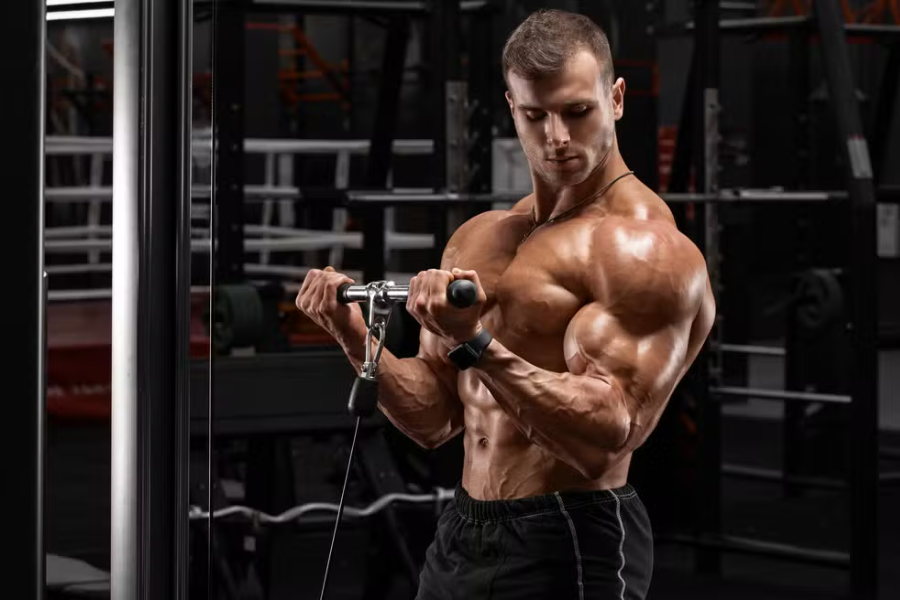
A smart bicep workout plan does more than just add inches to your arms. It helps you build real strength for everyday pulling and lifting, protects your elbows and shoulders, and makes the rest of your upper body training more effective.
Below, you will learn how to structure your bicep workouts for muscle growth, how often to train, and which exercises belong in your routine, whether you are a beginner or more advanced.
Understand your bicep muscles
Before you pick exercises, it helps to know what you are trying to train.
Your biceps are not just one muscle. When you design a bicep workout plan, you want to think about all the elbow flexors that contribute to arm size and strength:
-
Biceps brachii
The classic “bicep” on the front of your upper arm. It has two heads, a long head and a short head, and it flexes your elbow and helps you twist your forearm (supination). Research from RP Strength notes that indirect work from back exercises is not enough for maximum growth, so you still need direct bicep work for best results. -
Brachialis
Sits underneath your biceps. When it grows, it pushes the biceps up and makes your arms look thicker from the side. -
Brachioradialis
Runs along the top of your forearm and plays a key role in elbow flexion and overall pulling strength.
A well rounded bicep workout plan should hit all three. That is why you will see curl variations with different grips and angles in the routines below.
Key principles for bicep growth
Instead of guessing in the gym, build your plan around a few clear principles.
Choose the right volume and exercises
You do not need a dozen different curls every session. According to RP Strength, ideal bicep workouts include 1 to 3 exercises per session and 2 to 5 exercises per week. This gives you variety without turning arm day into a marathon.
In practical terms, that means:
- On a push pull or upper body day, you might add 2 bicep exercises.
- If you have a dedicated arm day, you might use 3 or 4 exercises total.
Focus on quality sets instead of endless variations that all do the same thing.
Use an effective rep range
For muscle growth, most of your training should fall in the 8 to 12 rep range, with 3 to 4 sets per exercise, as recommended in the research and by multiple strength coaches. That rep zone is heavy enough to build strength and light enough to focus on form and muscle tension.
You can still benefit from mixing loads:
- Heavy, 5 to 8 reps per set for strength.
- Moderate, 8 to 15 reps per set for most hypertrophy work.
- Light, 15 to 20 plus reps per set to drive extra blood and practice control.
RP Strength suggests that about half of your weekly sets can sit in the moderate range, with some heavier and lighter work around it for an ideal balance of stimulus and fatigue.
Train often enough, but not every day
Your biceps respond well to repeated weekly stimulation, as long as you recover between sessions.
- Training biceps two to three times per week leads to more hypertrophy than once per week, with research showing around a 3.1 percent greater weekly increase in muscle size at this frequency.
- Daily bicep training is not recommended because muscle growth happens when you rest. If you never give your biceps a chance to repair, performance and size gains stall and injury risk goes up.
Most people grow best with:
- 2 focused bicep sessions per week if you are a beginner or very busy.
- 2 or 3 focused bicep sessions per week if you are intermediate or advanced, depending on how much pulling work you already do on back days.
If you already do heavy rows, pull downs, and chin ups, remember that your biceps are working hard there too. Count that volume when you decide how many isolation sets to add.
Best exercises for your bicep workout plan
To build bigger, stronger biceps, use a mix of compound and isolation exercises that target both heads of the biceps and the surrounding elbow flexors.
Here are six of the best options, based on current coaching guidance and 2024 recommendations.
1. Chin ups
Chin ups are one of the most effective compound exercises for bicep growth. With an underhand or neutral grip, chin ups train both your biceps and your upper back at the same time.
If you cannot do full bodyweight chin ups yet, you can:
- Use an assisted pull up machine at the gym.
- Loop a resistance band around the bar and under your knees or feet.
- Perform negative reps, where you jump or step up to the top position and then lower yourself slowly.
Planet Fitness highlights pull up variations, including assisted versions, as a smart way for beginners to build bicep strength and technique safely.
2. Hammer curls
Hammer curls use a neutral grip, with your palms facing each other. This position heavily targets your brachialis and brachioradialis, so it is great for adding upper arm thickness and forearm size.
Hammer curls are also useful at the start of a bicep workout. Fatiguing these smaller elbow flexors early can encourage greater fiber recruitment in the larger biceps later in the session.
3. EZ bar curls
EZ bar curls allow you to use more weight while keeping your wrists comfortable. The angled grips can emphasize either head of the biceps depending on your hand position.
Strength coaches, including Jeff Cavaliere of Athlean X, often recommend heavy barbell or EZ bar curls with slow eccentric phases, where you take about four seconds to lower the weight. Cavaliere notes that heavy curls with controlled eccentrics are more effective than simply chasing a stretch at the bottom of the movement.
4. Preacher curls
Preacher curls place your upper arm on a sloped bench so you cannot swing or use momentum. This setup focuses the work on the biceps, especially the short head, and is also useful for correcting strength imbalances if you work one arm at a time.
The research points out that single arm preacher curls, when performed through a full range of motion, can be particularly effective for the short head and for ironing out left right differences.
5. Concentration curls
Concentration curls have you sit, brace your elbow against your inner thigh, and curl a dumbbell with full focus. They emphasize the short head of the biceps and encourage a strong mind muscle connection, which is helpful if you struggle to really “feel” your biceps working.
6. Single arm high cable curls
With the cable set at shoulder height or above, single arm high cable curls keep constant tension on the biceps from start to finish. Cables are highlighted as particularly effective because they do not let the muscle rest at the top or bottom of the rep, in contrast to free weights where gravity sometimes reduces tension.
Sample beginner bicep workout plan
If you are new to strength training or you have never followed a structured bicep routine before, start with a simple plan that teaches good habits.
Warm up (about 5 minutes)
A short warm up prepares your elbows and shoulders without wearing you out. A suggested sequence includes:
- Banded chin ups, easy reps to wake up your back and biceps.
- Rotational dumbbell curls with light weights.
- Inverted plank for core and shoulder stability.
- Straight arm, behind the back bicep stretches.
Move through these drills without going anywhere near failure. You should feel warm, not tired.
Main workout
Aim for this twice per week:
- Seated dumbbell curls
- 3 sets of 10 to 12 reps
- Sit tall, keep your back against the bench, and minimize body swing.
- Seated curls make it easier to isolate the biceps, since you cannot use your legs or hips for momentum.
- Standing barbell or EZ bar curls
- 3 sets of 8 to 10 reps
- Keep your elbows close to your torso and avoid letting them drift forward.
- If you tend to swing the weight, stand with your back lightly against a wall or bench to keep your form honest.
- Single arm preacher curls
- 2 to 3 sets of 10 to 12 reps each arm
- Use a controlled tempo and fully straighten the arm without locking the elbow aggressively.
- This unilateral work helps prevent or fix strength and size imbalances between sides.
Rest 60 to 90 seconds between sets. If you are consistently hitting all your reps with good form, increase the weight slightly next time.
Intermediate bicep workout for size and strength
Once you are comfortable with the basics and can control the weight without swinging, you can move to a routine that uses more variety and slightly more volume.
Perform this routine 2 or 3 times per week, depending on how much pulling work you already do.
Workout structure
- Hammer curls
- 3 sets of 10 to 12 reps
- Start your session by targeting the brachialis and brachioradialis.
- Focus on a firm grip and a pause at the top.
- EZ bar curls with slow eccentrics
- 3 to 4 sets of 6 to 8 reps
- Lift the bar in about 1 to 2 seconds.
- Lower the bar in about 4 seconds, as recommended by Jeff Cavaliere to increase biceps activation and mind muscle connection.
- Stop your set when you can no longer control the slow descent.
- Single arm high cable curls
- 3 sets of 12 to 15 reps
- Think about twisting your pinky slightly up at the top to emphasize supination, one of the key roles of the biceps.
- Cables will keep tension constant across the full range.
- Optional finisher: Chin ups
- 2 sets close to failure
- Use band assistance if you need it.
- This gives you a final compound hit for both back and biceps.
If you like intensity techniques, you can occasionally add one of the advanced methods discussed in the research, such as:
- A down set, where you reduce the weight by 10 to 20 percent after your last heavy EZ bar set and do one more high rep set.
- A drop set, especially on cable curls, where you lower the weight and keep going without resting.
Use these sparingly, not in every workout, so your elbows and recovery can keep up.
Common mistakes that slow bicep progress
Even a good bicep workout plan can fail if your execution is off. Watch out for these issues.
Swinging and cheating too early
Leaning back and throwing the weight up shifts tension away from your biceps and into your front delts and lower back. Cheating has a place only for a couple of final reps after you have already reached strict failure, not from the first rep of the set.
Keep your torso still, move through a controlled range, and save any small cheat reps for the very end if you know you can handle them safely.
Using too much volume
Your biceps are small compared to your legs or back. The research notes that if you try to do as many sets for biceps as you do for lats or quads, you are likely to overtrain them and stall or even lose size.
Start on the lower end of volume, such as 6 to 10 hard sets per week, and only add more if you are recovering well and still making steady gains.
Chasing “peak” or “lower bicep” isolation
Coaches emphasize that specific curl variations do not magically carve out a lower bicep or create a taller peak. You cannot truly isolate small portions of the biceps that way. Instead, focus on overall size and strength with a variety of curls and grips, and your shape will improve as a result.
Recovery, balance, and staying consistent
Your bicep workout plan does not exist in isolation. To get the best results:
- Give yourself at least one full day between hard bicep sessions.
- Eat enough protein and calories to support muscle repair.
- Pay attention to elbow and shoulder comfort, not just numbers on the bar.
- Adjust your bicep volume if you are increasing or decreasing your back training.
Planet Fitness points out that strong biceps do more than look good. They support everyday movements, improve elbow range of motion, stabilize your shoulders, and can help increase bone density through regular resistance training.
If you focus on controlled movement, consistent training two or three times per week, and a mix of smart exercises, your biceps will respond. Start with one of the plans above, track your weights for the next four to six weeks, and adjust from there as your strength and size increase.