Calf raises with dumbbells are a simple way to build stronger, more defined lower legs without complicated machines. With just a pair of dumbbells and a small step or sturdy plate, you can challenge your calves, support your ankles, and even help protect your Achilles tendon from injury.
The key is learning how to perform each variation with good form and the right setup for your space.
Why train calves with dumbbells
Your calves do more than help you look good in shorts. They stabilize your ankles, support your knees, and power everyday movements like walking up stairs, pushing off to run, or jumping.
When you perform calf raises with dumbbells, you:
- Add external resistance that encourages strength and muscle growth
- Improve balance by training smaller stabilizing muscles in your feet and ankles
- Can train at home or in a small gym corner with minimal equipment
- Adjust the weight quickly to match your current fitness level
According to Edward R. Laskowski, M.D., the calf raise exercise with dumbbells strengthens the muscles in the back of your lower legs and helps protect your Achilles tendon from injury by building supportive strength around it.
Basic standing calf raises with dumbbells
The standing variation is your starting point. It targets mainly the gastrocnemius, the larger calf muscle that gives your lower leg its rounded shape.
How to do it
- Stand tall with your feet shoulder width apart.
- Hold a dumbbell in each hand, arms relaxed at your sides.
- Keep your back straight and your knees softly locked in place.
- Rise up onto the balls of your feet as high as you comfortably can.
- Pause briefly at the top and feel the tension in the back of your lower legs.
- Slowly lower your heels back to the floor in a controlled motion.
Nicole L. Campbell from the Mayo Clinic recommends keeping your movements smooth and controlled, rather than bouncing, to get the most from the exercise and reduce strain on your Achilles tendon.
If you find it hard to balance, you can lightly rest one hand on a chair, wall, or pole for support while holding a single dumbbell in the other hand.
How many reps and sets
For most people, the Mayo Clinic suggests one set of 12 to 15 repetitions of calf raises with dumbbells as an adequate workout. You can build from there over time by:
- Adding a second or third set
- Increasing the weight of the dumbbells
- Slowing the tempo to increase time under tension
Focus first on mastering the movement before you add more weight.
Using a step for better range of motion
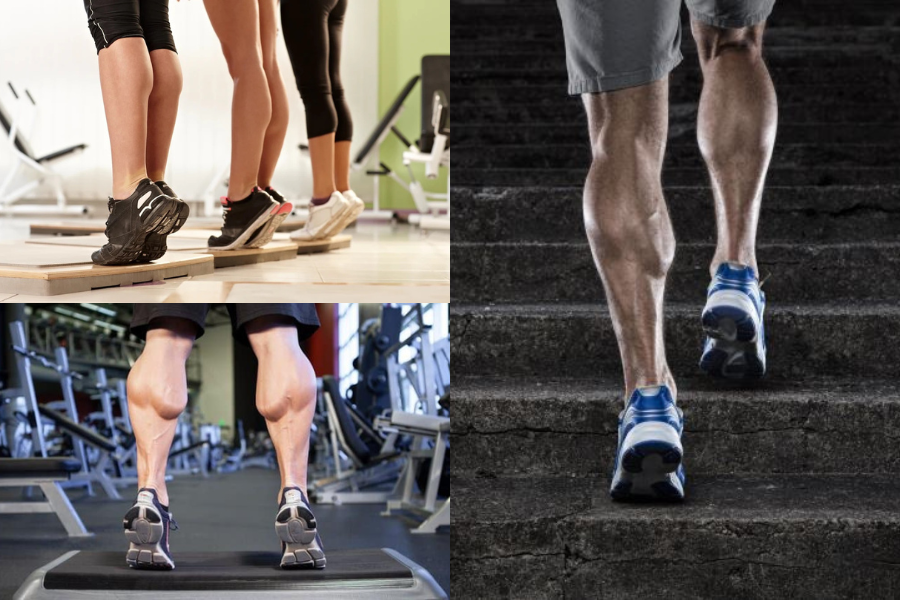
You might have seen people doing calf raises with their heels hanging off a raised surface. This small change makes a big difference.
When you perform calf raises with dumbbells on an elevated surface, your heel can drop below your toes at the bottom of the movement. This increases the stretch on your calf and can create a stronger training stimulus compared to doing the exercise flat footed.
The Frankoman dumbbell workout popularized this setup by having lifters balance the front of the foot on a stand so the heel hangs off.
How high should the step be
You do not need a tall object. Community discussions around this method generally suggest that only a few inches of elevation is enough to be effective. A sturdy exercise step, a thick weight plate, or a low homemade platform works well as long as it:
- Is stable and does not wobble
- Has a non slip surface
- Lets the ball of your foot rest securely while your heel hangs off
Some lifters build simple, affordable steps based on shared plans so they can perform elevated calf raises at home when they cannot find a commercial stand.
Elevated standing dumbbell calf raise
To try this version:
- Place the balls of your feet on the edge of a step or plate with your heels hanging off.
- Hold a dumbbell in each hand by your sides.
- Keep your core engaged and your back straight.
- Lower your heels as far as comfortable to feel a stretch in your calves.
- Press through the balls of your feet and raise your heels as high as possible.
- Pause briefly at the top, then lower slowly through the full range of motion.
This extended range helps recruit more muscle fibers and can boost strength and size when you progress the weight over time.
Single leg standing calf raises with dumbbells
Once regular two leg calf raises feel easy, you can move to single leg variations. These target the same calf muscles but increase the demand on each leg and challenge your balance.
Why single leg raises work so well
The single leg standing calf raise with a dumbbell effectively targets both the gastrocnemius and the soleus. These muscles are essential for ankle extension and play a big role in foot stability and knee support.
The soleus muscle contains a high proportion of slow twitch fibers, so it responds well to higher repetition work. The gastrocnemius has fewer slow twitch fibers and tends to benefit from moderate to higher loads. By shifting to a one leg at a time setup, you can:
- Use relatively heavier weight for each leg
- Mix heavier, lower rep sets with lighter, higher rep sets
- Improve ankle control, which can carry over to running and sports
How to perform the single leg version
- Stand on one foot on the floor or on a low step, holding a dumbbell in the hand on the same side as the working leg.
- Use your free hand to lightly hold a wall, chair, or rail for balance if needed.
- Keep your knee straight but not locked.
- Lower your heel as much as possible to create a stretch.
- Press through the entire width of your forefoot and raise your heel strongly.
- Move slowly and with control on the way up and down, avoiding any bouncing.
Pushing through the whole ball of your foot, instead of just the big toe, helps you recruit the full calf rather than shifting the strain to a smaller area.
If balancing on one leg feels too difficult at first, you can start with double leg raises and work toward single leg as your control improves.
Seated dumbbell calf raises
Standing raises emphasize the gastrocnemius because your knee is straight. When you sit and bend your knees, you shift more of the work to the soleus, which sits deeper under the larger calf muscle.
Both muscles matter for a strong, stable lower leg, so it helps to include a seated variation in your routine.
How to do seated raises
The seated dumbbell calf raise is straightforward and does not require a special machine.
- Sit on a sturdy bench or chair with your feet flat on the floor.
- Place a dumbbell across your thighs close to your knees. You can hold it in place with your hands.
- Optionally, place the balls of your feet on a low weight plate or block for added range of motion.
- Keep your back supported and your torso upright.
- Raise your heels off the ground as high as you can.
- Pause at the top, then lower your heels slowly, feeling the stretch in the lower calf.
Maintaining good back support is important here to prevent strain in your lower back. If holding the dumbbell is awkward, you can use a towel or pad between the weight and your legs for comfort.
Common mistakes to avoid
Even a simple move like calf raises with dumbbells can be less effective or more risky if your form breaks down. A few things to watch for:
- Moving too quickly and relying on momentum instead of muscle control
- Bouncing out of the bottom position, which transfers the force to your Achilles tendon rather than your calf muscles
- Cutting the range of motion short because the weight is too heavy
- Letting your ankles roll outward or inward instead of pushing evenly through the foot
Training slowly and through a full range of motion helps you feel the muscle doing the work, not your joints. If you notice your technique slipping, reduce the weight, lower your reps, or rest a bit longer between sets.
How often to do calf raises with dumbbells
You do not need to train calves every day to see results. Incorporating dumbbell calf exercises such as standing and seated raises 2 to 3 times per week is enough for most people, as long as you:
- Use a challenging but manageable weight that lets you move with control
- Gradually increase either weight, reps, or sets over time
- Allow at least one rest day between focused calf sessions
Since your calves are involved in a lot of daily movement, they can generally handle moderate training frequency, but they still need recovery to grow and adapt.
Understanding strength standards and progression
If you enjoy tracking progress, you might find strength standards helpful. They give you a sense of how your dumbbell calf raise strength compares to others of your sex and bodyweight.
According to data collected by Strength Level in 2026:
- The average one rep max dumbbell calf raise weight for a male lifter is 85 lb, which places that lifter in the Intermediate strength category and is considered very impressive.
- A male beginner might aim for about 17 lb for a one rep max, which is still quite strong compared to the general population.
- For female lifters, the average one rep max is about 48 lb, also in the Intermediate strength range.
- Female beginners can target a one rep max of around 16 lb, which is already impressive relative to most non lifters.
These standards are not rules. They are simply a framework you can use to see where you stand and set realistic strength goals over time.
Choosing the right starting weight
When you first add calf raises with dumbbells to your workouts, it is better to start lighter and move well than to overload the exercise. Pick a weight that:
- Lets you complete all your reps without bouncing
- Allows you to control both the lifting and lowering phases
- Makes the last 2 or 3 reps feel challenging but not sloppy
For many people, this might mean using smaller dumbbells at first, then progressing as your calves adapt. As you feel more confident, you can experiment with:
- Heavier weights for 6 to 10 reps per set to target strength and size
- Lighter weights for 15 to 20 reps to emphasize endurance, especially for the soleus
Mixing both approaches across different sessions or within the same week can help you develop well rounded calf strength.
Simple sample calf workout with dumbbells
To put everything together, here is a basic structure you can follow two or three times per week:
- Standing dumbbell calf raises, flat footed
- 2 sets of 12 to 15 reps
- Elevated standing dumbbell calf raises
- 2 sets of 10 to 12 reps with a slow tempo
- Seated dumbbell calf raises
- 2 sets of 15 to 20 reps
If you are more advanced, you can swap one of the standing variations for single leg calf raises and adjust the weight accordingly.
Focus on quality over quantity. A few well executed sets with full range of motion will do more for your calves than many rushed, partial reps.
Start with one or two of these exercises in your next workout and notice how your calves feel the day after. As you get more comfortable with the movements, you can adjust the weight, volume, and variations to match your goals.