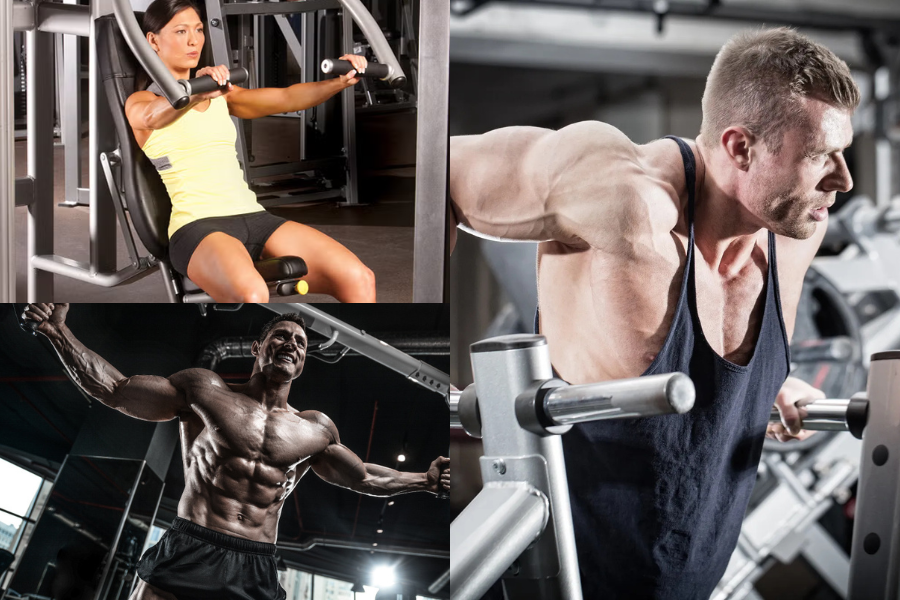
A focused chest workout for upper chest strength does more than build muscle around your collarbone. It can improve your posture, help your pressing strength in other lifts, and give your chest a fuller, more lifted look from the front and the side. With the right exercises and technique, you can start noticing changes in a matter of weeks, not months.
Below, you will find a simple, effective upper chest workout, why it works, and how to tailor it to your fitness level.
Understand your upper chest muscles
If you want your chest workout for upper chest to work quickly, it helps to know what you are actually training.
The upper chest is mainly the clavicular head of the pectoralis major. These fibers start along your collarbone and run down and outward toward your upper arm. Because of that angle, they respond best when your arm moves up and across your body at a slight diagonal, instead of straight out to the side.
Exercises that press or fly your arms upward, like incline presses or low to high cable flyes, will target this area more effectively than flat or decline movements. Research also shows that cable exercises create greater shoulder joint moments and constant tension, which boost upper chest activation compared with some machine variations.
Key principles for upper chest growth
You do not need a complicated routine to grow your upper chest. You do need to follow a few clear principles consistently.
First, use angles that favor the clavicular head. That usually means an incline bench set somewhere between 30 and 45 degrees, or any movement where your hands start lower and finish higher than your shoulders. Too steep an angle shifts more work to your front delts instead of your pecs.
Second, focus on controlled form and full range of motion. Dumbbells tend to allow a deeper stretch and more natural path than a barbell because your hands are not fixed. This greater range at the bottom of a press can increase muscle fiber recruitment and help correct side to side imbalances, something seen when comparing incline dumbbell presses to flat presses in lab studies of chest activation.
Finally, progress your training slowly. To build strength and size you will want to:
- Add a little weight over time
- Or add a rep or two per set
- Or add an extra set once your current workload feels manageable
Aim to train chest 1 to 2 times per week, including at least 2 exercises that hit your upper chest each session, and support your workouts with adequate sleep, recovery, and protein intake.
The best exercises for upper chest
You have many options for a chest workout for upper chest. The exercises below combine free weights, cables, and bodyweight so you can build a routine around the equipment you have.
Incline dumbbell bench press
The incline dumbbell bench press is one of the most efficient ways to target the upper chest. Set the bench at about 30 to 45 degrees so your arms press slightly upward, not straight out. This angle increases activation of the clavicular head compared with flat pressing and lets you feel a deep stretch at the bottom.
Using dumbbells instead of a bar also allows your wrists and elbows to move naturally. That reduces joint strain and helps you keep the line of pull in line with your upper chest fibers. A 2010 study found that incline angles in the mid range created greater upper chest activation than flat pressing, and later analysis highlighted the benefits of dumbbells for range of motion and contraction quality.
Start with lighter weights than you think you need so you can control the descent, pause briefly at the bottom, and press up with intent without bouncing.
Incline dumbbell squeeze press
Once you are comfortable with basic incline pressing, the incline dumbbell squeeze press is a powerful variation for building mind muscle connection.
You will set up on a 30 to 45 degree bench as before, but this time you press the dumbbells together the entire time. Squeezing them in increases tension through the inner and upper chest and keeps your pecs working from start to finish. This constant tension is excellent for hypertrophy, especially around the collarbone area.
Do not chase heavy weight on this exercise. Choose a moderate load that lets you maintain the squeeze for all your reps without your shoulders taking over.
Reverse grip bench press
If your gym does not have an adjustable bench, the reverse grip bench press gives you another way to hit the upper chest on a flat bench.
You will use an underhand grip, so your palms face your head. This grip keeps your elbows closer to your torso and shifts more work to the upper chest and even the biceps brachii while often feeling kinder on the shoulder joint. The bar path will feel slightly lower on your torso compared with a traditional grip, so take your time and use a spotter if you are new to it.
Begin with light to moderate weight, focus on a smooth descent, and press up while keeping your elbows tucked, not flared.
Low to high cable fly
For a strong finishing pump and detailed upper chest work, low to high cable flyes are hard to beat. Set the pulleys just below hip level, take a step forward, and bring your hands up and together in an arc that ends around shoulder or collarbone height.
This upward diagonal path mirrors the arm position of an incline press and targets the clavicular head effectively. Studies suggest that cable based fly movements provide constant tension and greater shoulder joint activity, which helps drive hypertrophy in the upper chest fibers more than some machine variations.
Keep the weight light enough that you can move slowly, with a slight bend in your elbows, and focus on squeezing your upper chest as your hands meet.
Decline push up for upper chest
If you train at home or want a bodyweight option, decline push ups are a practical alternative to incline pressing. Place your feet on a bench or box and your hands on the floor so your body is angled downward. This shifts more of your body weight onto your hands and loads the upper chest and front shoulders more heavily, especially as you raise the height of your feet.
You can adjust difficulty by changing the elevation or adding a weighted vest. Use a stable surface, maintain a straight line from head to heels, and lower your chest close to the floor before pressing back up. High rep sets of decline push ups also work well as a finisher after your main incline work.
Sample upper chest workout plan
You can organize the exercises above into a simple routine that fits into 45 minutes or less. Try the structure below 1 to 2 times per week.
- Incline dumbbell bench press
- 3 to 4 sets of 6 to 8 reps
- Rest 90 seconds between sets
- Reverse grip bench press or flat dumbbell press
- 3 sets of 8 to 10 reps
- Rest 90 seconds
- Incline dumbbell squeeze press
- 3 sets of 10 to 12 reps
- Rest 60 to 75 seconds
- Low to high cable fly
- 3 sets of 12 to 15 reps
- Rest 45 to 60 seconds
- Decline push up
- 2 sets to near technical failure
- Rest 60 seconds
You can reduce volume if you are a beginner by dropping one set from each exercise. As you grow stronger, add weight in small jumps while keeping your reps in the suggested ranges.
A useful rule of thumb: stop each set with 1 or 2 good reps still in the tank. This helps you push hard without letting your form break down.
Technique tips and common mistakes
A chest workout for upper chest pays off only if your form matches your goals. A few small tweaks can transform how each rep feels.
During any incline or reverse grip press, plant your feet, keep a slight arch in your upper back, and pinch your shoulder blades together. This creates a stable base and lets your chest, not your shoulders, drive the movement. Lower the weight under control for 2 to 3 seconds rather than dropping into the bottom position.
Avoid turning your upper chest session into a shoulder workout. If you feel all the tension in your front delts, your bench angle may be too steep or your elbows may be drifting too high above your torso. Adjust the bench down slightly and think about moving your biceps toward your upper chest at the top of each rep.
On flyes and push ups, do not rush the stretch. The bottom position is where your upper chest gets the most mechanical tension. Pause briefly, then squeeze the muscle as you come up instead of relying on momentum.
How to progress week by week
To boost your strength fast, track what you do. Write down the weight, sets, and reps for each upper chest session so you can make small improvements over time.
A simple four week progression might look like this:
- Week 1: Learn the movements and choose weights that feel like a 7 out of 10 effort.
- Week 2: Add 1 rep to each working set where you can maintain form.
- Week 3: Add a small amount of weight, for example 2.5 to 5 pounds per dumbbell, and return to the lower end of the rep range.
- Week 4: Keep the same weight and try to match or slightly beat your Week 2 reps.
After four weeks, you can repeat this cycle, switch one exercise for another upper chest variation, or slightly increase total sets if you are recovering well.
Consistent practice using these principles will help your chest workout for upper chest translate into visible strength and shape around your collarbone. Start with one or two of the exercises in this guide at your next session, focus on quality reps, and build from there as your confidence and strength grow.