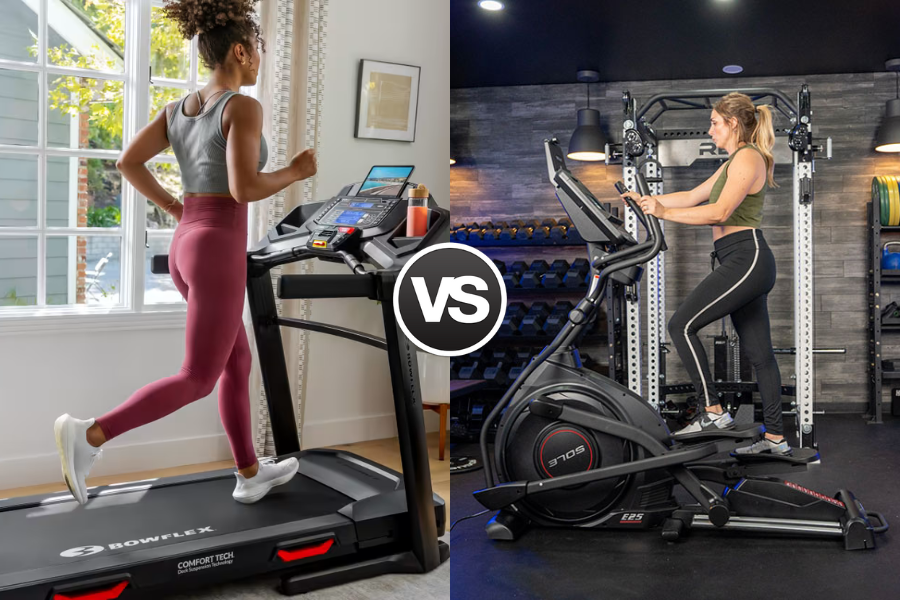
A cardio machine can become your best friend when you are trying to lose weight and improve your health. If you have ever wondered about elliptical vs treadmill cardio, you are not alone. Both machines look similar at a glance, but they work your body in different ways and feel very different once you start moving.
Below, you will learn how each machine affects your joints, calories burned, muscles worked, and long term progress, so you can choose the option that fits your body and your goals.
Understand what each machine does
Before you compare elliptical vs treadmill cardio, it helps to know what each one is actually asking your body to do.
A treadmill mimics outdoor walking or running. You support your full body weight while your feet repeatedly leave and strike the belt. You can adjust speed and incline to make the workout gentler or more intense, which is one reason treadmills are a favorite for high intensity interval training, or HIIT, and structured running workouts (Healthline, Nike).
An elliptical keeps your feet planted on pedals that move in a smooth circular or oval path. You glide rather than pound, which reduces the impact on your knees, hips, and ankles. Most ellipticals also have moving handles so your upper and lower body work together. This makes the elliptical a popular choice for beginners, older adults, and anyone easing back into exercise or dealing with joint issues (Healthline, NordicTrack, Nike).
In short, the treadmill feels more like classic running, while the elliptical feels more like a smooth glide that spreads the work across more joints and muscles.
Compare calorie burn and weight loss potential
If your main goal is fat loss, you probably want to know which machine burns more calories for the same amount of time and effort.
Several sources point in a similar direction. A Harvard Health summary reported that a 155 pound person burns about 335 calories in 30 minutes on an elliptical, compared to about 372 calories in 30 minutes of treadmill running at a 10 minute mile pace (Livefit). That is a small advantage for the treadmill, but not a huge one.
A 2010 study found that calories burned, oxygen consumption, and heart rate were nearly identical when you use an elliptical or a treadmill at comparable intensities (Healthline). More recent summaries from Nike echo this, noting that both machines produce similar improvements in calories burned and heart rate when effort is matched (Nike).
You will also see anecdotal experiences that show how tricky machine counters can be. One gym user reported that their LifeFitness elliptical displayed 1200 to 1400 calories per hour, while the treadmill at a comfortable speed showed about 700 calories per hour, even though their heart rate and perceived effort were higher on the treadmill (Reddit). This suggests built in calorie estimates can be unreliable.
The useful takeaway for you is this:
At the same level of genuine effort, elliptical vs treadmill cardio tends to burn similar calories, with a slight edge to treadmill running. What matters most is how hard you work, how long you stay consistent, and which machine you will actually use regularly.
If you find the elliptical more comfortable, you will likely stick with it longer and get better results than forcing yourself onto a treadmill you dread.
Look at joint impact and injury risk
Impact and joint stress are where the two machines really separate.
On a treadmill, your body experiences impact loading with every step. This weight bearing stress is not automatically bad. It can strengthen bones and support bone density, which helps reduce fracture risk over time (Nike). At the same time, the repeated pounding can increase your risk of shin splints, knee pain, and stress fractures, especially if you ramp up too quickly or already struggle with joint issues (Healthline).
The elliptical keeps your feet glued to the pedals, so there is no jarring foot strike. This low impact movement typically puts less stress on your knees, hips, and ankles and is often recommended if you have low back pain, arthritis, osteoporosis, or you are recovering from certain injuries (Healthline, Nike). That is why ellipticals are frequently described as joint friendly or rehab friendly.
However, low impact does not mean zero joint load. A 2024 lab study that compared an elliptical like motion with stationary cycling found that elliptical style pedaling created higher peak knee torque and greater peak forces at the knee and ankle, especially as pedaling speed increased (Medicina via PMC). The study also noted that the elliptical design tended to internally rotate and invert the ankle, which can require more work from the knee to control the motion (Medicina via PMC).
For you, this means:
- The treadmill has more impact and may irritate joints if you have existing problems, but can be great for bone health if you build up gradually.
- The elliptical is smoother and easier on impact, but you still need to pay attention to speed, form, and resistance so you do not overload your knees or ankles (Medicina via PMC).
If you know your joints are sensitive, the elliptical is usually the safer starting point. If your doctor has cleared you for running and you want stronger bones and legs, the treadmill can be a useful tool, as long as you respect its impact.
See which muscles each machine targets
Muscle recruitment is another big part of elliptical vs treadmill cardio.
On a treadmill, you mainly work your lower body. Your quadriceps, hamstrings, calves, and glutes do the bulk of the work propelling you forward, especially as you increase speed or incline (Healthline, NordicTrack). Your core also engages to keep you stable, but your upper body mostly goes along for the ride unless you intentionally pump your arms.
On an elliptical, you involve more of your body at once. The moving handles engage your arms, chest, shoulders, and upper back, while the pedals challenge your glutes, hip flexors, and quadriceps (Healthline, NordicTrack). You can also change directions. Pedaling backward tends to shift more work to your hamstrings and glutes, while forward pedaling emphasizes your quads and hip flexors.
If you want a pure lower body strength and running specific workout, the treadmill is your better match. If you want a single machine that challenges your upper and lower body together, the elliptical has the advantage.
Consider workout variety and intensity
Both machines let you adjust speed and incline or resistance, and both can support HIIT workouts where you alternate hard bursts with easier recovery periods. Those intense intervals are very effective for burning calories, reducing body fat, and improving cardiovascular fitness in less time (Healthline, Livefit).
Treadmills tend to offer very precise control over speed, incline, and structured programs. This makes them ideal if you like clear numbers, pace goals, or you are training for outdoor events where specific paces matter (Healthline, Nike).
Ellipticals give you resistance and sometimes incline changes, but the feel is different. You might perceive the same heart rate as easier because there is less impact and your weight is spread more evenly. That can be a plus if you want to work hard without feeling beaten up.
One smart strategy is to use both. Alternating elliptical vs treadmill cardio helps you engage different muscles, prevent boredom, and reduce the risk of overuse injuries from repeating the exact same motion every day (NordicTrack).
Match the machine to your goals
When you line everything up, the best choice depends on what you want most from your workouts.
If your top priority is:
- Joint friendliness, comfort, and long term consistency
- A gentler return to fitness after time off or injury
- A single machine that works your upper and lower body together
then the elliptical is likely your best main option. It offers low impact movement that most people can sustain several times per week without feeling beat up, and it can still deliver strong calorie burn and cardiovascular benefits (Healthline, Nike).
If your priority is:
- Training for outdoor walks, runs, or races
- Maximizing leg strength and bone loading
- Structured pace and incline workouts with very precise control
then the treadmill deserves a big place in your routine. Treadmill workouts slightly edge out the elliptical in calorie burn for many people, mainly because you are supporting your full body weight and engaging large lower body muscles like the glutes and quads at higher intensities (Livefit, Nike).
If you have access to both, you do not have to choose just one. You might use the treadmill for one or two interval or hill sessions per week and the elliptical for lower impact steady state cardio on other days. That combination can keep your body challenged without overwhelming your joints.
Turn the science into a weekly plan
To see how this could look in your real life, here is a simple example routine that mixes elliptical vs treadmill cardio. Adjust times and intensities so they feel challenging but doable for you.
-
Day 1, Treadmill intervals
Walk to warm up for 5 minutes, then do 6 to 8 rounds of 1 minute brisk run or fast walk uphill and 1 to 2 minutes easy walk. Cool down for 5 minutes. -
Day 2, Elliptical steady state
Set a moderate resistance that lets you talk in short sentences. Glide for 25 to 35 minutes, alternating forward and backward every 5 to 10 minutes. Lightly use the handles so your arms help but do not take over. -
Day 3, Rest or light activity
Go for a short walk, do mobility work, or take the day off. -
Day 4, Elliptical intervals
Warm up for 5 minutes. Do 8 rounds of 45 seconds strong effort and 75 seconds easy pedaling. Keep your posture tall and drive evenly through your feet. Cool down 5 minutes. -
Day 5, Optional treadmill walk
Walk 20 to 30 minutes at a comfortable pace. If it feels good, add a slight incline for a few minutes at a time.
You do not need to copy this exactly, but using both machines this way can help you build fitness, burn calories, and protect your joints at the same time.
The bottom line on elliptical vs treadmill cardio
When you strip away the calorie counters and brand marketing, elliptical vs treadmill cardio is less about which machine is “better” and more about which one fits you.
Both can help you lose weight, strengthen your heart and lungs, and improve your health. Treadmills lean toward slightly higher calorie burn and better race simulation. Ellipticals lean toward joint friendliness and total body engagement.
If you enjoy one more, start there and commit to using it consistently. If you can use both, rotate them to keep your workouts fresh and your body resilient. The surprising truth is that the best cardio machine is the one you can stick with for months, not just a single intense week.