Elliptical workouts for beginners are one of the easiest ways to start improving your fitness without punishing your joints. You get low impact cardio, a full body workout, and a simple learning curve that suits you whether you are returning to exercise or starting from scratch. With a bit of structure, you can use the elliptical to boost your health, support weight loss, and build confidence in the gym.
Use this guide to understand the benefits, learn proper form, and follow ready-made beginner elliptical workouts you can start this week.
Why the elliptical is great for beginners
If running feels too hard on your knees or you are worried about injuries, the elliptical is a smart place to begin.
Elliptical machines provide a low impact, full body workout where your feet stay on the pedals the entire time, so there is less stress on your hips, knees, ankles, and back compared with a treadmill or outdoor running (Lose It!). They are often recommended for people with joint issues or those recovering from injuries or surgery, because you can improve range of motion and cardiovascular fitness without pounding your joints (Cleveland Clinic).
You also work a lot of muscle in a single session. When you use the moving handles, you engage your upper and lower body at the same time, which helps you burn more calories and build strength and endurance in one workout (Lose It!).
How often you should do elliptical workouts
As a beginner, you do not need long daily sessions to see progress.
Guidelines from certified trainers suggest that new elliptical users start with 15 to 30 minute workouts, two or three times per week, at a low resistance level under 5 and a gentle incline between 1 and 8 (Garage Gym Reviews). This gives your muscles and joints time to adapt while you build the habit.
You can also begin with even shorter sessions. Some experts recommend starting around 10 minutes and adding a few minutes each week as your endurance improves (Verywell Fit). Over time, a 30 minute moderate intensity workout can help you meet daily activity guidelines and support weight management.
How an elliptical can support weight loss
If weight loss is part of your goal, the elliptical can be an effective tool as long as you pair it with consistent nutrition.
Calories burned will vary based on your weight and workout intensity. One estimate suggests that a 150 pound person doing a 30 minute moderate intensity elliptical workout can burn about 170 calories (Cleveland Clinic). Another source notes that a typical 155 pound person can burn about 335 calories in 30 minutes on an elliptical (ProForm). You will likely fall somewhere in this range depending on your own body size and effort level.
Elliptical workouts for beginners that use both the upper and lower body, use enough resistance to make you push and pull actively, and occasionally include intervals can help you burn more calories during your sessions (ProForm). Remember that sustainable weight loss comes from a combination of regular exercise and a calorie appropriate diet, not from workouts alone (Garage Gym Reviews).
How to set up the elliptical
Taking a minute to adjust the machine will make your workout safer and more comfortable.
Most ellipticals let you enter your age and weight, which helps provide a more accurate calorie estimate. Many machines are calibrated for a 150 pound person, so adding your own stats gives you better feedback on your sessions (Prevention).
Choose a moderate resistance that feels challenging but still controllable. You should be able to push and pull through the full stride without jerking or losing form. Very high resistance can cause you to lean, lose control, or move with poor technique, which increases injury risk (Hospital for Special Surgery).
If your elliptical offers incline options, keep it low in the beginning. A low incline of 1 to 8 with resistance under level 5 is usually enough for your early workouts (Garage Gym Reviews).
Proper form for a safe, effective workout
Good technique helps you get more from every minute on the machine and protects your joints.
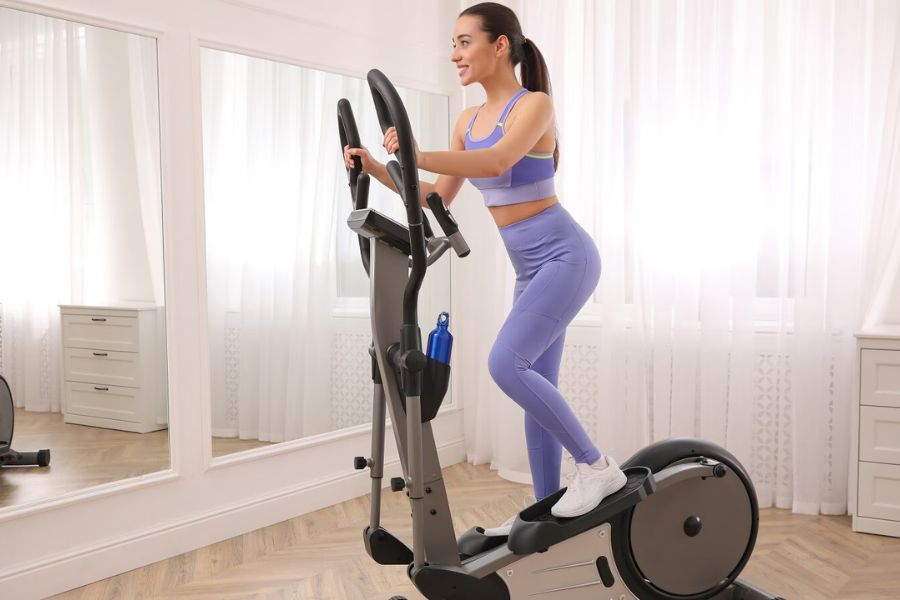
Stand tall with your shoulders back, your eyes forward, and your core gently engaged. Avoid slouching or leaning heavily on the handlebars, since that reduces how hard your muscles are working and can strain your back and shoulders (ProForm).
Your legs should push down and back and then pull up and forward through the full circle. This active motion engages your quadriceps and other leg muscles instead of letting the machine do the work for you (Hospital for Special Surgery). Try to sit back slightly into your heels, not your toes, so your larger muscle groups work harder and you reduce the chance of foot numbness (Prevention).
If coordinating arms and legs feels awkward at first, that is normal. You can start by holding the center handles or resting your hands lightly on the static bars to master the leg motion. Once you feel stable, add the moving handles so you can involve your arms, back, and chest in the workout (Hospital for Special Surgery).
Understanding intensity as a beginner
You do not need a heart rate monitor to judge how hard you are working.
A practical method is the perceived exertion scale from 1 to 10, where 1 feels like sitting on the couch and 10 feels like an all out sprint. For most beginner elliptical workouts, you want to stay between levels 4 and 6. This range feels like a comfortable to slightly challenging pace where you are breathing more deeply but can still talk in full sentences (Verywell Fit).
As you gain experience, you can briefly push into level 7 or 8 during short intervals. This helps build fitness and burn more calories without spending the entire workout at a very hard intensity.
Sample 20 minute beginner elliptical workout
Use this as a simple first routine. Adjust resistance and incline so they feel appropriate for you, and focus on smooth movement and relaxed breathing.
If you have any illnesses, injuries, medical conditions, or take medication that affects your heart rate, talk to your doctor before starting an elliptical program (Verywell Fit).
-
Warm up, 3 to 5 minutes
Start at very low resistance and low incline. Aim for a perceived exertion around 3 to 4, where the movement feels easy and you are settling into the stride. Many coaches suggest using resistance level 3 or lower during this warm up phase (Garage Gym Reviews). -
Build up, 5 minutes
Gently increase resistance to a moderate level while keeping incline low. Your effort should feel like a 5 on the 1 to 10 scale, just above an easy pace. You should still be able to talk comfortably. -
Steady work, 7 minutes
Maintain or slightly increase resistance, still at a low incline. Stay at level 5 or 6 effort where you are out of your comfort zone but not gasping for air (Verywell Fit). -
Cool down, 3 to 5 minutes
Gradually decrease resistance back to a very light level. Let your breathing slow and your heart rate come down. A cool down at low resistance and low incline helps reduce soreness and aids recovery (Garage Gym Reviews).
Follow this structure two or three times a week for a couple of weeks. As you feel stronger, add 2 to 3 minutes to the steady work section until you reach a comfortable 30 minute session that meets common activity guidelines (Verywell Fit).
Interval elliptical workouts for faster progress
Once you are comfortable with steady state sessions, you can add simple intervals to boost your fitness and calorie burn in less time.
Trainers often recommend three types of beginner elliptical workouts: short high intensity interval training (HIIT), progressive intervals that change every minute, and steady state sessions that gradually extend longer (Garage Gym Reviews).
Here is a gentle interval example suited to beginners:
- Warm up for 5 minutes at easy effort.
- For 10 minutes, alternate 1 minute at moderate to hard effort (around level 7) with 1 minute easy (around level 4). Keep resistance increases modest so you can maintain form.
- Cool down for 5 minutes at very easy effort.
This style of interval workout can take 20 minutes total and still give you a strong training effect. HIIT on the elliptical, where you work hard for short bursts followed by rest, is known to increase calorie burn during and shortly after your workout (ProForm).
Ways to keep your workouts interesting
Monotony is one of the fastest ways to lose motivation, so it helps to vary how you use the elliptical.
Most machines include preset programs like hill climbs, intervals, and rolling terrain. These built in options can automatically change resistance and sometimes incline during your workout, which makes it easy to match your session to your current fitness level and goals (Cleveland Clinic).
You can also vary:
- Direction: Try a few minutes of backward pedaling to emphasize hamstrings and glutes, then switch back to forward motion that targets your quads. Changing direction works different muscles and reduces boredom (Prevention).
- Resistance and incline: On some days keep both low for an easy recovery workout. On others, slightly raise resistance or incline for brief intervals to challenge your legs more. Just avoid cranking up either so high that your form suffers (ProForm).
- Handle use: Alternate between using the moving handles for a full body workout and letting go briefly during warm up or cooldown to engage your core and balance more intensely (Lose It!).
These small changes keep your muscles and mind engaged, which helps you stick with your routine long term.
Simple safety and comfort tips
A bit of preparation makes your elliptical workouts feel better from day one.
Wear running shoes or cross trainers that fit well and offer arch support, stability, and cushioning. These styles work well with the flat pedals on most ellipticals and help reduce foot and ankle discomfort (Lose It!).
Drink water before, during, and after your workouts. Staying hydrated supports joint health, nutrient circulation, body temperature regulation, and reduces the risk of dehydration, especially as you start sweating more regularly (ProForm).
Finally, pay attention to how you feel when you step off the machine. You should feel pleasantly tired but not dizzy or in pain. Using enough resistance that you cannot easily coast is important, but going so hard that you are completely wiped out every time is not necessary, especially at the beginning (Prevention).
Key takeaways
- Elliptical workouts for beginners give you low impact cardio that is easy on your joints and suitable if you are new to exercise or coming back from a break.
- Start with 10 to 30 minute sessions at low to moderate intensity, two or three times per week, and increase duration gradually as your fitness improves (Garage Gym Reviews).
- Focus on upright posture, active leg drive, and controlled resistance so your muscles do the work, not the machine.
- Use a mix of steady state workouts and simple intervals to support heart health and weight loss, alongside a balanced diet.
- Vary direction, resistance, programs, and handle use to keep your workouts engaging and to challenge different muscle groups.
Pick one of the beginner routines above, set a realistic schedule for this week, and give the elliptical a fair try. You may find it becomes your favorite way to build a stronger, healthier body with less stress on your joints.