A stationary bike can be more than a piece of equipment you pass on the way to the treadmill. With the right approach, exercise bike workouts can become your go‑to way to lose weight, build stamina, and actually look forward to cardio.
You get an efficient aerobic workout that strengthens your heart, lungs, and muscles while putting less stress on your joints than higher impact options like running (Healthline). That combination makes the bike a smart choice if you want results without beating up your knees and hips.
Below, you will find practical ways to make exercise bike workouts enjoyable, effective, and sustainable for weight loss.
Understand why exercise bike workouts help you lose weight
To lose weight, you need to burn more calories than you take in. An exercise bike helps you do that in a way that is controlled, scalable, and joint friendly.
Stationary cycling can burn more than 600 calories an hour, depending on your weight and how hard you pedal (Healthline). Even a moderate 30 minute ride can burn roughly 100 to 400 calories for most people (Defined). When you pair that with a modest calorie deficit from your diet, research shows you can reduce body fat and improve cholesterol and triglyceride levels (Healthline, Defined).
You also build endurance and leg strength as you ride. Regular workouts train your heart to pump more efficiently, improve blood flow, and increase lung capacity so you can handle longer or more intense sessions over time (NutroOne).
Because the bike is low impact, it puts less pressure on your knees, hips, and ankles. This makes it a good option if you deal with joint discomfort or simply want to protect your joints as you increase your activity level (Healthline, Defined).
Set up your bike so riding feels good
You are much more likely to stick with exercise bike workouts if the bike feels comfortable and safe from the start. A quick setup routine before you begin can prevent common aches and pains.
Aim to set your seat so that it is roughly at hip height when you stand next to the bike. When you pedal, your knee should be slightly bent at the bottom of the stroke, not locked out or deeply bent. This position helps protect your knees and hamstrings during your workout (CAROL Bike).
Make sure the handlebars are within easy reach so you do not have to hunch or overstretch. On upright and spin bikes, a slight forward lean with a stable core is ideal. On recumbent bikes, adjust the seat so you can press the pedals without your hips rocking side to side.
Take a few minutes to warm up at an easy pace. A proper warm up of 5 to 10 minutes allows your heart rate and blood flow to rise gradually, which reduces your risk of injury and helps you perform better once the work begins (CAROL Bike).
Choose the type of exercise bike that fits you
You do not need the perfect bike to get results, but picking the right style for your body and goals makes your workouts more enjoyable.
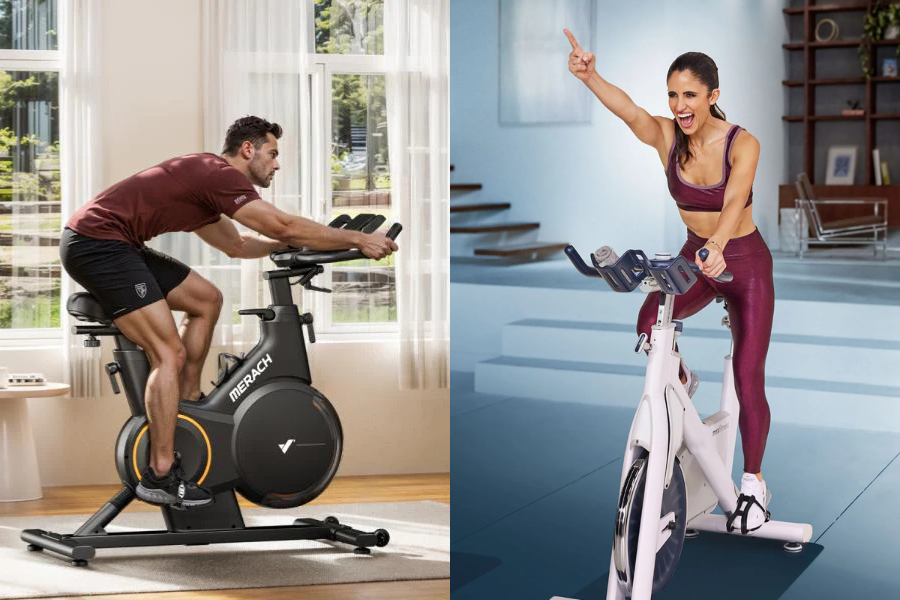
Upright bikes are the most common. You sit in a position similar to an outdoor bike, which can help strengthen your core and improve posture as your legs work against the resistance (NutroOne).
Recumbent bikes have a larger seat and a reclined backrest. Your legs extend in front of you rather than below you. This setup provides more support for your lower back and can feel better if you have back or joint issues. Recumbent models are especially gentle on knees and hips while still providing a solid cardio workout (Defined).
Spin bikes typically allow for higher intensity riding. They often support standing climbs and fast sprints, which is useful if you want interval training or a class-style experience that really challenges your endurance (NutroOne).
If you are just starting out, any style that feels comfortable and stable is a good choice. The most important factor is that you enjoy using it regularly.
Start with beginner friendly workouts
When you are new to exercise bike workouts, your goal is consistency. You want a routine that feels manageable, not one that leaves you so sore or exhausted that you avoid the bike for a week.
Health and fitness experts suggest that beginners start with just a few minutes at a time and gradually build up their duration (Verywell Fit). A realistic first target is a 20 minute session, including warm up and cool down. Over several rides, you can add short five minute blocks until you reach 30 minutes, which lines up with the minimum daily activity recommendation for many adults (Verywell Fit).
You might structure an early ride like this:
- 5 minutes easy pedaling to warm up
- 10 minutes at a steady, moderate pace
- 5 minutes gentle cool down
Use a simple effort scale from 1 to 10, where 1 is very easy and 10 is an all out sprint. Aim for a 5 or 6 during the middle part of the ride. You should be breathing faster but still able to say short sentences.
As your fitness improves, you can follow a progression that alternates 3 minutes at that baseline effort with 2 minutes a little harder until you reach 30 minutes total (Verywell Fit). This kind of small, controlled increase keeps things challenging without feeling overwhelming.
Make interval training fun, not intimidating
High intensity interval training can sound intense, but on an exercise bike you can scale everything to your own level. Intervals are simply periods where you alternate harder efforts with easier recovery.
Studies show that interval style stationary bike workouts help you burn more calories in less time and improve cardiovascular fitness (Healthline). They also break up the monotony of steady pedaling, which keeps your mind engaged.
Here is a simple interval session you can try once you are comfortable riding for 20 to 30 minutes:
- Warm up for 5 to 10 minutes at an easy pace
- Alternate 1 minute at a higher effort (around 7 or 8 out of 10) with 2 minutes easy
- Repeat this 6 to 8 times
- Cool down for 5 minutes
As you get fitter, you can experiment with slightly longer or more intense intervals. Some advanced protocols, such as the REHIT style 2 x 20 second all out sprints, have been shown to significantly improve aerobic fitness and deplete a meaningful portion of your stored glycogen in only a few minutes of hard work (CAROL Bike). Those brief sprints are not where you start, but they illustrate how flexible bike workouts can be.
The key is to keep the hard segments challenging but short enough that you do not dread them. Your intervals should feel tough while they are happening, yet recoverable during the easy portions.
Build a weekly routine you can stick to
For weight loss and overall health, what you do week after week matters more than any single workout. The Centers for Disease Control and Prevention recommend at least 150 minutes of moderate intensity aerobic activity per week. You can meet that goal by riding your exercise bike for about 30 minutes a day, five days a week (Defined, NordicTrack).
A simple beginner friendly weekly plan might look like this:
- 2 days of easy steady rides to build your aerobic base
- 2 days that include gentle intervals or slightly higher resistance
- 1 optional day of a longer, comfortable ride or a non biking activity you enjoy
- 2 rest or light activity days such as walking or stretching
You do not need complex training blocks at the start. In fact, experienced riders often recommend focusing on shorter, consistent rides rather than long, occasional efforts, because that helps you build a sustainable habit and steady aerobic fitness (Reddit Fitness).
Aim for at least three cardio sessions per week, including your bike workouts, to support endurance gains and calorie burn, and mix in other forms of movement so you do not feel locked into one type of exercise (Verywell Fit).
A realistic goal is 150 minutes of moderate intensity cycling spread over the week. This gives your heart and muscles enough repeated stimulus to adapt, without demanding long daily sessions.
Track your progress so motivation stays high
Seeing progress is one of the fastest ways to make exercise bike workouts feel enjoyable. Most bikes show basic metrics such as time, distance, and speed. Some also display power in watts, cadence in RPM, and calories burned.
Monitoring a few of these numbers over time can help you see improvements you might otherwise miss. For example, you may notice that you can ride farther in the same amount of time, maintain a higher speed at the same effort level, or complete intervals with a bit less strain.
If your bike or a compatible app allows it, you can also use heart rate to guide your intensity. Some systems build training zones around a threshold heart rate measured in a structured test so you can clearly see when you are in an easy recovery range versus pushing into higher zones for intervals (CAROL Bike).
At a basic level, you do not need advanced data to lose weight, but having a few numbers to follow can make rides feel like a game instead of a chore.
Keep safety and comfort in focus
Even though exercise bikes are generally safe and low impact, it still pays to listen to your body. Stationary bikes are often recommended for people with joint pain or osteoarthritis, because they reduce joint stress and can actually help decrease knee pain and improve function when used appropriately (Health, NordicTrack).
If you have an existing illness, injury, or you take medications that affect your heart rate, talk with your doctor before starting or intensifying your cycling routine (Verywell Fit). They can help you set safe intensity limits and identify any red flags to watch for, such as dizziness or chest discomfort.
Dress in comfortable, breathable clothing and consider padded cycling shorts if you find the seat uncomfortable. Adjust your schedule so you have at least one rest day between harder interval sessions, and remember that mild soreness is normal, but sharp or persistent pain is a sign to back off.
Make exercise bike workouts something you look forward to
The best exercise bike routine for losing weight is the one you enjoy enough to repeat. Fortunately, indoor cycling is easy to customize.
You can:
- Stream a favorite show and let the episode length define your ride
- Join virtual classes or app based workouts that guide you through intervals
- Create playlists with songs that match your target intensity
- Ride with a friend on nearby bikes or on a video call for accountability
Apps such as Zwift, TrainerRoad, and the Peloton app offer structured workouts and virtual environments that keep things interesting, even if you ride a basic bike without built in programs (Reddit Fitness).
As you get into a rhythm, you may notice benefits beyond the scale. Regular stationary bike workouts can improve your sleep, help manage stress, and leave you feeling more energetic throughout the day (Defined).
Start with one small step today. Adjust your bike, queue up a short beginner ride, and pedal at a pace that feels doable. Each enjoyable workout you complete makes the next one easier to begin, and over time those sessions add up to meaningful weight loss and better health.