If you want stronger, more powerful legs without relying on big machines or a barbell, a focused hamstring workout with dumbbells is a smart place to start. With just a pair of dumbbells, you can train your entire posterior chain, build muscle, and improve performance in everyday activities like walking, running, and climbing stairs.
Below, you will learn why your hamstrings matter, how to perform key dumbbell exercises with safe form, and how to put them together into an effective workout you can do at home or in the gym.
Understand your hamstrings
Your hamstrings are the group of three muscles at the back of your thigh. These are the biceps femoris, semimembranosus, and semitendinosus, and they control hip extension and knee flexion, movements that are essential for walking, running, squatting, and bending your knees. When your hamstrings are strong, you generate more power in sprints and jumps and you stabilize your knees and hips more effectively.
Weak or tight hamstrings, on the other hand, can increase your risk of strains and can contribute to lower back discomfort. Because hamstrings often recover slowly if injured, you are better off training them consistently, with good technique and conservative weight increases, instead of overdoing it once in a while.
Dumbbells give you a practical way to do exactly that. They let you load the hamstrings in both hip hinge and knee flexion patterns, and you can easily adjust weight and range of motion to match your current strength level.
Why use dumbbells for hamstrings
You might think you need a barbell or a leg curl machine to train your hamstrings properly. In reality, a targeted hamstring workout with dumbbells can give you a complete lower body challenge.
According to a 2021 guide from Born Tough, dumbbell hamstring exercises effectively strengthen not only your hamstrings but also your quads, glutes, calves, and lower back muscles, so you get more work done per set. Compared with machines, dumbbells usually involve more balance and core engagement, which makes the training feel more athletic and transferable to real life.
There are also practical advantages. Dumbbells are easier for beginners to handle than a barbell. You can adjust your grip and the way the weight sits next to your body, which often feels more comfortable and reduces lower back strain during hip hinge movements like the Romanian deadlift. You can also do most of these exercises in a small space at home.
If you are new to lower body training or coming back from a layoff, you should start with light weights and slow, controlled motions. Born Tough notes that hamstrings are prone to long recovery times and can be easily re-injured, so a gradual approach to weight increases is important.
Learn the dumbbell Romanian deadlift
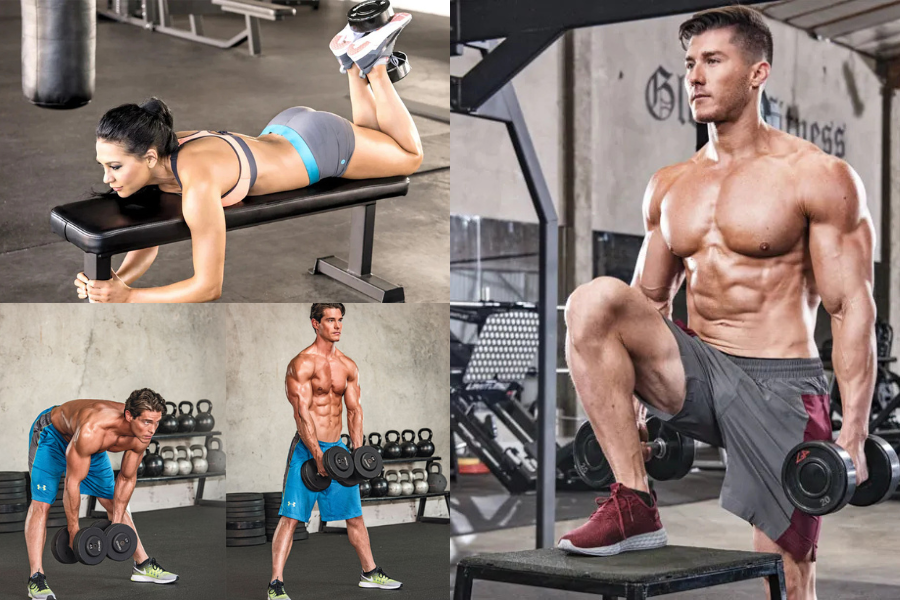
The cornerstone of an effective hamstring workout with dumbbells is the dumbbell Romanian deadlift, often shortened to dumbbell RDL. Men’s Health fitness director Ebenezer Samuel calls it essential for lifters from beginners to advanced because it builds strength, teaches a proper hip hinge, and carries over to many other exercises. It specifically targets your hamstrings, glutes, lower back, and even your forearms.
Step by step form
- Stand with your feet hip width apart and hold a dumbbell in each hand at your thighs. Your palms should face your legs.
- Before you even start, set the dumbbells on a bench or box at about knee height instead of picking them up from the floor. This reduces strain on your lower back when the weights are heavy.
- Soften your knees with a slight bend and brace your core. Keep your chest open and your spine long.
- Hinge at your hips by pushing them back behind you as if you are trying to close a car door with your glutes, a cue trainer Julie Ledbetter recommends to reinforce the hip hinge pattern.
- As your hips move back, let the dumbbells travel straight down close to your thighs and shins. Do not let them drift far away from your body.
- Lower until you feel a strong stretch in your hamstrings, usually when the dumbbells are around mid shin. Stop before your lower back starts to round.
- Press your feet into the floor, especially through your heels, and drive your hips forward to stand tall again. Squeeze your glutes at the top but do not lean back or arch your spine.
You should feel the majority of the work in your hamstrings and glutes, not in your lower back. If your back feels like it is taking over, reduce the range of motion, check that your spine is neutral, and think about pushing your hips back instead of folding forward.
Common mistakes to avoid
Trainers highlight several errors that can limit your progress or raise your injury risk in the dumbbell RDL:
- Hunching or rounding your back shifts tension away from your glutes and hamstrings and into your spine, which increases injury risk.
- Turning the movement into a squat by bending your knees too much reduces hamstring activation and makes it more like a regular deadlift.
- Using momentum, especially during fast or drop sets, instead of lifting and lowering with control.
- Letting the dumbbells drift far in front of your legs, which stresses your lower back and shoulders.
Julie Ledbetter recommends hinging with a slight knee bend, keeping the dumbbells close to your shins, lowering with control, and pressing through your heels as you stand. She also emphasizes that chasing heavier dumbbells at the expense of form reduces gains and raises the chance of injury. Perfect form with moderate weight will build your hamstrings more effectively over time than poor form with impressive numbers.
Sets, reps, and tempo
For strength and muscle growth, Men’s Health suggests three to four sets of six to eight reps with heavier weights, using a controlled tempo of about two seconds on the way down, a brief pause, then a strong but smooth drive back to standing.
If you are newer to the movement, you might start with:
- 3 sets of 8 to 10 reps, light to moderate weight
- 2 to 3 minutes rest between sets
As your technique improves, you can gradually increase the weight and shift toward the heavier 6 to 8 rep range.
Add more dumbbell hamstring exercises
A complete hamstring workout with dumbbells does not rely on one exercise. Combining a few patterns lets you train the hamstrings from slightly different angles and with different challenges for your balance and core.
Here are effective options supported by the Born Tough guide and other coaching sources.
Dumbbell deadlift
The standard dumbbell deadlift uses a similar hip hinge pattern, but you lower the weights closer to the floor.
- Stand with feet hip width apart and hold a dumbbell in each hand in front of your thighs.
- Soften your knees and hinge at the hips as you lower the dumbbells toward the floor, keeping your back straight and your chest open.
- Stop when your hamstrings reach a strong but comfortable stretch, then push through your feet and extend your hips to stand tall again.
Born Tough recommends about 3 sets of 12 to 15 reps for this variation. Think of it as a slightly higher rep complement to the heavier Romanian deadlift.
Single leg dumbbell deadlift
The single leg version challenges your hamstrings one side at a time and demands more stability from your core and hips.
- Hold a single dumbbell in your right hand and stand on your left leg.
- Create a slight bend in your left knee, brace your core, and hinge at the hips as you let the dumbbell travel down your left leg.
- As you hinge, extend your right leg back behind you, forming a straight line from your head to your heel.
- When you feel a strong stretch in the left hamstring, drive your foot into the ground and return to the starting position.
Born Tough suggests 3 sets of 10 to 12 reps per side. If balance is a challenge, you can lightly touch your back foot to the floor instead of fully lifting it.
Weighted glute bridge and hip thrust
Glute bridges and hip thrusts are usually known as glute exercises, but they also train your hamstrings and the rest of your posterior chain.
Weighted glute bridge:
- Lie on your back with your knees bent and feet flat on the floor, hip width apart.
- Place a dumbbell across your hips and hold it steady with both hands.
- Brace your core, then press through your heels to lift your hips until your body forms a straight line from shoulders to knees.
- Squeeze your glutes at the top, pause for a second, then lower with control.
Born Tough recommends 3 sets of 10 reps for weighted glute bridges and 3 sets of 12 reps for elevated hip thrusts. To shift more emphasis to the hamstrings, move your feet slightly farther away from your body while still keeping your heels on the ground.
Dumbbell good morning
The dumbbell good morning is another hip hinge movement that teaches you to keep your spine neutral while the hamstrings stretch.
- Stand with feet shoulder width apart.
- Hold a single dumbbell vertically against your chest.
- Soften your knees and hinge at the hips, sending them back as your torso leans forward, while you maintain a long spine.
- When your torso is roughly at a 45 degree angle, drive through your feet and return to standing.
Born Tough suggests 3 sets of 8 to 12 reps. Choose a weight that allows you to maintain perfect posture for every rep.
Other helpful dumbbell moves
You can also include lower body exercises that are not strictly hamstring isolated but still train them effectively:
- Dumbbell sumo squats
- Reverse lunges
- Dumbbell squats
Born Tough notes that dumbbell squats can engage your legs, core, forearms, quads, traps, and lats and can be as beneficial as barbell squats for many people, even though barbells allow heavier loads.
Try this sample hamstring dumbbell workout
You can turn the exercises above into a simple yet effective hamstring workout with dumbbells. Adjust the weights and rest times based on your fitness level.
Aim to perform this workout 1 to 2 times per week, with at least 48 hours of rest between sessions for the same muscle group.
Warm up, 5 to 8 minutes
- Light cardio such as brisk walking or cycling
- Dynamic leg swings, bodyweight good mornings, and a few unweighted hip hinges
Main workout
- Dumbbell Romanian deadlift
- 3 to 4 sets of 6 to 8 reps
- 2 to 3 minutes rest between sets
- Single leg dumbbell deadlift
- 3 sets of 8 to 10 reps per side
- 60 to 90 seconds rest
- Weighted glute bridge or elevated hip thrust
- 3 sets of 10 to 12 reps
- 60 to 90 seconds rest
- Dumbbell good morning
- 2 to 3 sets of 10 to 12 reps
- 60 seconds rest
If you prefer slightly higher total volume with lighter weights, you can swap in dumbbell deadlifts, sumo squats, or reverse lunges, following the 8 to 15 rep ranges outlined by Born Tough.
Progress safely and avoid injury
To make long term progress, you need both challenge and consistency. You can increase the difficulty of your hamstring workout with dumbbells in several ways:
- Add a small amount of weight when you can complete all sets with perfect form.
- Slow down the lowering phase of each rep to increase time under tension.
- Add an extra set for one or two exercises once your current volume feels easy.
Because hamstrings are powerful but injury prone, you should also keep a few safety guidelines in mind:
- Warm up thoroughly and never load heavy weights on cold muscles.
- Keep your spine neutral on all hinge movements. If you are not sure, shorten your range of motion.
- Stop a set if you feel sharp pain in the back of your thigh or your lower back. Tight muscular fatigue is fine, but stabbing or pulling sensations are not.
- Plan rest days so your legs can recover. Training the same muscles hard every day can stall progress and raise your injury risk.
Men’s Health notes that training plans that balance rest and work, especially when they include key moves like the dumbbell Romanian deadlift, are an effective way to boost athleticism and build muscular hamstrings.
With a pair of dumbbells and a bit of space, you can build a strong, resilient posterior chain. Start with one or two of the exercises above, focus on smooth, controlled reps, and gradually build your way up to the full hamstring workout. Over time, you will notice more power in your stride, better stability in your knees and hips, and stronger legs overall.