A strong core does much more than help you see abs in the mirror. The right ab workout for athletes can sharpen your movements, protect your spine, and give you more power in every sprint, jump, throw, and lift. When your midsection is stable and strong, your entire game changes.
Below, you will learn how your core actually works, why traditional sit-ups are not enough, and how to build an ab workout that supports real athletic performance, not just aesthetics.
Understand what “core” really means
When you think of abs, you might picture only the six-pack muscle on the front of your stomach. In reality, your athletic core is a full 360-degree system that wraps around your torso and connects your upper and lower body.
Your abdominal core includes:
- Rectus abdominis, the classic six-pack, important for flexing the spine
- Internal and external obliques, which rotate and side-bend your trunk
- Transverse abdominis, a deep corset muscle that stabilizes your spine and pelvis
- Quadratus lumborum, in your lower back, crucial for side bending and spinal stability
- Psoas major and other hip flexors, which help you lift your legs and stabilize your hips
When these muscles work together, they stabilize your spine and pelvis so your arms and legs can move efficiently in sport. Strength coaches describe the core as everything that stabilizes the shoulder and pelvic girdle with the spine. This creates a fixed point so you can produce strong, powerful actions like throwing, sprinting, tackling, or jumping.
A strong core also improves posture, reduces your risk of low back pain, and boosts performance in big lifts like squats, deadlifts, and bench presses.
Why your abs matter for performance
Your core is the power transfer station of your body. Your legs might create a lot of force, but if your trunk is unstable, you leak that force before it ever reaches the ball, bar, or finish line.
A well trained core helps you:
- Maintain balance and body control in fast or awkward positions
- Change direction quickly without losing stability
- Keep your spine aligned during heavy lifts and landings
- Generate more speed and power in rotational movements like swinging or throwing
Core training focused on stability and anti movement patterns also helps prevent injuries. By keeping your spine in a safer position and supporting quick directional changes, you reduce the risk of back, knee, and ankle problems, especially in dynamic sports like basketball, soccer, and tennis.
Rethink the typical ab workout
If your ab workout is mostly sit-ups and crunch variations, you are not training your core the way an athlete needs.
Coaches like Brandon Robb from HEROIC Athletics point out that athletes often overemphasize sit-ups, which mainly target the rectus abdominis in a single plane of motion. This can create imbalances and even contribute to low back pain over time.
To build a bulletproof, functional core, you need movements across all three planes:
- Sagittal, flexion and extension, like crunches or supermans
- Frontal, lateral flexion and extension, like side bends or side planks
- Transverse, rotation and anti rotation, like Russian twists or Pallof presses
You also need anti movement work, where your goal is to resist motion rather than create it. Strength coach Mike Boyle popularized this approach because resisting flexion, rotation, and side bending closely matches how your core works in sport. Instead of repeatedly curling your spine, you are teaching your trunk to stay solid while the rest of your body moves explosively.
Learn the key ab exercises for athletes
You do not have to spend an hour on abs. Many effective ab workouts for athletes can be done with just bodyweight in around 15 minutes, two to three times per week. The key is choosing exercises that train different functions of your core.
Here are some of the most useful movements from the research, plus what they do for you.
Planks and side planks
Planks teach you to brace your entire midsection and hold a neutral spine. When you engage your transverse abdominis during a plank, it acts like a natural weightlifting belt that stabilizes your spine and pelvis during heavy or fast movements.
Side planks shift the focus to anti lateral flexion. They target your obliques and deep stabilizers, helping you resist side bending and keep your spine aligned when you cut, land on one leg, or absorb contact. They are especially useful for posture, core endurance, and injury prevention.
Deadbugs and bird dogs
Deadbugs are a staple in athletic core programs. Lying on your back, you move opposite arm and leg while your core keeps your spine neutral. This teaches you to brace while your limbs move, which is exactly what you need for sprinting, jumping, and changing direction. They are often programmed two to three times per week to help prevent low back pain and build stable movement patterns.
Bird dogs are a great option if you feel back discomfort during ab work. From an all fours position, you extend opposite arm and leg while keeping your torso steady. Research highlights bird dogs as a way to safely engage both core and back muscles, improving lower back function and potentially reducing pain.
Leg raises and ab wheel progressions
Leg raises target your lower abs and hip flexors. Stronger hip flexors and lower abs can improve your performance in running, sprinting, and squatting. You can start with lying leg raises and, as you get stronger, progress to hanging leg raises.
Ab wheel rollouts and their progressions are powerful anterior core exercises. They challenge your ability to resist spinal extension as you move forward and back. Coaches use them as part of anti flexion work, training you to stay braced when force is pulling your spine out of position.
Supermans and trunk extension work
Supermans, where you lift arms and legs off the floor while lying on your stomach, train trunk extension. They strengthen your lower back and help balance the many flexion focused movements in typical ab training. This is one of the five core exercises recommended to build total trunk strength, alongside movements for lateral flexion, rotation, and bracing.
Rotational and anti rotational exercises
Many sports involve twisting, such as tennis, golf, baseball, and throwing events. Weighted core exercises like Russian twists and cable woodchoppers develop rotational strength in your obliques and transverse abdominis. By adding load over time, you can progressively build more power through your torso.
On the flip side, anti rotational moves like Pallof presses and landmine rotations train you to resist twisting forces. Isometric lunge banded rotations, for example, put you in a split stance and challenge your trunk stability during rotational tension. This mimics real sport scenarios like swinging, passing, or catching while your lower body is in motion.
Bicycle crunches and teapots
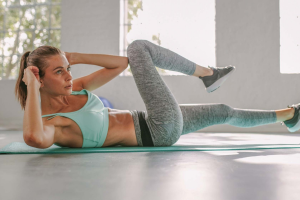
If you want to include a more traditional ab exercise, bicycle crunches are a strong choice. The American Council on Exercise ranks them as one of the most effective ab exercises because they engage your obliques and deep transverse abdominis. They also involve spinal rotation and can be done anywhere without equipment.
Kettlebell teapots, where you side bend and return to upright with a weight in one hand, train lateral flexion and help strengthen the muscles that keep your torso upright when you are loaded unevenly, such as when you carry or receive contact from one side.
Train across planes and patterns
To build a complete ab workout for athletes, you want to mix patterns rather than repeat the same type of movement.
A simple way to think about your core training is:
- Anti flexion and anti extension, resisting bending forward or backward, like planks and ab wheel rollouts
- Anti lateral flexion, resisting side bending, like side planks or loaded carries
- Anti rotation, resisting twisting, like Pallof presses or banded holds
- Rotation, producing controlled twisting, like Russian twists or medicine ball throws
You can also view progress in three phases:
- Stability, focus on motor control and holding neutral positions with bodyweight, such as basic planks, deadbugs, and bird dogs
- Strengthening, increase intensity with more load, slower tempos, or longer isometric holds, such as weighted Russian twists or cable woodchoppers
- Chaos, introduce unpredictability and reactive elements, such as partner tosses, unstable surfaces, or dynamic band work
Keeping a base exercise and rotating through these modes over weeks helps your core adapt to more realistic, game like challenges.
Sample 15 minute ab workout for athletes
Here is a simple structure you can use two or three times per week. Adjust sets and reps to your level and the demands of your sport.
-
Deadbugs
3 sets of 8 to 10 reps per side
Focus on keeping your lower back gently pressed to the floor. -
Side planks
3 sets of 20 to 30 seconds per side
Keep your body in a straight line from shoulders to ankles. -
Bicycle crunches
3 sets of 12 to 15 reps per side
Move slowly and with control, think quality over speed. -
Bird dogs
2 to 3 sets of 8 to 10 reps per side
Do these as a cool down or “reset” for your back and hips.
Once this feels comfortable, you can swap in or add:
- Hanging leg raises or ab wheel rollouts for more intensity
- Russian twists or cable woodchoppers for rotational strength
- Pallof presses or banded anti rotation holds for extra stability
Aim to finish your ab work feeling stable and “switched on,” not completely exhausted. Your core still needs to perform in the rest of your training and in competition.
Do not forget body composition and recovery
If you are chasing visible abs in addition to better performance, training alone is not enough. To see muscle definition, you need to lower your body fat percentage while maintaining or building muscle.
Research suggests general ranges for visible abs are around 6 to 15 percent body fat for men and 10 to 22 percent for women. That does not mean you must reach the extreme low end, but it does show why even strong cores can stay hidden under a layer of fat.
Supporting your core training with smart nutrition helps you:
- Recover and rebuild muscle with enough protein
- Maintain strong bones and muscle contractions with minerals like magnesium, calcium, and potassium
- Limit excess processed and high sugar foods that add calories without useful nutrients
Good sleep and stress management also matter. Your body adapts to training when you rest, not while you are grinding through more sets of crunches.
Turn core strength into a competitive edge
An ab workout for athletes is not about doing as many sit-ups as possible. It is about building a core that can stabilize, resist, and transfer force in every direction your sport demands.
When you train all your core muscles, move through multiple planes, and include anti movement patterns, you create a trunk that supports powerful, efficient, and safer performance. Start by adding two or three of the exercises above to the end of your regular workouts, then gradually build to a focused 15 minute routine.
Pay attention to how your balance, speed, and lifts feel over the next few weeks. As your core gets stronger and smarter, you will likely notice that everything else, from your first step to your final rep, feels more controlled and more explosive.