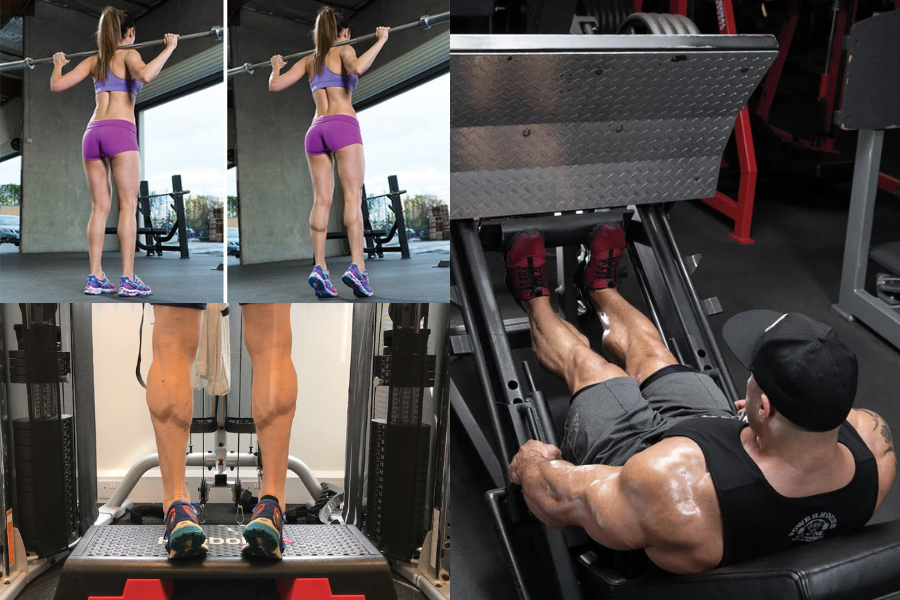
A strong set of calves does more than fill out your jeans. The best exercises for calves help you run faster, jump higher, and protect your ankles from injury, all with simple moves you can do at home or at the gym. With a little strategy, you can turn a stubborn muscle group into a real strength.
Below, you will find the most effective calf exercises, how to use them in your workouts, and easy progressions so you keep seeing results.
Understand your calf muscles
Before you load up on reps, it helps to know what you are training.
Your calves are mainly two muscles: the gastrocnemius and the soleus. The gastrocnemius is the larger, upper muscle that you see when you flex. It has more fast-twitch fibers and it drives explosive movements like sprinting and jumping, as described by Sport and Spinal Physiotherapy in 2024. The deeper soleus has more slow-twitch fibers and supports endurance and posture.
Knee angle changes which muscle works harder. Straight-leg calf work hits the gastrocnemius. Bent-knee variations shift more load to the soleus, a pattern confirmed by a 2014 study from Suzuki et al that compared muscle activation at different knee angles.
Most calf fibers are slow-twitch, so they respond very well to higher volume and lighter loads as long as you train with effort. Research summarized by Brad Schoenfeld in 2020 found that calves grow with both heavy and light weights when you push sets close to fatigue.
Why strong calves matter
Well trained calves pay off in more ways than appearance.
Bigger, stronger calves improve short sprints, vertical jumps, and agility. A 2018 study by Mock et al showed that maximum dynamic calf strength is a key factor for sprint performance. Your calves also absorb and release force every time your foot hits the ground, which is why they are so important for running, changing direction, and even swimming kicks.
On the injury side, strong calves support your ankles and Achilles tendon. They help prevent ankle sprains and reduce the risk of issues like shin splints by stabilizing the lower leg and controlling landing forces. If you play sports with cutting and jumping or you simply walk a lot, your calves are working all the time.
Best exercises for calves: the essentials
The best exercises for calves all share a few things. They move through a full range of motion, they can be progressed from bodyweight to added load, and they allow higher reps with control.
1. Standing calf raises (straight knee)
Standing calf raises are the classic move and a foundation for calf strength.
You can do them on the floor or off a step for extra stretch. According to Surrey Physio in 2024, 20 to 30 repetitions twice per day is a solid starting point, with options to add a barbell or dumbbells when bodyweight becomes easy.
To perform them, stand tall, knees straight but not locked, then slowly rise onto your toes and lower your heels again. A pause at the top and a controlled descent increase time under tension, which is useful for growth.
2. Single leg calf raises
Once both-leg raises feel easy, you can double the challenge by working one leg at a time. Single leg calf raises are one of the best exercises for calves because they load each side fully and build ankle stability.
Surrey Physio recommends 20 to 30 repetitions twice daily, standing on one leg and lifting slowly onto the toes while holding on to a wall or chair for balance. When that feels comfortable, you can hold dumbbells or use a step to increase range of motion.
This variation helps even out left and right strength and is especially useful if you have a history of ankle sprains.
3. Seated calf raises (bent knee)
To target the soleus, you need bent-knee work. Seated calf raises do exactly that.
You can sit on a chair with feet flat and then raise your heels, or use a gym machine. Surrey Physio suggests lifting your heels off the ground for 20 to 30 repetitions, twice a day, with either bodyweight or added weight on your knees for extra resistance.
Because the soleus is highly endurance-focused, you tend to tolerate quite a bit of volume here. Seated raises are also friendlier on the Achilles if you are easing back from an injury.
4. Bent knee standing calf raises
Bent knee standing raises combine the balance element of standing work with the soleus focus of seated work.
Stand with your knees slightly bent, then rise up onto your toes and lower with control. You can do these on both legs or as single-leg raises. The progression methods are the same as for straight knee raises: more repetitions, single-leg versions, and added weight.
Including both straight knee and bent knee variations in your routine ensures that you train both major calf muscles effectively, a strategy supported by research on muscle activation and knee angle from Suzuki et al in 2014.
5. Eccentric calf raises
Eccentric calf raises put extra focus on the lowering phase. They are excellent for strength, size, and tendon health.
One simple version is to rise up using both legs, then shift your weight to one leg and lower slowly on that side for three to five seconds. This approach has been widely used in rehab for Achilles tendon issues and it translates very well into performance training.
Because eccentrics create more muscle damage, start with lower volume and build up over several weeks.
6. Hopping and plyometric drills
Hopping is essentially a series of fast, explosive single-leg calf raises. It is one of the most functional ways to train your calves for running and jumping performance.
You can start with gentle in-place hops on two legs, then progress to single-leg hops, faster tempos, higher jumps, or hopping over low obstacles as your strength improves. Research on functional calf training notes that reducing ground contact time and increasing hop height are simple ways to progress intensity.
If you want more variety, plyometric calf step-ups are another option. Per Surrey Physio, you step briskly onto a bench, drive your knee upward, then step down with control. They suggest 10 to 15 repetitions on each leg twice a day to build lower-leg power.
Small technique tweaks that boost growth
Once you know the best exercises for calves, the details of how you perform them make a big difference.
Foot position is one powerful tweak. A 2020 study on foot positioning found that turning your toes out hits the inner (medial) head of the gastrocnemius, turning them in targets the outer (lateral) head, and pointing them straight ahead activates both heads. You can use this by doing separate sets with different foot angles in the same workout.
There is also the question of weight versus effort. Since calves respond well to both heavy and light loads when you work close to fatigue, you do not need massive weights to grow them. Instead, focus on controlled reps, a full stretch at the bottom, a hard squeeze at the top, and sets that feel challenging in the last few reps.
Finally, range of motion matters. Training off a step or block so your heels can drop below your toes, as long as it is pain free, increases stretch and can stimulate more growth over time.
Quick rule of thumb: if you are not getting at least a slight burn by the end of each set, the load or volume is probably too low for meaningful progress.
Sample calf workout plan
You do not have to live on a calf machine to get results. Two or three focused sessions per week are usually enough, especially if you are also walking, running, or playing sports.
Here is a simple structure that you can adapt to your level:
- Standing calf raises, 3 sets of 15 to 20 reps
- Seated calf raises, 3 sets of 15 to 20 reps
- Single leg calf raises, 2 sets of 10 to 15 reps per leg
- Hopping in place, 2 sets of 20 to 30 seconds
Rest 45 to 60 seconds between sets, and aim to increase either repetitions or weight once you can complete all sets with good form. For home workouts, you can hold water bottles or a backpack for extra resistance.
Because calf muscles are slow-twitch dominant, they often handle higher frequency work well. Some people like to sprinkle in one or two light sets of bodyweight raises on non-training days as a “mini pump” and to keep the ankles feeling mobile. Just be sure to listen to your joints and back off if you notice persistent soreness in the Achilles or under the foot.
Warm up, stretch, and stay injury free
You will get more from the best exercises for calves when your lower legs move well.
Start your workout with a brief warm up: a few minutes of walking, ankle circles, and easy heel raises to bring blood into the muscles. After training, a mix of stretching and light foam rolling helps maintain mobility and reduce tightness.
Fitness expert Stephanie Mansour emphasizes that calf stretches and ankle mobility work are crucial foundations for building bigger, stronger calves and avoiding issues like shin splints. Simple moves such as a wall calf stretch or a bent-knee ankle stretch, held for 20 to 30 seconds, fit easily at the end of your session.
If you are new to calf training, increase volume gradually. Jumping straight into high-repetition, high-impact work can irritate your Achilles or the bottom of your foot. Add a little more work each week, watch how your body responds, and keep rest days in the mix.
Putting it all together
To build stronger, more muscular calves, you do not need a complicated routine. You need a few of the best exercises for calves, done with intention and enough effort to challenge you.
Start with standing calf raises, seated or bent-knee variations, and single-leg work. Add in hopping or plyometric drills once your basic strength is solid. Experiment with foot positions and tempo, and let higher reps with focused technique do the heavy lifting.
Pick one or two of the exercises above and include them in your next workout. Over the next few weeks, you will likely notice not just fuller calves, but smoother runs, higher jumps, and more confident steps every day.