A lot of people feel stuck with small calves, no matter how much they walk or run. If you are trying to figure out how to get bigger calves, the key is to treat them like any other muscle you want to grow, with smart exercise selection, the right amount of volume, and a plan you can stick to.
Below, you will learn how your calf muscles work, which exercises actually build size, and how to put everything together into a simple training plan you can follow.
Understand your calf muscles
Before you pile on reps, it helps to know what you are training. Your calves are mainly two muscles that work together any time you push through the ball of your foot.
Gastrocnemius vs soleus
The calf muscles consist of the gastrocnemius and the soleus. Both help you point your toes down, which is called plantar flexion. They respond differently depending on how your knee is positioned.
The gastrocnemius is the more visible, diamond shaped muscle that pops when you flex your calf. It crosses both your ankle and your knee. It is primarily activated when your knees are straight, for example during standing calf raises.
The soleus sits underneath the gastrocnemius. It crosses only the ankle and is worked more when your knee is bent, for example in seated calf raises. This difference in activation based on knee position is important if you want complete calf development, as explained by ISSA in May 2023.
If you only ever do one style of calf raise, you are probably leaving growth on the table in one of these muscles.
Use the most effective calf exercises
To get bigger calves, you do not need an endless list of movements. A handful of proven strength exercises, done consistently and with good form, will go a long way.
Core strength exercises for bigger calves
Effective calf exercises to build size include standing calf raises, seated calf raises, elevated calf raises, jump rope, bent knee calf raises, single leg calf raises, and farmer’s carry. These cover both heavy strength work and more explosive or endurance focused movements.
A simple approach is to pick:
- One straight leg exercise to focus on the gastrocnemius
- One bent knee exercise to focus on the soleus
- One explosive or athletic movement to round out your training
You might do standing calf raises, seated calf raises, and jump rope in a single week, for example. According to RP Strength’s hypertrophy guide, including between 1 and 3 different calf exercises per training session and 2 to 4 different exercises per week is recommended to optimize exercise variation without overuse.
Straight leg calf exercises
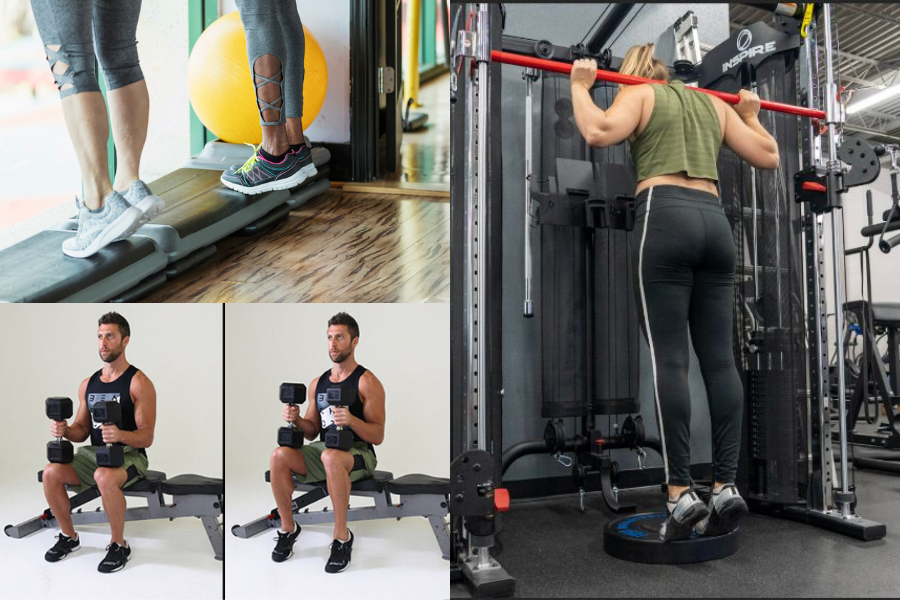
Standing calf raises are the classic move. You can do them on a machine, with a barbell, or holding dumbbells. Focus on rising as high as you can on your toes and controlling the lowering phase.
Elevated calf raises are a variation where the balls of your feet are on a step or block. This lets your heel drop below the step for a greater stretch. The increased range of motion provides a powerful stimulus when combined with tension at the bottom.
Single leg calf raises increase the load on each leg without needing heavy weights. Use a wall or rail for balance, and move slowly to keep control.
Bent knee calf exercises
Seated calf raises, whether on a machine or with a barbell or dumbbell on your thighs, emphasize the soleus because your knees are bent. This allows you to push hard through the bottom half of the movement.
Bent knee calf raises can also be done standing by slightly bending your knees and then moving through the ankle. This is helpful if you do not have a seated calf raise machine.
Including at least one bent knee and one straight leg variation in your weekly training will help you target the full calf complex.
Explosive and athletic movements
Traditional resistance exercises are important, but explosive movements can also play a useful role. Plyometric and explosive movements such as box jumps, jump squats, and single leg jumping have been shown to positively impact calf muscle hypertrophy by challenging the muscle differently compared to standard strength work.
Jump rope is another practical option. It is less intense than high box jumps but still encourages your calves to contract quickly and repeatedly.
Train with the right volume and intensity
If you want to know how to get bigger calves, the details of your training matter as much as the exercise list. You need enough volume to stimulate growth, but not so much that you cannot recover.
Sets, reps, and weekly volume
Calf training benefits from a range of loads corresponding to roughly 5 to 30 reps per set, with an emphasis on moderate reps of 10 to 20 for most weekly working sets and a mix of heavier 5 to 10 and lighter 20 to 30 rep ranges to maximize hypertrophy, according to RP Strength’s hypertrophy guidance.
A good starting point is:
- 3 to 5 sets per exercise
- 6 to 12 reps for your heavier, strength focused sets
- 12 to 20 reps for lighter, higher tension sets
As you progress, you can increase total weekly sets for calves, either by adding another exercise or adding sets to the exercises you already do.
Exercise variety without overuse
You do not need to change exercises every session, but some variation helps prevent overuse and keeps progress moving. Including between 1 and 3 different calf exercises in a single workout, and 2 to 4 over a week, is usually enough.
You might focus on standing and seated calf raises for one block of training, then swap one of them for single leg calf raises or elevated calf raises in the next block.
Apply key muscle growth principles
To grow any muscle, you need to steadily challenge it. Your calves are no different. A few simple training principles will help you turn effort into visible results.
Progressive overload and tempo
Progressive overload means gradually making your training harder. You can do this by adding weight, adding reps, slowing down the tempo, or increasing the range of motion. To promote muscle growth in the calves, key training principles include increasing workout volume over time, slowing down tempo to increase time under tension, enhancing range of motion, shortening rest periods between sets, and consistently overloading the muscles.
A slower lowering phase is especially effective. Take 2 to 3 seconds to lower your heel, pause briefly in the stretch, then drive up powerfully.
Many lifters benefit from holding a strong, sometimes uncomfortable stretch at the bottom of the calf raise. Employing a painful stretch at the bottom of the movement, holding it for up to 2 seconds, is suggested as a powerful stimulus for muscle growth. Beginners should start with low volume here, because this style of training often creates intense delayed onset muscle soreness, according to RP Strength’s 2024 guide.
Range of motion and stretch
Partial reps have their place, but most of your work for calves should be through a full range of motion. Let your heel drop as low as your ankle comfortably allows, then rise fully to the top on each rep.
If you use elevated calf raises, this increased range of motion, paired with controlled tempo, significantly boosts time under tension. The result is a stronger growth signal to the muscle.
Plan your weekly calf training
Calves respond well to frequent training, as long as you respect recovery. With a little planning, you can fit effective calf work into almost any routine.
Frequency and rest intervals
Calves recover relatively quickly due to high local vascularization and few synergistic muscle limitations. This allows for possible rest times as short as 10 seconds between sets in some contexts. In general, you should let your performance guide rest length. If your reps and effort are dropping, you may need a bit more rest. If you feel ready sooner, you do not have to wait a full two or three minutes.
Frequency of calf training is best personalized by monitoring recovery. Many people can train calves 3 to 6 times per week at effective volumes. Alternating exercises between sessions can mitigate overuse and reduce injury risk.
A simple setup might look like this:
- Day 1: Standing calf raises, heavier sets
- Day 3: Seated calf raises and jump rope
- Day 5: Single leg or elevated calf raises
You can adjust this based on your overall leg training, but aim to hit calves several times per week rather than only once.
Sample calf workout structure
Here is one way you could structure a focused calf session:
- Standing calf raises: 4 sets of 8 to 12 reps, full range of motion
- Seated calf raises: 3 sets of 12 to 15 reps, slow tempo
- Jump rope: 3 to 5 minutes broken into short intervals
You can place this at the end of a lower body workout or as a short, standalone session on a lighter day.
Quick reminder: when you increase volume or intensity, do it gradually. Your calves may feel fine during the workout but very sore a day or two later.
Support calf growth with recovery and lifestyle
Even the best program will stall if your recovery habits work against you. Calf training is no exception.
Sleep and nutrition basics
Adequate sleep and nutrition are essential for calf muscle growth. Sleep facilitates hormone regulation, muscle recovery, and protein synthesis. Nutrition that includes sufficient protein, carbohydrates, healthy fats, hydration, and micronutrients supports overall muscle hypertrophy.
Make sure you:
- Eat enough total calories to support muscle gain
- Get regular protein rich meals throughout the day
- Stay hydrated, especially if you are adding jump rope or plyometrics
You do not need a special “calf diet,” but you do need a basic muscle building friendly way of eating.
Managing soreness and staying consistent
Because calves are used all day for walking and standing, they can get very sore when you first start focused training. This is normal, especially if you use deep stretches and slow tempos.
To manage soreness:
- Start with fewer sets than you think you need
- Add volume and intensity slowly from week to week
- Use light walking or cycling to get blood flowing on sore days
Your biggest long term driver of growth will be consistency. Training calves 3 times a week for several months, using good form and progressive overload, will do more for you than one brutally hard session followed by weeks off.
Key takeaways
If you have wondered how to get bigger calves, the path forward is clear once you break it into manageable steps.
- Train both the gastrocnemius and soleus by using straight leg and bent knee calf exercises
- Choose a few proven movements like standing calf raises, seated calf raises, and jump rope, and do them consistently
- Use a mix of rep ranges between about 5 and 30 reps, with most sets in the 10 to 20 range
- Emphasize full range of motion, slow lowering phases, and a strong stretch at the bottom
- Train calves several times per week, adjusting volume and rest based on how you recover
- Support your workouts with solid sleep and nutrition so your muscles can actually grow
Try adding one focused calf session to your week, even if it is only 10 minutes at the end of a workout. Once that feels routine, build from there. Over time, those small, deliberate sessions can add up to visibly stronger, bigger calves.