A strong pair of quadriceps does more than shape your legs. The right training helps you stand up with ease, climb stairs without thinking about it, sprint harder, and protect your knees from everyday wear and tear. When you focus on the best quadricep exercises, you build strength, power, and stability in one of the most important muscle groups in your body.
Below, you will learn how your quads work, the most effective exercises to train them, and how to structure a simple quad-focused workout you can stick with.
Understand your quadriceps
Before you load up the bar or grab the dumbbells, it helps to know what you are trying to train. Your quadriceps, or quads, are a group of four muscles on the front of your thigh. Together, they extend your knee and help flex your hip, which makes them essential for almost every lower body movement.
The four key quadriceps muscles are:
- Rectus femoris, crosses your hip and knee, helps you lift your thigh and straighten your leg
- Vastus lateralis, the largest muscle on the outside of your thigh
- Vastus medialis, sits near the inner part of your knee and helps stabilize the joint
- Vastus intermedius, lies deep between the other muscles and also extends the knee
A well-rounded quad workout should challenge all four. Strong quads support activities such as standing up, sprinting, and jumping, and they help stabilize your knee to lower the risk of meniscus or ACL injuries and to prevent falls, as highlighted by exercise physiologist Karen Feakes and the Cleveland Clinic.
Start with bodyweight quad exercises
If you are new to strength training or coming back after a break, bodyweight movements are a smart place to begin. They teach proper form, build baseline strength, and prepare your joints and tendons for heavier loads later.
Air squats
Bodyweight squats, also called air squats, are one of the best overall exercises to strengthen your quadriceps along with your hamstrings, glutes, core, and spinal erectors. Stand with your feet around shoulder-width apart, sit back and down as if you are lowering into a chair, then drive through your feet to return to standing.
To make the squat more quad focused, keep your torso relatively upright and let your knees travel forward in line with your toes. Only go as low as you can while keeping your heels on the floor.
Sit-to-stand from a chair
If deep squats feel intimidating, the sit-stand exercise is a gentle but effective alternative. Sit on a sturdy chair, plant your feet under your knees, lean slightly forward, and stand up without using your hands. Then lower back down with control.
This pattern is very similar to everyday movements and is one of the quadricep exercises the Cleveland Clinic recommends for practical strength and independence in daily life.
Step-ups
Step-ups are simple and highly functional. Place one foot on a step or sturdy box, drive through that foot to stand tall on the platform, then lower back down with control. Your front leg does most of the work, which challenges the quads, glutes, and stabilizing muscles around your knee and hip.
Start with a low step height and your own bodyweight, then progress by increasing height or holding dumbbells at your sides.
Walking lunges
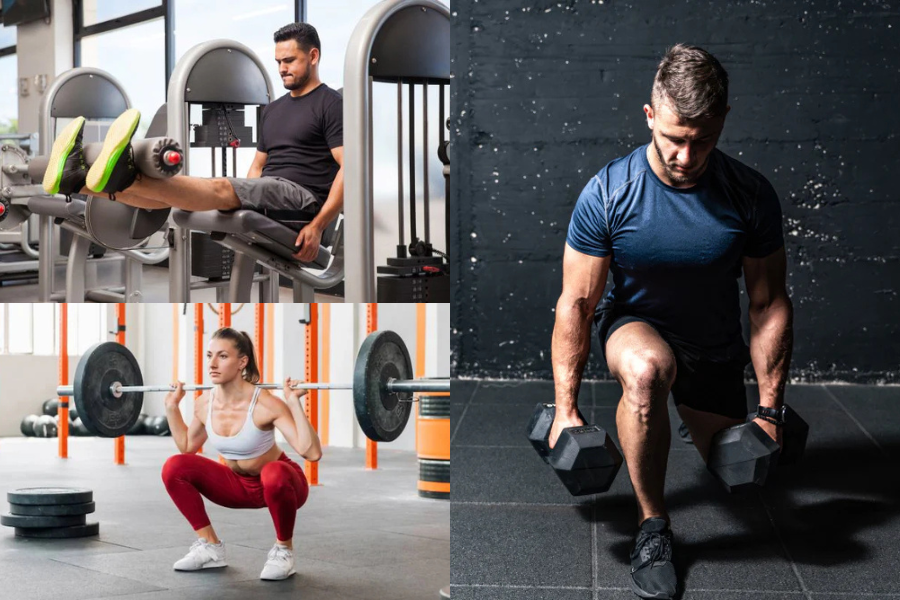
Walking lunges help boost leg and core strength by targeting the quadriceps, hamstrings, glutes, and core. Step forward into a lunge, lower until both knees are bent, then push off your front foot to bring your back foot forward into the next step.
If full lunges feel tough on your knees at first, lunge only halfway down or shorten your step length. When you want more challenge, you can hold dumbbells to increase resistance.
Progress with quad-focused squat variations
Once you are confident with bodyweight movements, you can shift toward exercises that place more direct emphasis on the quads. These variations take advantage of a more upright torso and greater knee bend to increase quad activation.
Goblet squats and heel-elevated goblet squats
Goblet squats are performed by holding a dumbbell or kettlebell close to your chest and squatting down under control. The front-loaded position naturally encourages you to stay upright, which shifts more work to your quads.
To make this even more quad dominant, you can elevate your heels on small plates or a wedge. This changes the angle of your ankles and allows your knees to travel further forward, increasing demand on the quadriceps while reducing the need to hinge deeply at the hips. Gymshark notes that heel-elevated goblet squats are among the best quad exercises for building size and strength because they increase knee extension demand and minimize hip involvement.
Front squats
Front squats use a barbell held across the front of your shoulders. Similar to goblet squats, this position keeps your chest more upright and your weight centered over your midfoot, which loads the quads heavily.
You do not need to lift very heavy to benefit. Gymshark recommends using lighter weights and focusing on form, especially maintaining your posture and tracking your knees over your toes, for safe and effective quad growth.
Hack squats and sissy squats
If you have access to a hack squat machine, it can be an excellent way to target your quads. The machine supports your upper body so you can focus on driving your knees forward and extending through your thighs. Placing your feet lower on the platform increases quad activation, and a slightly wider stance can add emphasis to the inner thighs.
Sissy squats are an advanced movement where you lean back and bend your knees deeply while keeping your hips extended. They place very high tension on the quads and should only be added once your strength and joint stability are well developed. Start with assistance and a short range of motion before progressing.
Use unilateral quad exercises for balance
Single-leg or unilateral exercises are important if you want balanced, stable legs. They help correct strength differences between sides and challenge your balance and coordination.
Forward lunges and variations
Traditional forward lunges already work the quads, but you can emphasize them further by slightly elevating your front foot on a plate or low platform. This increases how far your knee can bend, which shifts more of the load onto the quadriceps.
Gymshark highlights lunges with the front foot elevated as one of the most effective unilateral quad builders. Keeping your torso upright and allowing your front knee to track over your toes, while still lining up with your second and third toes, is key for targeting the quads and protecting your joints.
Bulgarian split squats
Bulgarian split squats are one of the most challenging and rewarding lower body exercises you can do. Place your back foot on a bench or step, stand on your front leg, and lower your back knee toward the floor. A shorter stance and upright torso increase quad emphasis, while elevating the front heel can further enhance range of motion and quad recruitment.
These help strengthen the quadriceps, hamstrings, hips, and core, and Gymshark notes that they are especially useful for improving muscle balance and maximizing quad growth. If you are new to them, start with bodyweight and limit depth to halfway down, then gradually increase the range as your knees and hips adapt.
Add isolation moves for maximum quad focus
Compound exercises like squats and lunges should be the foundation of your quad training, but isolation exercises let you finish your workout with precise, targeted work.
Leg extensions
The leg extension machine is one of the most effective isolation exercises for the quadriceps. You sit with your legs bent and extend your knees against resistance, which allows you to focus almost entirely on your quads while the rest of your body is supported.
Both Cleveland Clinic and Gymshark highlight leg extensions as a powerful way to build quad size and strength, and Gymshark emphasizes their value for increasing training frequency since they cause less overall fatigue than heavy compound lifts. You can also use single-leg extensions or short isometric holds at the top to make them more challenging without needing much extra weight.
Leg raises for the rectus femoris
Straight-leg raises are especially good for the rectus femoris since this muscle crosses both the hip and knee. Lying on your back with one leg straight and the other bent, tighten your thigh and lift the straight leg a few inches off the floor, then lower slowly.
This simple move also engages your hip flexors and core and can be useful if you are dealing with knee discomfort that limits squatting depth, since it works the quads without putting a lot of pressure on the joint.
Program the best quadricep exercises into a workout
Knowing the best quadricep exercises is one thing, knowing how to put them together into a routine you can stick to is where you see real progress. For most people, training quads twice a week is ideal. Research summarized by Gymshark suggests that performing at least 10 total sets for your quads per week in the 8 to 12 rep range is effective for muscle growth, as long as you also allow time for recovery.
Here is a simple template you can adjust to your fitness level:
-
Warm up
Spend 5 to 10 minutes with light cardio, such as walking or cycling, followed by dynamic leg swings and a few easy bodyweight squats or lunges. -
Main quad workout
- A: Squat pattern, such as goblet squats or front squats, 3 to 4 sets of 8 to 12 reps
- B: Unilateral exercise, such as walking lunges or Bulgarian split squats, 3 sets of 8 to 12 reps per leg
- C: Step-ups or sit-to-stand, 2 to 3 sets of 10 to 15 reps
- Isolation finisher
- Leg extensions or straight-leg raises, 2 to 3 sets of 10 to 15 reps
- Cool down
Finish with gentle stretches for the quads, hamstrings, and hips, and a short walk to bring your heart rate back down.
To increase intensity over time, you can add weight with dumbbells, resistance bands, ankle weights, or a leg extension machine. The Cleveland Clinic recommends keeping exertion at a moderate level and avoiding sudden jumps in load to reduce your risk of overload or injury.
Train your quads safely and effectively
Strong quads make everything from standing up to sprinting feel more powerful and controlled. As you start using these best quadricep exercises, listen to your body, progress gradually, and focus on form rather than chasing numbers.
If you are a beginner, have knee or hip issues, or want help tailoring a plan to your goals, it is wise to check with your healthcare provider before starting and to consider working with a fitness professional. With the right mix of squats, lunges, step-ups, and isolation work, you can build stronger, more resilient legs that support you in the gym and in everyday life.