A bicep workout at home can be just as effective as training in a gym if you choose the right exercises and use smart technique. You can build strength and definition with bodyweight moves, simple equipment, or even household items you already own.
Below, you will find practical ways to warm up, train your biceps, and progress over time without needing a full home gym.
Understand your biceps and why they matter
Your biceps are the muscles on the front of your upper arm. They help you bend your elbow and rotate your forearm so your palm can face up. You use them whenever you carry groceries, lift a box, or pull yourself up.
When you focus on a structured bicep workout at home, you are not just training for looks. Strong biceps support your shoulders, improve your pulling strength, and make everyday tasks easier on your joints and back.
Set up for an effective home workout
You do not need much space or gear to train your biceps at home, but a little preparation goes a long way.
If you have them, basic tools like:
- A pair of dumbbells
- A barbell
- A resistance band
- A chinup bar that fits in a doorway
are more than enough for a complete routine.
If you do not have equipment, you can still challenge your biceps with your bodyweight and common household items such as water bottles, canned goods, filled milk or water gallons, loaded backpacks, or heavy purses. Focusing on the lowering phase of each rep, known as the eccentric, helps you maximize strength and muscle growth even with lighter loads.
Warm up your biceps before you start
A good warm up makes your workout feel better and reduces the chance of strain. You only need about five minutes, but it should be focused and controlled rather than rushed.
You can use a simple sequence such as:
- Light pulling variation, like banded chin ups if you have a band and bar, to wake up your back and biceps without going to failure.
- Rotational curls with light weights to get blood flowing through the full range of motion.
- A core move like an inverted plank to stabilize your shoulders.
- A straight arm, behind the back bicep stretch to open the front of your arm.
Move through each step with smooth, comfortable reps. The goal is to feel warm and ready, not tired, before your main bicep workout at home.
Try bodyweight bicep exercises at home
You can train your biceps hard using just your bodyweight and basic fixtures in your home.
Chinups and assisted chinups
If you have a chinup bar or a sturdy horizontal surface you can hang from, chinups are one of the best bodyweight moves for your biceps. Use a shoulder width underhand grip so your palms face you, then pull your chest toward the bar and lower under control.
If a full chinup is too difficult right now, loop a resistance band over the bar and under your knees for assisted chinups. The band supports part of your bodyweight so you can practice good form and gradually build strength.
Biceps focused push ups
Standard push ups emphasize your chest and triceps, but a simple hand adjustment can bring your biceps into the movement. Start in a regular push up position, then turn your hands so your fingers point toward your feet and bring your hands a bit closer together.
This variation, often called a biceps push up, shifts more of the work to the front of your arms. Keep your core tight and move in a smooth range so your wrists stay comfortable.
Door frame bodyweight curls
Door frame bodyweight curls are a creative way to work your biceps without any equipment. Stand in an open doorway, grab both sides of the frame at about chest height, lean your body back, and use your arms to pull yourself toward the frame.
The further your feet are from the door, the harder the exercise becomes. This is a great option if you are short on space or training in a room with very little equipment.
Use household items as makeshift weights
If you want a bit more resistance but do not own dumbbells, you can create your own weights easily.
Backpack curls are one simple option. Fill a sturdy backpack with books or other heavy items, hold the top handle with both hands, and curl it up toward your chest. You can also hold a bag in one hand for single arm curls.
You can use filled milk or water gallons or heavy purses as stand in dumbbells. Grip them like you would a weight and perform curls, hammer curls, or cross body curls. To increase the challenge without changing the object, slow down the lowering phase of each rep. Paying attention to the eccentric portion of the movement places more tension on the muscle and supports strength and hypertrophy at home.
If you prefer not to move through a full range, you can experiment with isometric curls. Loop a belt, rope, or bedsheet under your foot, hold the other end in your hand, and pull as if you are trying to curl a heavy weight that will not move. Hold the contraction for 10 to 20 seconds, then rest and repeat. Even though your joint angle does not change, your biceps still work hard.
Build your routine with dumbbells and barbells
If you own basic free weights, you can structure a classic bicep workout at home that looks and feels similar to a gym routine.
Seated dumbbell curls
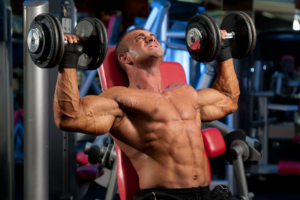
Seated dumbbell curls help you focus on strict form. Sit upright with your hips pushed back and your chest lifted so you do not swing the weights. Hold the dumbbells with your palms facing forward and a fixed grip.
Curl the weights up until they reach about chest height, where your biceps contract strongly, then pause briefly and lower them with control. Because you are seated, it is easier to keep momentum out of the movement and keep tension where you want it.
Standing barbell curls
Standing barbell curls let you handle more total weight, which is helpful for building size and strength. Stand tall, grip the bar with your hands shoulder width apart, and keep your upper arms close to your sides.
As you curl, focus on keeping your elbows still rather than letting them drift forward. Bring the bar toward your chest, squeeze your biceps hard at the top, then lower it steadily. The final few reps of each set should feel challenging but controlled, not jerky.
Single arm preacher curls
If you have an incline bench at home, you can set it up as a preacher station. Place the back of your upper arm against the bench, let your arm fully extend at the bottom, then curl the weight up through a full range of motion.
Single arm preacher curls emphasize the short head of the biceps and allow you to correct side to side imbalances. Working one arm at a time also forces you to stabilize each shoulder and prevent your stronger side from taking over.
Explore simple bicep machines for home gyms
If you are building a more complete home setup, several compact machines can make your bicep workout at home more varied and comfortable.
A dedicated biceps curl machine, such as the PLS 0600 style design, often includes multiple grip options. You can use narrow or wide grips, try reverse curls, or perform one arm curls while adjusting the elbow position to match your frame. This kind of customization makes it easier to find a groove that feels right on your joints and targets your muscles directly.
Preacher curl benches are another popular option because they lock your upper arms in place. This isolation reduces help from other muscle groups and keeps the tension where you want it, on the biceps. Adjustable seat curl machines work in a similar way and allow you to change the seat height so your elbows align with the machine pivot for better form.
Cable machines, if you have space, offer very consistent resistance through the full range of motion. Swapping attachments, such as straight bars, rope handles, or single grips, lets you tweak the angle of pull and vary your curls to keep your training engaging.
Dumbbells and barbells still remain the foundation in most home gyms. They support natural wrist movement, balanced work between arms, and heavy loading for classic curls and variations like incline dumbbell curls.
Structure a beginner friendly bicep workout at home
If you are just starting out, a simple and repeatable plan will help you see progress without feeling overwhelmed. You can train your biceps two times per week, with at least one day of rest between sessions.
For a no equipment workout, begin with two sets of each chosen exercise, such as:
- Chinups or assisted chinups
- Biceps push ups
- Door frame bodyweight curls
- Backpack or water gallon curls
Perform each set to near failure while keeping good technique. As you get stronger, move to three sets and keep aiming for controlled reps that challenge you.
If you have dumbbells and a barbell, you can follow a more traditional beginner plan that focuses on mastering three core exercises:
- Seated dumbbell curls, 3 sets of 12 to 10 reps
- Standing barbell curls, 3 sets of 10 to 8 reps
- Single arm preacher curls, 2 to 3 sets of 12 to 10 reps
This structure targets both heads of the biceps and gives you enough volume to grow without overcomplicating your session.
A good starting rule is to choose 2 to 4 bicep exercises, perform 2 to 3 challenging sets of each, and focus on slow, controlled reps instead of chasing very high weight right away.
Progress your training safely over time
To keep getting stronger, you need to increase the difficulty gradually. You can do this by adding weight to your backpack or dumbbells, increasing your reps, or slowing down the eccentric portion of each curl.
Pay attention to how your elbows and shoulders feel. A deep muscle burn during the last reps is normal, but sharp joint pain is not. If something feels off, stop the exercise, reduce the load, or switch to a variation that feels smoother.
Aim to finish each workout feeling worked but not wiped out. With consistent effort, even a short bicep workout at home can add up to noticeable strength and definition in just a few weeks.