A strong pair of biceps does much more than look good in a tank top. Effective bicep workouts for women help you carry groceries, lift luggage into an overhead bin, and twist open a stubborn jar with less effort. With a smart plan, you can build power and tone quickly, even if you are short on time or equipment.
Below, you will find clear guidance on how your biceps work, the best exercises to target them, and how to put everything together into simple routines you can start this week.
Understand your biceps and why they matter
Your biceps sit on the front of your upper arm and control some of your most common daily movements. They help you bend your elbows, lift and pull objects toward you, and rotate your forearms for tasks like turning a door handle or twisting a bottle cap, as experts noted in a 2023 overview for Women’s Health.
An effective bicep workout should target both parts of the biceps brachii:
- The long head sits on the outer side of your arm and helps create that noticeable “peak.”
- The short head lies closer to your body and adds width and overall fullness.
When you choose exercises that hit each head from different angles, you build arms that are not only stronger but also more balanced and defined.
How often you should train biceps
You do not need to train biceps every day to see results. In fact, you should not.
Research suggests that working a muscle group 2 to 3 times per week can lead to faster hypertrophy, or muscle growth, than training it only once a week, with about 3.1 percent greater week over week gains reported in one analysis cited by Gymshark’s 2024 guide. That frequency gives your muscles enough stimulus to grow while still allowing for recovery.
A simple structure is:
- 2 bicep focused days per week if you are just starting.
- Up to 3 days per week if you are more advanced, as long as your arms do not feel overly sore or fatigued.
Between sessions, you should have at least one rest day where you do not directly train biceps. That rest period is when microtears in your muscle fibers repair and rebuild, which is what actually creates strength and size over time.
Pick the right weight, sets, and reps
For strength and tone, you want a balance of volume and intensity. You are aiming to challenge your muscles, not exhaust your joints.
A solid guideline for most women is:
- 2 to 4 different bicep exercises per workout
- 3 to 4 sets of each exercise
- 8 to 12 repetitions per set
Choose a weight that feels moderately heavy. You should be able to complete all the reps with good form, but the last 2 or 3 should feel challenging. If you breeze through a set without effort, it is time to increase your dumbbell weight by about 1 to 2.5 pounds, as ACE certified trainer Colette Nguyen recommends in Women’s Health.
Many women can complete an effective session in about 15 minutes, using 5 to 10 pound dumbbells if they are beginners or intermediate lifters, and around 12 pounds or more if they are more advanced.
A simple rule of thumb: if you can talk easily during the last few reps, your weight is probably too light. If your form falls apart before you reach the final rep, it is likely too heavy.
Warm up before you lift
A short, focused warmup prepares your joints and muscles so you can lift more safely and effectively.
Spend about 5 minutes on:
- Light cardio, such as marching in place or a gentle jog
- Dynamic arm swings and big circles forward and back
- A set of easy banded chin up pulls or assisted rows to wake up your upper back
- Gentle biceps stretches with your arms extended behind you
This quick routine increases blood flow, improves your range of motion, and helps your elbows and shoulders handle heavier loads without complaint.
Best dumbbell bicep exercises for women
Dumbbells are accessible, easy to store, and perfect for training each arm evenly. The exercises below let you target your biceps from multiple angles.
1. Supinated biceps curl
This is the classic curl and still one of the most effective.
How to do it:
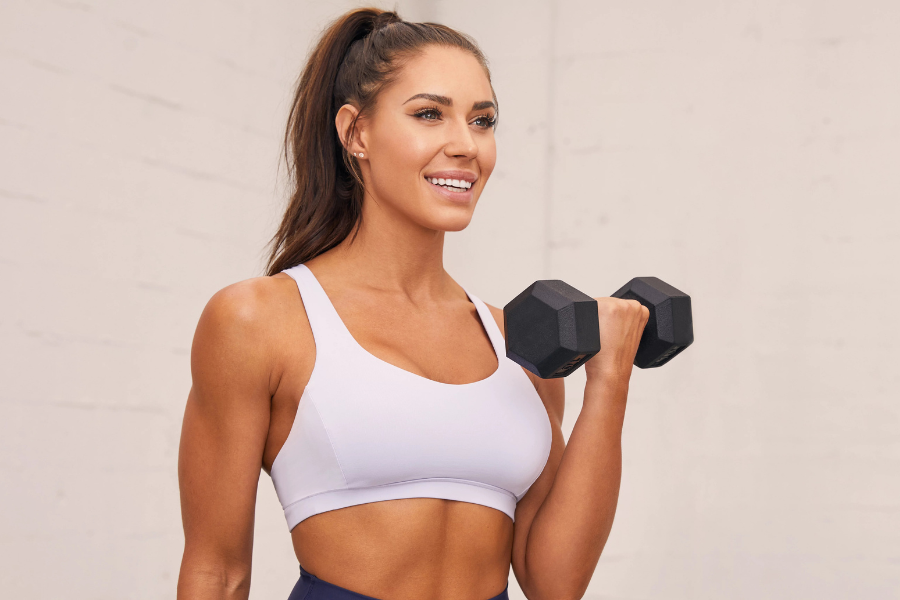
- Stand or sit tall with a dumbbell in each hand, arms down by your sides, palms facing forward.
- Keep your elbows close to your torso and curl the weights up toward your shoulders.
- Squeeze your biceps at the top for a second.
- Lower the weights slowly back to the starting position.
Aim for 3 sets of 10 to 12 reps. Focus on keeping your wrists straight and moving only at the elbow.
2. Hammer curl
The hammer curl shifts the emphasis slightly to the long head of the biceps and also works the brachialis and brachioradialis, which helps your arms look stronger overall.
How to do it:
- Hold dumbbells at your sides with your palms facing each other, like you are holding hammers.
- Curl both weights up while keeping your elbows tucked in.
- Pause briefly at the top.
- Lower with control.
Try 3 sets of 8 to 12 reps. If regular curls bother your wrists, hammer curls often feel more comfortable.
3. Tempo curl
Changing the speed of each rep increases time under tension, which can be a powerful growth stimulus.
How to do it:
- Use a lighter weight than usual.
- Curl up for a count of one or two seconds.
- Lower for a slow count of three or four seconds.
- Keep your core tight and avoid swinging your hips.
Do 2 or 3 sets of 8 to 10 reps. This variation is especially useful if you do not have heavier dumbbells at home.
4. Isometric biceps hold
Isometric work teaches your muscles to stay strong in one fixed position and builds a deep burn without many reps.
How to do it:
- Curl the dumbbells halfway up so your elbows are bent at a 90 degree angle.
- Hold this position, keeping your shoulders relaxed and your elbows by your sides.
- Aim for 20 to 30 seconds per hold.
Repeat 2 or 3 times. You can pair this with regular curls to really pack a punch into a short workout.
Best mass building bicep moves
If your priority is adding noticeable size, you will want a few heavier, more focused moves. Gymshark’s 2024 guide highlights several that are especially effective for women building mass.
1. Concentration curl
This is excellent for targeting the short head and building a strong mind muscle connection.
How to do it:
- Sit on a bench with your feet apart, a dumbbell in one hand.
- Rest the back of that upper arm against your inner thigh, letting the dumbbell hang toward the floor.
- Curl the weight up toward your shoulder, keeping your upper arm fixed.
- Lower slowly until your elbow is nearly straight.
Work for 3 sets of 8 to 12 reps per arm. Think about squeezing your biceps from the bottom of the movement all the way to the top.
2. EZ bar or barbell curl
Using a bar lets you handle more total weight, which is helpful for building mass in both bicep heads.
How to do it:
- Stand with feet hip width apart, gripping the bar with palms facing up.
- Keep your elbows just in front of your body.
- Curl the bar up to shoulder level, pause briefly.
- Lower under control for about three to four seconds.
Jeff Cavaliere of Athlean X emphasizes that slower eccentrics, or lowering phases, on heavy curls can be more effective for muscle gain than focusing only on stretch based moves. Aim for 3 sets of 8 to 10 heavier reps.
3. Preacher curl
The preacher curl locks your arm in place and emphasizes the short head for front arm fullness.
How to do it:
- Sit at a preacher bench, resting your upper arms on the pad.
- Hold a dumbbell or EZ bar with palms facing up.
- Curl the weight toward your shoulders.
- Lower until your elbows are nearly straight, without hyperextending.
Try 3 sets of 10 to 12 reps. This move is also useful for correcting left right strength imbalances when done one arm at a time.
4. Chin up
Chin ups are advanced, but they train your biceps along with your back, shoulders, and grip.
How to do it:
- Grab a pull up bar with your palms facing you and hands about shoulder width apart.
- Start from a dead hang with arms straight.
- Pull your chest toward the bar, driving your elbows down and back.
- Lower yourself back to the starting position with control.
If a full bodyweight chin up is not possible yet, use a resistance band for assistance or a machine that offsets some of your weight. Aim for 3 sets of as many quality reps as you can manage.
At home bicep workouts with little or no equipment
You can still train your biceps effectively without a gym membership. Many everyday items work as makeshift weights, and bodyweight moves add extra stimulus.
Simple at home options
You can use:
- Backpack curls, fill a backpack with books and curl it like a dumbbell.
- Water bottle or milk jug curls, using a secure grip on the handle.
- Resistance band curls and hammer curls, varying the grip to hit different angles.
- Shoulder tap pushups and plank shoulder taps, which engage biceps while training your chest, triceps, and core.
Monkey bars at a playground, rows with a resistance band looped around a sturdy object, and assisted chin ups are all excellent ways to build functional pulling strength along with your biceps.
Common form mistakes to avoid
Good technique matters more than the exact weight you are lifting. A few key tips will help you get the most from each set while protecting your joints.
Keep an eye out for these mistakes:
- Using momentum, swinging your hips or throwing your shoulders back to move the weight.
- Cutting the range of motion short, not fully extending or fully bending at the elbow.
- Letting your wrists collapse, which shifts tension away from the biceps.
- Training only with straight bars, which can hide left right imbalances.
Focus on strict elbow flexion and a complete range of motion each rep. Control both the lifting and lowering phases for one or two seconds each. If you feel the movement more in your shoulders than in the front of your upper arm, the weight is probably too heavy or your form has drifted.
Sample 15 minute bicep workout for women
Here is a quick routine you can try two or three times per week. You only need a pair of dumbbells.
- Supinated biceps curl
- 3 sets of 10 to 12 reps
- Hammer curl
- 3 sets of 8 to 10 reps
- Concentration curl
- 3 sets of 8 to 10 reps per arm
- Isometric biceps hold
- 2 sets of 20 to 30 seconds
Rest 45 to 60 seconds between sets. If you finish and feel like you could easily repeat everything again, increase your weights slightly next time.
What kind of results you can expect
If you are new to strength training, you may notice improvements in biceps strength within one to two weeks, according to trainers interviewed by Women’s Health. Visible changes in size and definition usually take a bit longer, but consistency pays off.
Novice lifters tend to gain strength more quickly, while intermediate and advanced lifters may need to pay closer attention to workout intensity, exercise variety, and nutrition. Regardless of your starting point, prioritizing good form, steady progression, and adequate recovery will help you build stronger, more powerful arms that support everything else you do.
Start with just two exercises from this guide in your next workout. Once those feel comfortable, add a third, increase the weight, or slow the tempo. Small, consistent upgrades are what turn a simple routine into real, lasting strength.