A good calf workout does more than build definition. The right calf workouts help you walk, run, and jump with less effort, support your knees and ankles, and reduce that heavy, tired-leg feeling at the end of the day. With a mix of strength moves, plyometrics, and smart programming, you can turn weak, tight calves into a real asset.
Below, you will find exactly how your calf muscles work, common training mistakes, and simple routines you can follow at home or in the gym.
Understand your calf muscles
Before you load up on calf raises, it helps to know what you are actually training. Your calves are not just one muscle. They are a team that needs slightly different approaches.
Gastrocnemius and soleus
The calf muscle group mainly includes:
- Gastrocnemius
- Soleus
The gastrocnemius is the larger, more visible part of your calf. It crosses both your knee and ankle joints and helps flex your knee and point your toes when your leg is straight. The soleus sits underneath. It works hardest when your knee is bent and plays a major role in keeping your lower leg and ankle stable while you stand, walk, or run.
Both muscles drive plantar flexion, the motion you use every time you push off the ground to walk, run, or jump. If you only train one part, you leave strength and stability on the table.
Why your calves feel weak or tired
If your calves often feel heavy, tight, or weak, it usually comes down to a few issues:
- You walk a lot, but rarely train your calves with real resistance.
- You do a few fast, short calf raises at the end of leg day and call it good.
- You only use one rep range or one exercise.
Your calves are used to thousands of easy, low-intensity steps each day. To get stronger or bigger, they need something different: higher loads, longer ranges of motion, and varied rep schemes that challenge both slow and fast twitch fibers.
Why calf workouts matter
Strong, well trained calves impact more than how your legs look in shorts. Good calf workouts pay off across your entire lower body.
Better performance and power
Your calves are heavily involved in the toe off phase of walking and running. When you push the ground away, they help you accelerate, sprint, and change direction. Stronger calves increase muscular output and explosiveness, which can improve running pace and stride length while reducing injury risk.
If you play sports, jump, or sprint, focused calf training makes your movements feel snappier and more controlled.
Joint stability and injury prevention
Calf raises strengthen both the gastrocnemius and soleus, plus the tendons and ligaments around your ankles. This added support improves ankle stability and balance and can lower the risk of common issues like ankle sprains and Achilles tendon problems.
Sports rehab specialists also point out that weak calves often show up in people with recurring Achilles pain. On the Coach Em Up podcast, David Grey highlighted that many athletes neglect calf raises, which leads to weak calves and repeat Achilles issues. Consistent, focused calf work is one of the simplest ways to protect this area over time.
Everyday benefits you notice
Stronger calves help you:
- Climb stairs without burning out halfway
- Walk longer without lower leg fatigue
- Stand for work with less discomfort
- Hike on uneven ground with better balance
Regular calf raises can also improve circulation in your lower legs and may help reduce swelling and discomfort if you sit or stand for long periods.
Common calf training mistakes
If your calves never change despite your effort, you might not need more work. You probably need different work.
Using too little weight
Many people treat calf raises as an afterthought. You might bang out a quick set with light resistance and call it a day. The problem is that your calves are used to low intensity work from walking. To grow, they need load that actually feels heavy.
David Grey notes that one of the biggest mistakes in calf workouts is not lifting enough weight. Without adequate resistance, you will not stimulate muscle growth or real strength gains.
Short, rushed reps
Another common issue is partial reps with no pause or control. Because your calves handle a lot of daily activity, they respond best when you train them through a large range of motion with deliberate tempo.
Performing short range, low intensity reps that mimic your regular steps will not move the needle. Instead, you want full stretches at the bottom and strong contractions at the top, or at least focused work in the bottom half where most strength is built.
Too much variety, not enough focus
Constantly changing calf exercises can look productive, but it can also stop you from making progress. Grey suggests limiting excessive exercise variety and emphasizing standing calf raises as a primary builder.
That does not mean you never use seated or bent knee variations. It just means you pick a few key moves and stick with them long enough to add weight and track improvement.
Essential calf exercises to know
You do not need fancy machines to build solid calves, but using a mix of straight leg and bent knee exercises is important so you train both the gastrocnemius and soleus effectively.
Standing calf raises
Standing calf raises are the foundation of most good calf workouts. You can do them on a machine, with a barbell, holding dumbbells, or simply using your bodyweight on a step.
Focus on:
- A strong push through the ball of your foot
- Controlled lowering into a stretch
- Staying upright without bouncing
These primarily focus on the gastrocnemius since your leg is straight.
Seated and bent knee calf raises
When you bend your knee, you shift more work to the soleus. Seated calf raises or bent knee calf raises are ideal for this. Keeping a partial bend in your knee helps the soleus do more of the lifting so you achieve more balanced calf development.
Single leg variations
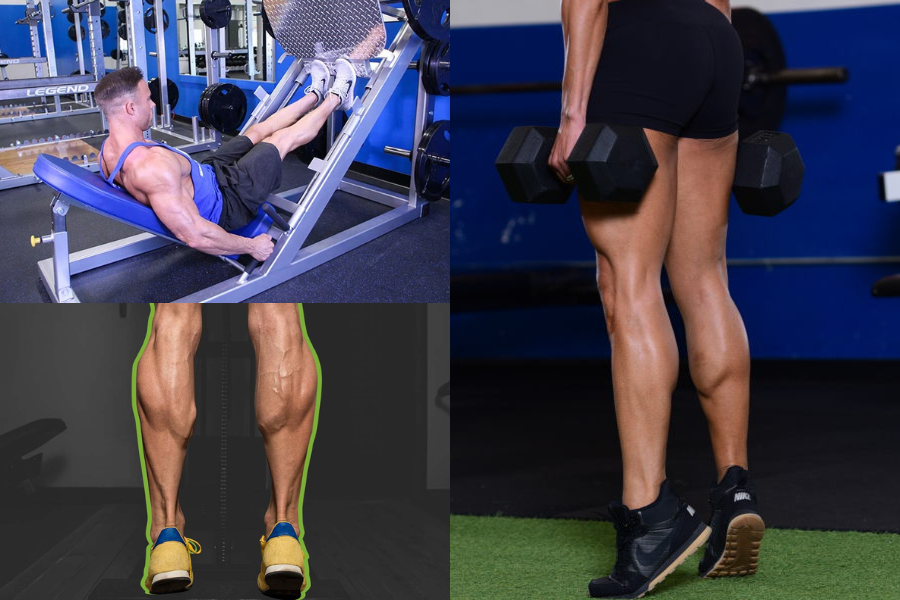
Single leg calf raises, either standing or using a leg press, challenge your balance and can help fix left to right strength imbalances. Fitness experts Ebenezer Samuel and Don Saladino recommend single leg calf raises on the leg press for 3 sets of 12 to 20 reps as part of a solid calf routine.
Plyometric and jumping work
Plyometric moves like box jumps, jump squats, and single leg hops complement traditional strength training. They teach your calves to produce force quickly, which is great for sports and overall athleticism. Research also shows that these explosive exercises can positively affect calf hypertrophy and strength when used alongside resistance work.
A simple gym based calf workout
If you have access to a gym, you can combine machine and free weight movements for a complete session. Adjust the loads so the last few reps of each set feel challenging while still controlled.
- Standing calf raise machine
- 3 to 4 sets of 10 to 15 reps
- Emphasize a strong push at the bottom half of the movement.
- Single leg calf raises on the leg press
- 3 sets of 12 to 20 reps per leg
- Keep the motion deliberate, avoid bouncing.
- Seated calf raises
- 3 sets of 8 to 15 reps
- Pause at the bottom stretch and top squeeze.
- Jump rope intervals
- 3 to 4 rounds of 30 seconds on, 30 seconds off
- Stay light on your feet and maintain good posture.
MensHealth highlights a similar structure using these key movements, along with safety squat bar squat raises and high rep standing calf raises, to build stronger, more symmetrical calves.
Aim to train calves like this 2 times per week at first. Over time, you can increase to 3 sessions if you recover well.
An effective at home calf workout
You can still get excellent results at home with minimal equipment. A step, a backpack or dumbbell, and a wall or chair for balance are enough.
Here is a simple routine you can do 2 to 3 times per week:
- Elevated standing calf raises
- 3 sets of 12 to 20 reps
- Stand on a step to increase your range of motion.
- Single leg calf raises
- 3 sets of 10 to 15 reps per leg
- Hold a wall or counter for balance if needed.
- Bent knee wall calf raises
- 3 sets of 12 to 15 reps
- Lean into a wall with your knees slightly bent and lift your heels.
- Jump squats or lunge jumps
- 2 to 3 sets of 8 to 12 reps
- Land softly to protect your joints.
- Calf rock stretch
- 2 sets of 20 to 30 seconds per side
- Rock gently between a stretch and a light contraction to finish.
If you want more variety later, you can rotate in exercises like tiptoe walks, raised heel squats, high knees, or outward and inward calf raises. The key is still the same: progress the load and range of motion over time.
How often to train your calves
You can train calves more frequently than larger muscle groups because they recover relatively quickly, but quality still matters more than just frequency.
- For general strength and health, 2 to 3 sessions per week works well.
- For size and more noticeable growth, 3 to 5 shorter, focused sessions can be effective if you manage fatigue and do not overload your tendons.
The ISSA suggests 4 to 5 sets in the 6 to 12 rep range twice per week for muscle growth, with exercises like standing and seated calf raises, elevated calf raises, and single leg variations. You can mix in higher rep work up to 20 or 25 reps on some days and heavier sets in the 6 to 10 rep range on others. This variety keeps your calves from adapting to one narrow workload.
Programming tips for better results
A few simple tweaks to how you structure your calf workouts can make a big difference.
Think of calf training as you would any other muscle group. Plan it, load it, and track it, instead of just “throwing it in” at the end.
Use different rep ranges
Your gastrocnemius has a nearly even mix of slow and fast twitch fibers. If you always do the same 15 rep sets, it will adapt and stop changing. Rotate between:
- Strength focused sets of 6 to 10 reps
- Moderate sets of 10 to 15 reps
- High rep sets of 20 to 25 reps
This approach challenges your calves in multiple ways and keeps progress moving.
Prioritize progressive overload
To grow, your calves need fresh challenges. You can progress by:
- Adding weight
- Increasing reps with the same weight
- Slowing the tempo on the lowering phase
- Increasing your range of motion on a step or platform
Avoid adding too many new exercises at once. Instead, stick with a few core moves and work on doing them better and heavier over time.
Do not skip recovery
Calves might feel like a “small” muscle group, but they still need recovery. Adequate sleep is important for hormone regulation, protein synthesis, and muscle repair, which supports calf growth and performance.
Also, do not ignore stretching. Gently stretching your calves between sets and after training can improve mobility, enhance the muscle pump, and support recovery, which may help growth over the long term.
When to take it easy or see a professional
Soreness after a new calf workout is normal. Sharp pain, swelling, or difficulty bearing weight is not. Calf muscle pain often comes from strains during running or jumping without a proper warm up, or from simple overuse. If you notice severe pain or persistent swelling, it is wise to rest and consult a medical professional rather than push through.
Pay extra attention to your Achilles tendon. Gradual tightness, thickening, or sharp pain in this area is a sign to back off high impact work and seek advice before it turns into a serious injury.
Key takeaways
- Your calves are more than one muscle, and both the gastrocnemius and soleus need targeted work.
- Effective calf workouts use enough weight, full or purposeful range of motion, and a mix of straight leg and bent knee exercises.
- Plyometric moves like jump rope or jump squats add power and can complement your strength training.
- Training calves 2 to 3 times per week is enough for strength, while higher frequency can support growth if you recover well.
- Progress the load and rep ranges gradually, stretch consistently, and protect your Achilles by paying attention to pain signals.
Start by picking one gym routine or the at home plan and follow it for 4 to 6 weeks. Take notes on your weights and reps, and you will likely notice not just better looking calves, but stronger, more energetic legs overall.