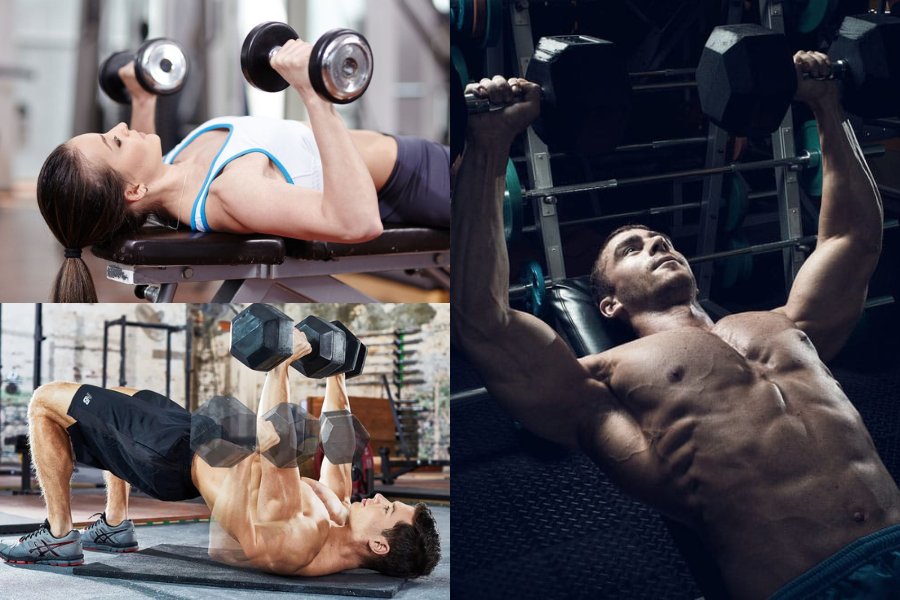
A chest workout with dumbbells is one of the simplest ways to build strength and muscle without needing a full gym setup. With the right exercises and structure, you can train effectively at home or in a busy gym, using only a bench and a pair of dumbbells.
Below, you will find a complete dumbbell chest workout plan, plus tips to get the most from every rep.
Why train your chest with dumbbells
When you train your chest with dumbbells instead of a barbell or machine, you gain several advantages that help you build a stronger, more balanced upper body.
Dumbbells allow each arm to work independently, which helps correct left and right strength imbalances that can be hidden during barbell presses. They also give you a larger range of motion because your hands can move freely instead of being locked on a bar. This deeper stretch increases tension on your chest muscles and can encourage more growth, as highlighted in a 2024 guide on dumbbell chest training.
Because dumbbells are less fixed than machines, your stabilizing muscles have to work harder to control the weight. That means more engagement through your shoulders, triceps, and core, and better overall functional strength in everyday movements.
Know your chest muscles first
Understanding what you are training makes it easier to pick smart exercises and feel the right muscles working.
Your chest is not a single flat muscle. It includes three key muscle groups:
- Pectoralis major: the large, fan-shaped muscle across your chest that is mainly responsible for pushing and bringing your arms toward the midline of your body.
- Pectoralis minor: a smaller muscle underneath the pec major that helps stabilize your shoulder blade.
- Serratus anterior: a muscle along your rib cage that helps rotate and stabilize your shoulder blade when you lift your arm overhead.
No single move hits every part of the chest equally. You need a mix of flat, incline, and fly type exercises to target the upper, middle, and lower portions effectively. This is why a well-rounded chest workout with dumbbells includes both pressing and fly variations, at different bench angles.
Key benefits of a dumbbell chest workout
A focused dumbbell chest routine does more than just build a bigger chest. It improves balance, control, and joint health.
Some of the biggest benefits include:
-
Greater range of motion
Compared with barbells and many machines, dumbbells let your wrists rotate and your elbows move in a more natural path. This takes stress off your joints and puts more tension where you want it, in the pec muscles. -
Better unilateral strength and symmetry
Because each hand moves its own weight, your stronger side cannot secretly carry the load. Over time, this reduces asymmetries and helps your chest look and perform more evenly. -
Improved stability and core engagement
Balancing two separate weights forces your shoulder stabilizers and core to work harder. This extra demand can improve coordination, balance, and overall functional strength in daily life. -
Accessibility and convenience
Dumbbells are available in almost every gym, and adjustable sets are easy to keep at home or take on the road. That makes it much easier to stay consistent with your chest training.
Technique tips for better chest activation
Good technique is what turns a basic chest workout with dumbbells into a highly effective one. Small changes in arm path and body position can dramatically change which muscles do the work.
Here are a few form cues to keep in mind, especially for pressing movements like the dumbbell bench press:
-
Align your arm path with chest fibers
If you flare your elbows straight out to the side, you shift the load toward your front delts instead of your chest. Research on the dumbbell bench press suggests you should move the dumbbells slightly forward toward your lower chest on the way down and slightly back toward your upper chest on the way up. This keeps your arm path in line with your chest fibers for better activation. -
Keep forearms vertical over your elbows
Letting your forearms tip inward shortens the lever and sends more work to your triceps. Keeping your forearms stacked directly over your elbows throughout each rep maintains tension where you want it, in the chest, and avoids cutting the stimulus in half. -
Set your shoulders, do not round forward
Rounding your shoulders at the top of a press hands the work to your front shoulders. Before you start your set, gently pinch your shoulder blades together and down into the bench. Keep this position as you press to open your chest and protect your shoulders. -
Pick the right bench angle
A slight incline of about 15 to 30 degrees can more than double upper chest growth compared with a flat bench, while a slight decline shifts more work to the lower chest. Higher inclines over 30 degrees tend to push too much work onto the shoulders and away from the chest.
The core of your dumbbell chest workout
Below are the main exercises that will form the base of your routine. You do not need to use all of them in a single session, but you will combine a few to cover your chest from multiple angles.
Dumbbell bench press
The dumbbell bench press is often considered one of the best all around chest exercises. It lets you lift heavy, use a full range of motion, and keep your joints in a comfortable path.
- Sets and reps: 3 to 4 sets of 6 to 8 reps
- Focus: Push the dumbbells up in a controlled arc, squeeze your chest at the top, and avoid touching them together if that makes you lose tension.
Dumbbell incline press
The incline dumbbell press emphasizes the upper chest by changing the angle of pull. This helps you build the “upper shelf” look and more complete development.
- Bench angle: 15 to 30 degrees
- Sets and reps: 3 to 4 sets of 8 to 10 reps
- Focus: Keep your shoulder blades pinned, lower the dumbbells to around upper chest level, and avoid turning the move into a shoulder press by going too steep.
Dumbbell chest fly
The dumbbell chest fly targets chest adduction, or the motion of bringing your arms toward the middle. This is a different function than pressing and helps you hit fibers that are less stressed by heavy presses.
- Sets and reps: 3 sets of 10 to 12 reps
- Focus: Maintain a slight bend in your elbows, open your arms wide until you feel a deep stretch across your chest, then bring the dumbbells together by squeezing your chest, not your biceps.
Half bench single arm dumbbell press
This variation has you lie so only your upper back and shoulders are on the bench, with your hips off and glutes squeezed. You press with one arm at a time.
- Sets and reps: 3 sets of 10 to 12 reps per side
- Focus: Brace your abs and glutes hard to keep your torso level. This move challenges your chest and triceps while heavily engaging your core to prevent rotation.
Dumbbell floor press
The floor press is useful if you have wrist or elbow issues or no bench. The floor limits your range of motion slightly, which can be more joint friendly while still targeting your chest and triceps.
- Sets and reps: 3 sets of 8 to 12 reps
- Focus: Lie on your back with knees bent, elbows resting on the floor to start. Press until your arms are straight, pause, then lower until your triceps gently touch the floor again.
Tip: No matter which press you choose, think about “driving the dumbbells away by squeezing your chest” rather than simply pushing with your arms. This mental cue can improve engagement and results.
Sample dumbbell chest workouts by level
You can adjust the same core moves to suit your experience and current strength. Below are three sample workouts so you can plug in and start training right away.
Beginner chest workout with dumbbells
If you are new to strength training or returning after a long break, start with fewer exercises and keep your focus on form and control.
-
Dumbbell bench press
3 sets of 8 to 10 reps, rest 60 to 90 seconds -
Dumbbell chest fly
3 sets of 10 to 12 reps, rest 60 to 90 seconds -
Push ups
2 sets to technical failure, rest as needed
Use incline or knee push ups if full push ups are not yet comfortable.
Aim to perform this workout twice per week. When the last few reps of each set begin to feel easy, increase the weight slightly or add 1 to 2 reps per set.
Intermediate dumbbell chest workout
If you already lift regularly, you can use supersets to increase intensity and cut down training time. A superset means you do two exercises back to back with little or no rest in between.
- Superset A
- Dumbbell bench press, 3 sets of 6 to 8 reps
- Dumbbell chest fly, 3 sets of 10 to 12 reps
Rest 60 seconds after each superset
- Superset B
- Incline dumbbell press, 3 sets of 8 to 10 reps
- Push ups, 3 sets to near failure
Rest 60 seconds after each superset
As you progress week to week, either add weight to your presses, add a rep or two per set, or add an extra set for one of the key moves.
Advanced dumbbell chest workout with burnout finisher
If you are more experienced and want to push your chest close to its limits, you can combine supersets with a high rep bodyweight finisher to flood the muscles with tension.
- Superset A
- Dumbbell bench press, 4 sets of 6 to 8 reps
- Dumbbell chest fly, 4 sets of 10 to 12 reps
Rest 45 to 60 seconds after each superset
- Superset B
- Incline dumbbell press, 3 sets of 8 to 10 reps
- Half bench single arm dumbbell press, 3 sets of 10 reps per side
Rest 45 to 60 seconds after each superset
- Five minute bodyweight burnout
Set a timer for five minutes and cycle through push up variations without resting. You can start with standard push ups and switch to incline or knee push ups if you approach failure. This extended effort is designed to fully exhaust your chest and encourage hypertrophy.
This type of session will feel demanding, so keep an eye on your recovery and limit it to once per week, paired with a lighter chest day later in the week if you want to train chest twice.
How often to train and how to progress
To see noticeable changes from a chest workout with dumbbells, consistency and gradual progression matter more than any single exercise choice.
Most people do well training their chest with dumbbells twice per week, with at least one rest day between sessions. If progress stalls after several weeks, you can consider moving to three sessions per week by shortening each workout slightly.
Good ways to progress from week to week include:
- Performing more reps with the same weight
- Adding a small amount of weight while keeping reps the same
- Adding an extra set for one main exercise
With steady training, it is realistic to feel performance improvements after about 3 to 4 weeks, and to start seeing visible changes in chest size and shape after roughly 8 to 12 weeks, assuming your nutrition and sleep support muscle growth.
Safety pointers and form reminders
To keep your joints healthy and your results moving in the right direction, pay attention to these details in every chest session:
- Warm up your shoulders and elbows with light dynamic movements and a light first set.
- Choose weights that let you control the full range, without bouncing or arching excessively.
- Keep your wrists neutral, not bent backward, to avoid unnecessary strain.
- Engage your abs and glutes to stabilize your body, especially in single arm or half bench variations.
- If you feel pain in your shoulders rather than muscular effort in your chest, adjust your elbow angle or bench position.
Building a stronger chest with dumbbells does not require complicated routines. Start with 2 to 4 of the exercises above, focus on solid form and progressive overload, and give yourself time. With a consistent plan and thoughtful technique, your chest will grow stronger, more defined, and more balanced week after week.