A pair of dumbbells and a little know-how are all you need to build stronger, more defined arms. With the right dumbbell bicep exercises, you can target every part of the muscle, correct imbalances, and safely progress over time, whether you train at home or in the gym.
Below, you will learn how to perform key bicep moves with proper form, plus how to put them together into an effective workout for your goals.
Understand your biceps and why dumbbells help
Your biceps brachii has two heads: a long head that runs along the outside of your arm and a short head on the inside. Together, they bend your elbow and rotate your forearm so your palm faces up. Supporting muscles like the brachialis and brachioradialis also contribute to arm size and strength.
Dumbbells are ideal for training this area because each arm works independently. That unilateral setup helps you fix strength differences from side to side and follow a more natural range of motion that is easier on your wrists than many barbell variations. According to a 2024 guide from American Sport & Fitness, dumbbell curls effectively isolate the biceps while also engaging the brachialis and brachioradialis for upper arm definition.
Key form tips for all dumbbell bicep exercises
Before you add weight or advanced variations, lock in your technique. Good form makes every rep more effective and lowers your risk of injury.
Keep these basics in mind for most dumbbell bicep curls:
- Stand or sit tall with a neutral spine and tight core.
- Keep your elbows close to your torso until the very top of the curl.
- Lift and lower the weight with a smooth, controlled motion, not momentum.
- Keep your wrists straight and firm instead of letting them bend back.
Edward R. Laskowski, M.D., at Mayo Clinic notes that you should avoid swinging your arm or elbow during dumbbell biceps curls and focus on smooth, controlled repetitions for the best results.
You will use these same principles across almost all of the dumbbell bicep exercises below.
Classic standing dumbbell bicep curl
The standing dumbbell curl is often the first move you learn, and for good reason. It hits both heads of the biceps, lets you use a solid amount of weight, and carries over well to other variations.
How to do it
- Stand with your feet about hip width apart, dumbbells at your sides, palms facing forward.
- Brace your core and keep your shoulders relaxed.
- Curl the dumbbells up by bending at the elbows only, keeping your elbows near your torso.
- As you lift, keep your forearms supinated so your palms stay facing up.
- Bring the dumbbells toward shoulder height, squeeze your biceps at the top, then slowly lower back to the starting position.
Research from American Sport & Fitness recommends 4 sets of 12 to 15 controlled reps to build strong and defined biceps, emphasizing slow movement to isolate the muscle.
Tempo and tension tweaks
Jeff Cavaliere of Athlean-X suggests using a slow rep tempo of around four seconds up and four seconds down to maximize biceps activation and reduce injury risk. Slowing down like this increases time under tension so your muscles have to work harder even with moderate weight.
You can also increase tension by gripping the dumbbell a bit closer to one bell with your thumb and index finger. This creates a seesaw effect that makes forearm twisting more challenging and can heighten biceps contraction in the top half of the rep.
Alternating curls and iso-hold variations
Once you are comfortable with the basic standing curl, alternating curls and iso-holds let you keep tension high without needing heavier weights.
Alternating bicep curl
Instead of curling both arms at once, you curl one dumbbell while the other stays at your side. This slightly reduces overall fatigue and lets you focus on one arm at a time, which can be helpful if one side lags behind.
Alternate arms for your chosen number of reps, making sure both sides match in effort and form.
Alternating curl with iso-hold
To make things more challenging, try an iso-hold variation:
- Curl one dumbbell up and hold it near shoulder height.
- While keeping that arm in place, perform a full set of curls with the opposite arm.
- Switch sides and repeat.
This keeps one bicep under constant tension while the other is working through a full range of motion, which can increase muscle engagement and metabolic stress.
Hammer curls for overall arm thickness
Hammer curls look similar to standard curls, except your palms face each other in a neutral grip. This simple change recruits more of the brachialis and brachioradialis, the muscles that add thickness to your upper arm and support grip strength.
How to do hammer curls
- Stand or sit tall with a dumbbell in each hand, palms facing each other.
- Keep your elbows close to your sides and shoulders relaxed.
- Curl the dumbbells up, keeping the neutral grip the entire time.
- Pause at the top, then lower slowly under control.
Unlike mixing a hammer curl halfway through a traditional curl, which can skip the hardest part of the movement and reduce biceps activation, you keep a neutral grip from start to finish here so the right muscles stay targeted.
Hammer curls are typically performed for 3 sets of 8 to 12 reps. According to a 2024 American Sport & Fitness article, this variation is especially effective for improving grip strength and the long head of the biceps, which helps activities like rock climbing and tennis.
Concentration curls for peak and mind-muscle connection
If you want to really feel your biceps work, concentration curls are a strong choice. This variation limits help from your shoulders and torso, so the biceps do almost all of the lifting.
How to do concentration curls
- Sit on a bench with your feet flat. Hold a dumbbell in one hand.
- Lean forward slightly and rest the back of your upper arm against the inside of your thigh, just above the knee.
- Let the dumbbell hang toward the floor with your palm facing up.
- Curl the dumbbell toward your shoulder, focusing on squeezing the biceps.
- Pause briefly at the top, then lower with control.
Because the arm is braced, you cannot cheat easily. That makes it easier to build a strong mind-muscle connection, especially with the short head of the biceps that contributes to the peak. These are usually done with lighter weight for 3 sets of 8 to 12 reps.
Incline curls and preacher curls for a deep stretch
Stretching the biceps under load is another powerful way to stimulate growth, especially in the long head.
Incline dumbbell curl
For incline curls, you lie back on an incline bench with dumbbells in your hands and arms hanging straight down. This position places the biceps in a stretched position at the bottom of the rep.
Because your shoulders and torso cannot help you as much, you will likely need to use lighter weights. Focus on slow, strict form and feel the stretch at the bottom before curling up and squeezing at the top.
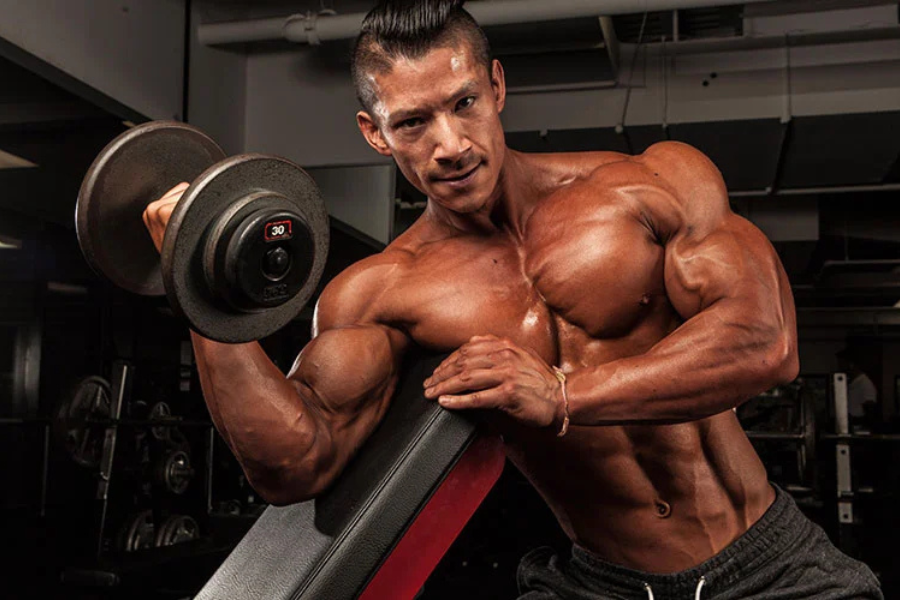
Dumbbell preacher curl
If you have access to a preacher bench, you can perform preacher curls with dumbbells instead of an EZ bar. According to the 2024 American Sport & Fitness summary, this setup often feels easier on the wrists and elbows and still isolates the biceps very effectively.
You rest the back of your upper arm on the angled pad, let the dumbbell lower until your arm is almost straight, then curl it back up. This fixed arm position reduces cheating and keeps stress squarely on the biceps.
Wall curls and strict form builders
Strict wall curls help you clean up your technique and keep your lower back safe when weights start to feel heavy.
To do a strict wall curl:
- Stand with your back, shoulders, and head against a wall.
- Press the backs of your upper arms lightly into the wall.
- With dumbbells in your hands, curl only at the elbows, keeping everything else still.
This variation prevents you from swinging or leaning back. It can feel harder than standard curls with the same weight, which is a sign that more of the load is actually going to your biceps instead of your hips or lower back.
Advanced intensity techniques for experienced lifters
Once you have several months of consistent training and solid form, you can use more advanced methods occasionally to push past plateaus. These should be reserved for experienced lifters, not beginners.
Purgatory reps
Purgatory reps alternate between partial curls and isometric holds. For example, you might:
- Hold one dumbbell midway through the range of motion
- Perform a few full curls with the other arm
- Switch roles and repeat
Cavaliere recommends this style to keep the muscles under tension for longer, which can be helpful for hypertrophy when used sparingly.
Mechanical drop sets
Mechanical drop sets mix several curl angles in one extended set without changing the weight. You might move from strict wall curls to standing curls, then to slight cheat curls at the end, all with the same dumbbells. The idea is to start with the most demanding version and gradually allow a bit more body English as you fatigue so you can keep going.
This type of set quickly ramps up fatigue, so keep it occasional, for example one set at the end of a workout.
Cheat reps and safety
Cheat reps involve using momentum to get a heavier weight up, then focusing on controlling the negative. The eccentric phase is where much of the muscle damage and growth stimulus happens, so advanced lifters sometimes use this method for extra overload.
However, this approach is not recommended for beginners because poor control, especially when you lean back or lose core tension, can shift stress to your lower back. If you try cheat reps later on, keep them very limited and stop if your form breaks down.
Sample dumbbell bicep workouts for every level
Use these templates as a starting point, then adjust weights and volume based on how you recover.
Beginner routine
Focus on mastering movement patterns and building a base.
- Standing dumbbell curls: 3 sets of 10 to 12 reps
- Concentration curls or preacher curls: 3 sets of 8 to 10 reps
Pick weights that you can lift about 10 times with good form and that make the last 2 or 3 reps challenging. As Mayo Clinic notes, one well performed set of 12 to 15 reps can be enough for many people, so you do not need a huge number of sets when you are starting out.
Intermediate routine
Add more volume and variety once your technique is consistent.
- Standing dumbbell curls: 3 to 4 sets of 8 to 12 reps
- Hammer curls: 3 sets of 8 to 12 reps
- Concentration curls: 2 to 3 sets of 10 to 12 reps
You can alternate between barbells and dumbbells in your overall program to prevent imbalances. Cavaliere suggests that dumbbells are particularly useful here because they lower core stability demands and let you work one arm at a time with heavier loads if needed.
Advanced routine
Include stretch-focused work and occasional intensity techniques.
- Incline dumbbell curls: 3 sets of 8 to 10 reps
- Standing curls or wall curls: 3 sets of 8 to 12 reps
- Hammer curls: 3 sets of 8 to 12 reps
- Optional finisher: 1 mechanical drop set or purgatory set
You do not need to train biceps every day. Two sessions per week, with at least one rest day in between, is usually plenty for growth when you push near failure on most sets.
Simple rule of thumb: if you cannot control the weight on the way down, it is too heavy for the goal of sculpting defined, healthy arms.
Common mistakes to avoid
A few habits can quietly limit your progress or put stress on the wrong joints:
- Swinging the dumbbells and using your hips or shoulders to start the rep.
- Letting your elbows drift far in front of or behind your torso.
- Rushing through reps instead of using a controlled tempo.
- Mixing grips mid-rep, for example turning a traditional curl into a hammer curl halfway up.
- Leaning back excessively during heavy curls, which shifts load to your lower back.
By keeping your core tight, elbows close, and wrists firm, you will feel the work where you want it: in your biceps.
Putting it all together
When you structure your workouts around smart, well performed dumbbell bicep exercises, you do not need a lot of fancy machines to see results. Start by nailing the basics like standing curls and hammer curls, then layer in concentration, incline, or preacher variations to hit different parts of the muscle.
Progress your weight or reps gradually from week to week, keep your tempo controlled, and listen to your joints. Over time, those simple habits add up to stronger, more sculpted arms that look and feel the way you want.