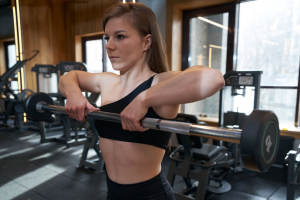
A full body fat loss workout helps you burn more calories in less time by training your entire body in one session. By combining strength work with cardio, you raise your heart rate, build muscle, and create an “afterburn” effect that keeps your metabolism elevated even after you leave the gym. If your goal is to lose fat efficiently and feel stronger overall, shifting to full body training can make a real difference.
Below, you will find how full body fat loss workouts work, exactly what to do in a session, and how to build a weekly plan that fits your schedule and fitness level.
Understand why full body fat loss workouts work
When you move multiple large muscle groups in the same workout, your body needs more energy. That higher energy demand is what makes a full body fat loss workout so effective.
You burn calories during the session itself, but the benefits continue afterward. Compound exercises like deadlifts, pull ups, kettlebell swings, and squats require significant effort from your muscles and nervous system. This leads to excess post exercise oxygen consumption, often called the afterburn effect, where your body continues to use more energy as it recovers.
Strength training is equally important. Muscle tissue burns more calories at rest than fat. When you add or maintain lean muscle through full body workouts, you gently raise your resting metabolic rate, which helps you burn more calories all day long, not just during your gym time.
Balance cardio and strength for best results
For fat loss, you want both cardiovascular exercise and resistance training in each full body session. Cardio helps increase your total calorie burn. Strength training helps you keep and build muscle. Together, they create the conditions your body needs to use stored fat for fuel.
A practical structure for a full body fat loss workout is:
- Short warm up
- Strength circuits that hit upper body, lower body, and core
- Short bursts of cardio between or after strength sets
This style of training keeps your heart rate elevated in the 60 to 90 percent of max range, which is roughly 220 minus your age, as recommended by ACE certified trainer Cat Kom for effective fat burning (2024).
You can also weave cardio directly into your strength routine. Moves like mountain climbers, burpees, jumping jacks, or walking or jogging with light weights raise your heart rate while engaging several muscle groups at once. This approach helps you burn more calories in the same amount of time and keeps your workout engaging.
Use high intensity intervals for maximum calorie burn
A full body fat loss workout does not have to be long to be effective. What matters is the quality and intensity of your work. High intensity intervals use short, demanding efforts followed by brief rest periods. This style of training is especially helpful for fat loss because it pushes your heart rate up quickly and keeps it elevated.
One research backed structure is a 6 step fat burning circuit where you perform exercises for 30 seconds back to back, then rest 30 to 60 seconds between rounds. Key moves include:
- Jumping jacks
- Burpees
- Squat jumps
- Skater jumps
- Plank jacks
- High knees
This style keeps your heart rate elevated and can significantly increase your energy expenditure (2024). If you are newer to exercise, you can shorten the work intervals, lengthen the rest periods, or choose lower impact versions like step jacks instead of jumping jacks.
Simple 6 move conditioning finisher
You can plug this into the end of any full body session:
- Jumping jacks, 30 seconds
- Squat jumps, 30 seconds
- Skater jumps, 30 seconds
- Plank jacks, 30 seconds
- High knees, 30 seconds
- Burpees or squat thrusts, 30 seconds
Rest 30 to 60 seconds, then repeat 2 to 4 times, depending on your fitness level. To increase intensity, hold light dumbbells of 1 to 3 pounds during jumping jacks to add resistance and further boost calorie burn (2024).
Choose exercises that hit your whole body
For a full body fat loss workout, you want movements that recruit as many muscles as possible. This approach increases calorie burn during the session and helps you build functional strength.
Some effective full body fat loss exercises include:
-
Burpees, 10 to 12 reps
These require no equipment and combine a squat, plank, and optional jump. They are excellent for raising your heart rate quickly when done intensely after a proper warm up. Beginners can use squat thrusts, which skip the jump, to lower impact and joint stress (2024). -
Mountain climbers, 10 to 12 reps per side
From a plank position, you drive your knees toward your chest. This move challenges your arms, back, core, and legs while also improving balance and agility. It is a simple way to add cardio into your strength routine and supports overall cardiovascular fitness (2024). -
Dumbbell squat presses, 10 to 12 reps
You perform a squat and then press dumbbells overhead as you stand. This combination targets your quadriceps, glutes, and hamstrings, and also involves your shoulders and core. It can be adapted to different skill levels by changing weight and depth (2024). -
Kettlebell swings, 10 to 12 reps
Swings use your hips, legs, core, back, and shoulders in a powerful movement. Research shows they can burn up to 400 calories in 20 minutes, which makes them a fast and efficient option for fat loss workouts (2024).
These compound movements can be organized in circuits, supersets, or complexes so that you move quickly from one to another with limited rest, which keeps your heart rate up and maximizes energy expenditure.
Sample beginner full body fat loss workout
If you are newer to exercise, you can start with bodyweight focused training. This helps you build strength and coordination without equipment or complex techniques.
Warm up for 5 minutes with light cardio, such as walking or easy marching in place, then perform:
- Squats or chair squats, 10 to 12 reps
- Incline push ups on a wall or counter, 8 to 10 reps
- Glute bridges, 10 to 12 reps
- Standing band or bodyweight rows using a sturdy support, 8 to 10 reps
- Dead bugs or basic crunches, 10 to 12 reps
Move through each exercise with 30 to 45 seconds of rest between them. Once you finish all 5, rest 1 to 2 minutes, then repeat for 2 to 3 total rounds. Finish with 3 to 5 minutes of easy walking.
PureGym suggests that beginners do 2 to 3 days of cardio and 2 to 3 days of strength training per week, leaving 2 days for rest and recovery to support steady fat loss and avoid burnout (June 2024 guidelines).
Move to intermediate and advanced workouts
As you get stronger, you can add external resistance and more advanced movements to your full body fat loss workout. Intermediate sessions might use light dumbbells, resistance bands, or a kettlebell. These tools increase muscle engagement and calorie burn and prepare your body for advanced gym based workouts.
An intermediate circuit might look like this:
- Dumbbell squat press, 10 to 12 reps
- Bent over dumbbell row, 10 to 12 reps
- Reverse lunges, 8 to 10 reps per leg
- Kettlebell swings or dumbbell swings, 10 to 12 reps
- Mountain climbers, 20 to 30 seconds
You can perform 3 to 4 rounds with 60 to 90 seconds of rest between rounds.
Advanced full body workouts often center on heavier compound lifts like deadlifts, barbell squats, bent over rows, push presses, and chin ups. Programs like the Build Muscle, Burn Fat plan from Men’s Health use structured supersets and circuits to maximize both fat loss and muscle gain over 4 to 6 weeks. That plan includes lower body supersets like deadlifts paired with goblet squats, and upper body supersets with incline dumbbell bench presses, rear delt flyes, pull ups, and push ups. The focus is on controlled form, progressive overload, and tracking reps and sets across weeks to steadily improve performance (Men’s Health, 2026).
Muscle & Fitness also outlines two full body options, called Option A and Option B, that use abs focused circuits, dumbbell complexes, and strength circuits with compound barbell lifts like deadlifts, bent over rows, hang cleans, push presses, and barbell overhead presses. These sessions can be alternated three times per week, with rotation of sets and reps, for example 3 sets of 10 reps, 4 sets of 5 reps, or 2 sets of 15 reps, to encourage both fat loss and muscle growth over time (Muscle & Fitness, 2026).
Build a weekly plan around recovery
To get the most from your full body fat loss workouts, you need a schedule that keeps you consistent but also leaves room for recovery.
For most adults, the World Health Organization recommends at least 150 minutes of moderate intensity exercise per week. For fat loss, a practical target is around 200 minutes that include both cardio and strength work. You can reach this by training 5 days per week for about 30 to 40 minutes per session or by doing slightly longer sessions fewer days per week.
A balanced week might look like this:
- 2 to 3 full body strength focused days that also include short cardio intervals
- 2 to 3 cardio focused days like brisk walking, cycling, or running
- 1 to 2 rest or light activity days like stretching or gentle yoga
Strength training at least three times per week, on nonconsecutive days, helps you build muscle while giving your body time to repair. You can train your core up to three times per week, on nonconsecutive days, using exercises such as planks, dead bugs, or rotational moves. Since core muscles are relatively small, they recover slightly faster, but they still benefit from rest.
Use full body training to support long term fat loss
Full body routines have another advantage that shows up outside your workouts. A study in the European Journal of Sport Science compared full body resistance training to split routines that isolate muscle groups. The full body group saw larger reductions in whole body fat mass while also experiencing lower levels of delayed onset muscle soreness, up to 7.5 times less soreness in the lower body compared with the split routine group. Less soreness likely helped participants stay more active throughout the rest of their day, which increases non exercise activity thermogenesis, or NEAT, a major contributor to daily calorie burn.
The study also controlled diet and protein intake, which suggests that the differences in fat loss were linked to training style rather than food alone. It did note that if you can maintain a calorie deficit and consistent habits with split routines, those can still be effective, but full body training appears to offer an edge when it comes to fat loss and daily movement.
In practice, this means that a well planned full body fat loss workout not only helps you burn calories during your session, it may also make it easier to stay active afterward because you are not as sore. That extra walking, standing, and general movement can quietly push your weekly energy expenditure higher.
Put it all together
If you want to design a full body fat loss workout that fits your life, start simple and build from there:
- Choose 4 to 6 compound exercises that hit your legs, upper body, and core
- Arrange them in circuits or supersets with limited rest
- Add short cardio intervals like mountain climbers or jumping jacks to raise your heart rate
- Train 3 to 5 days per week, alternating harder and easier days
- Support your training with balanced nutrition and enough sleep so your body can recover
A beginner friendly, bodyweight only plan is enough to start losing fat and gaining strength. As you adapt, you can add weights, try more advanced complexes, or follow structured programs like those from Men’s Health or Muscle & Fitness for extra guidance.
Try one full body session this week, even if it is just 20 minutes of basic movements. Notice how energized you feel afterward. With small, consistent steps, you can turn your workouts into a powerful tool for long term fat loss and better overall health.