A strong quad and hamstring workout does not require a gym full of machines. With a bit of planning, you can build powerful, balanced legs right at home using your body weight, a couple of household items, or a few basic pieces of equipment.
Below, you will learn how to train your quads and hamstrings effectively, protect yourself from injury, and design a routine you can stick to.
Understand your quads and hamstrings
Your quadriceps and hamstrings work together every time you walk, run, or climb stairs. Training them as a pair is the key to stronger, more resilient legs.
Your quads are the four muscles on the front of your thigh. They straighten your knee and help flex your hip. They include the rectus femoris, vastus lateralis, vastus medialis, and vastus intermedius, and all four need attention if you want well rounded quad development.
Your hamstrings are the three muscles on the back of your thigh. They bend your knee and extend your hip, which is vital for walking, running, and jumping. When your quads are much stronger than your hamstrings, you raise your risk of strains, knee pain, and even more serious injuries like ACL tears, a pattern highlighted in recent fitness guidance from American Sport & Fitness.
Balanced training keeps your knees, hips, and pelvis stable so you can move with more power and less discomfort.
Warm up properly before leg day
A good warm up prepares your muscles and joints for work and helps prevent pulls or tears. Hamstring injuries often happen when the muscle is stretched beyond its normal range or hit with a sudden load, such as a sprint from a standstill. You can lower that risk by easing your body into movement.
Start with 3 to 5 minutes of light cardio like marching in place, stair climbing, or brisk walking around your home. You want to feel warmer and slightly out of breath, not tired.
Then move into dynamic stretches for your hamstrings and quads. Dynamic movements increase blood flow and improve flexibility before your workout:
- Hamstring sweeps, where you straighten one leg in front with your heel on the floor and sweep your hands down toward your toes as you step forward
- Alternating high kicks, gently kicking one leg up at a time while keeping your core tight
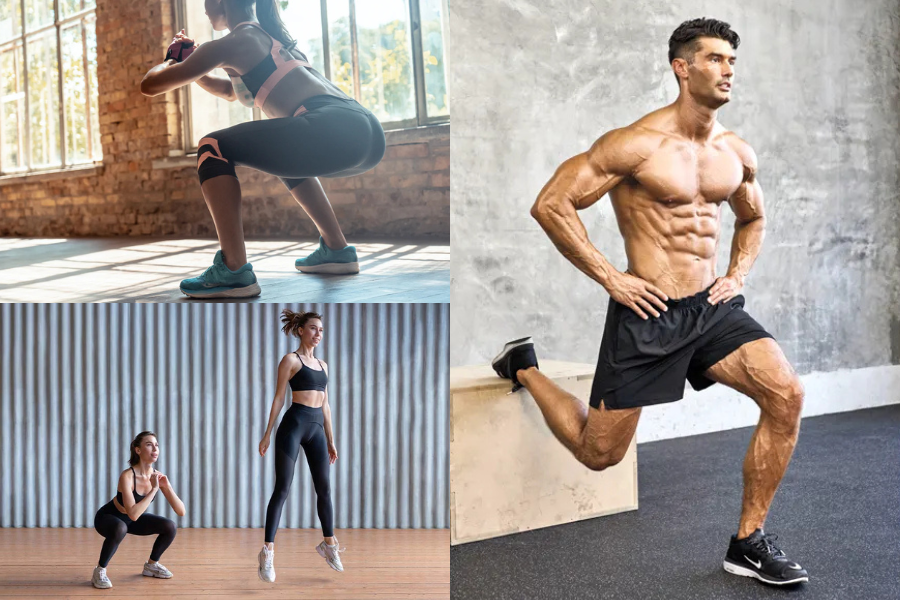
- Bodyweight squats and reverse lunges to wake up the quads and glutes
These types of movements are recommended in recent guidance on dynamic hamstring work because they prepare the muscles for activity instead of just holding a static stretch.
Focus on quad essentials at home
You can hit your quads hard at home with smart variations of squats and lunges. The goal is to emphasize knee bend, or knee extension, since that is where the quads take the lead.
Squats that target the quads
Squats are the foundation for leg mass, strength, and power. In a high intensity thigh building workout described by Muscle & Fitness, a 15 minute squat protocol using a weight that allows around 10 reps, repeated with short rests, is recommended to drive serious leg gains.
At home, you can adapt this approach with:
- Bodyweight squats, focusing on full range of motion and a slow, controlled tempo
- Heel elevated squats, placing your heels on a low book or small plate to shift more work into the quads
- Goblet squats, holding a dumbbell or backpack close to your chest for extra resistance
Quad focused squat variations, such as heel elevated goblet squats and front loaded squats, increase quad activation by putting your torso more upright and your knees further over your toes. This type of positioning is highlighted in recent quad training guides, including Gymshark’s 2024 leg workout article.
Unilateral quad work for balance
Single leg exercises not only target the quads, they also help correct muscle imbalances and improve core stability.
Try:
- Reverse lunges, stepping back instead of forward to protect your knees
- Bulgarian split squats, with your back foot on a chair or couch
- Step ups, using a sturdy bench or stairs
You can increase quad emphasis by elevating the front foot a little and keeping your torso more upright so the knee bends deeper. Fitness guidance from Gymshark notes that this simple tweak increases knee flexion and therefore quad involvement.
Isolation style quad work
While you may not have a leg extension machine at home, you can mimic isolation style work:
- Seated leg extensions with ankle weights or a resistance band attached to a table leg
- Wall sits, sliding down a wall and holding a seated position with your knees at about 90 degrees
Leg extensions are especially valued in gym settings because they isolate the quadriceps and allow for high activation with less whole body fatigue. You can get similar benefits with band or weight based leg extensions at home.
Aim to train your quads about twice per week, with at least two quad exercises per session and around 10 total sets per week, which matches the training guidelines summarized by Gymshark in mid 2024. Leave at least 48 hours between hard leg sessions so your muscles have time to repair and grow.
Build strong, explosive hamstrings
Hamstrings balance your quads, protect your knees, and power movements like sprinting and jumping. Since they often lag behind the quads, you want to be deliberate about how you train them.
Home friendly hamstring exercises
You can train your hamstrings effectively with little or no equipment:
- Romanian deadlifts, using dumbbells, a kettlebell, or a loaded backpack
- Single leg Romanian deadlifts, which challenge balance as well as strength
- Glute bridges and hip thrusts, starting with body weight and then adding a weight across your hips
- Hamstring curls with a stability ball or sliders, lying on your back and pulling your heels toward your hips
Guides from American Sport & Fitness recommend Romanian deadlifts, hamstring curls, glute ham raises, and kettlebell swings as core hamstring moves, all of which can be adapted to a simple home environment with bands, dumbbells, or just body weight.
Try low rep, powerful sets
Hamstrings respond well to low rep, explosive work. This helps explain why sprinters and Olympic lifters, who perform powerful hip extension and knee flexion with low reps, tend to have very developed hamstrings.
In a Muscle & Fitness hamstring giant set, lifters perform:
- Leg curls
- Romanian deadlifts
- Glute ham raises
They do 6 reps of each, rest only 10 seconds between exercises, and rest 2 minutes between giant sets. You can mimic this style at home by picking 2 or 3 hamstring moves, keeping the reps around 6 to 8, and using a challenging weight while focusing on crisp, controlled execution.
Create your balanced home leg routine
Once you know the building blocks, you can put them together into a simple quad and hamstring workout that you can repeat and adjust over time.
Here is a sample structure you can follow two days per week:
- Warm up with 5 minutes of light cardio, then 3 to 5 minutes of dynamic leg moves
- Quad focused block
- Goblet or bodyweight squats, 3 sets of 8 to 12 reps
- Reverse lunges or Bulgarian split squats, 3 sets of 8 to 10 reps per leg
- Hamstring focused block
- Romanian deadlifts, 3 sets of 6 to 10 reps
- Glute bridges or hamstring curls, 3 sets of 10 to 15 reps
- Finisher (optional)
- Wall sit, 2 rounds of 30 to 45 seconds
- Cool down with static stretching and light walking
You can adjust sets and reps to match your current fitness level, but keep the overall pattern: quads and hamstrings in the same session, with enough rest between workouts for recovery.
Use stretching and mobility to prevent injury
Strength is only part of the picture. Flexibility and mobility play a big role in keeping your legs healthy and pain free.
Research summarized in a 2024 Journal of Sport and Health Science overview, as discussed by Lose It!, notes that holding static quad and hamstring stretches for at least 30 seconds can help increase overall flexibility and protect your legs. Regular post workout stretching also helps loosen tight muscles and maintain range of motion.
Here are a few simple options:
- Standing quad stretch, sometimes called a standing foot grab, where you hold a wall or chair for balance and pull one foot toward your glutes, holding 30 seconds per side
- Toe touch hamstring stretch, standing tall with feet together and bending forward at the hips to reach toward your toes while keeping weight on your heels, holding 30 seconds
- Banded hamstring stretch, sitting with a resistance band around your foot and gently pulling your straight leg up for five reps per leg, as outlined in the 2024 Lose It! article
Static stretches are best after your workout, so your muscles are warm. Before you start lifting or jumping, favor dynamic moves instead.
Foam rolling your hamstrings for 3 to 5 minutes can also help. Focus on tender or tight spots for about 30 seconds at a time. This type of self massage has been shown to reduce soreness and support recovery when added to a regular leg training routine.
A simple rule of thumb: move dynamically before you train, then stretch and roll after you train.
Recover smart between workouts
Your muscles grow when you recover, not while you are doing squats. Pushing too hard, too fast is a common reason for hamstring and quad issues.
Try to give yourself at least 48 hours between intense leg workouts. On the days in between, use light activity like walking, easy cycling, or gentle mobility work to boost blood flow without adding strain. Fitness guidance from American Sport & Fitness highlights this kind of active recovery as a key part of avoiding overtraining.
Hydration and nutrition matter as well. Dehydration and low calcium levels can increase the likelihood of cramps, which are more common in the hamstrings than the quads. Drink water throughout the day instead of all at once, and build meals around lean protein, complex carbohydrates, and mineral rich foods like leafy greens and dairy or fortified alternatives.
Finally, pay attention to signs of strain. Soreness that feels sharper than usual, swelling, or trouble bearing weight are all cues to back off and rest. For mild pulls or strains, the standard early care advice is:
- Rest from intense activity
- Ice or cold therapy
- Compression with a bandage or compression shorts
- Elevation to reduce swelling
Severe tears sometimes require imaging like an MRI and can take three to six months to fully heal, so if pain is intense or you suspect a serious injury, see a medical professional rather than trying to push through.
Progress your quad and hamstring workout over time
To keep getting stronger, you need some form of progressive overload. That might look like:
- Adding a small amount of weight to your squats or deadlifts
- Adding 1 or 2 reps per set for a few weeks
- Slowing down the lowering phase of each movement
- Switching to a more challenging variation, such as moving from regular lunges to Bulgarian split squats
Guides from American Sport & Fitness emphasize the value of progressively increasing weight, reps, or tempo and rotating exercise variations like different squat and deadlift styles to avoid plateaus.
Every 4 to 6 weeks, you can tweak your home program by:
- Swapping one quad exercise and one hamstring exercise for new variations
- Moving from high rep work to slightly lower reps with more load
- Adjusting your schedule so you still hit at least 10 quality quad sets per week and a similar volume for your hamstrings
Start where you are today. Choose two quad moves and two hamstring moves you can perform with good form at home, warm up and cool down thoughtfully, and build from there. Over time, your quad and hamstring workout will not only feel stronger, it will support every step, climb, and jump you make in daily life.