A fat loss diet is less about eating tiny portions of “diet food” and more about consistently creating a gentle calorie deficit with satisfying, nutrient‑dense meals. When you understand what a realistic fat loss diet looks like day to day, you can stop guessing and start making small changes that actually move the scale.
Below, you will see how calorie deficits work, what to put on your plate, and how to build meals that help you lose fat without feeling deprived.
Understand what “fat loss diet” really means
A fat loss diet is simply a way of eating that helps you burn more energy than you take in, while still giving your body enough protein, fiber, vitamins, and minerals to stay healthy.
In practice, your fat loss diet should do three things:
- Create a moderate calorie deficit
- Keep you full and energized
- Protect your muscle while your body taps into fat stores
Crash diets that cut your intake to very low levels may show quick scale drops, but they mostly cost you muscle, energy, and long‑term progress. A realistic plan respects your biology and your lifestyle.
Create a safe, steady calorie deficit
To lose fat, you need a calorie deficit. You can create it by reducing what you eat, increasing activity, or a combination of both.
How big should your deficit be?
A common guideline is to aim for about a 500 calorie deficit per day, which usually leads to about 1 pound of weight loss per week because 1 pound of body weight equals roughly 3,500 calories (Calculator.net). This pace is considered sustainable for most people.
It is not advisable to cut more than 1,000 calories per day below your estimated maintenance level. Consistently losing more than 2 pounds per week can lower your metabolism and increase the risk of losing muscle along with fat (Calculator.net).
Why calorie counting is not the whole story
Calorie counting is a useful tool because it shows you how much energy is coming in versus going out. However, a fat loss diet that sticks also focuses on:
- Fiber, to keep you full
- Protein, to preserve muscle
- Food quality, so you feel good and stay healthy
As you progress, you might experiment with zigzag calorie cycling. This means some higher calorie days and some lower calorie days, while keeping your weekly calories about the same. This approach can help your body avoid adapting to consistent restriction and can make it easier to push through plateaus (Calculator.net).
Make protein the anchor of every meal
Protein is the backbone of a smart fat loss diet. When you are in a deficit, your body is more likely to break down muscle tissue if protein is too low. Losing muscle can slow your metabolism and make it harder to keep the weight off later.
Research suggests that higher protein diets, in the range of 1.2 to 1.6 grams of protein per kilogram of body weight per day, support greater weight loss, more fat loss, and better preservation of lean mass compared with lower protein diets, especially when people actually stick to the plan (PubMed). Controlled trials also find that higher protein meals increase feelings of fullness and can improve markers like triglycerides, blood pressure, and waist circumference under energy restriction (PubMed).
During weight loss, people can lose anywhere from 11 percent to 50 percent of their muscle mass if they are not careful about protein intake (Abbott). To protect your muscle, make protein a non‑negotiable at each meal.
A practical target is about 25 to 30 grams of protein per meal, which is a range supported by both research and clinical guidance (PubMed, Abbott).
What does that look like on your plate?
You can think in simple portion guides:
- About 3 ounces of lean meat or dairy (roughly the size of your palm) provides around 17 to 26 grams of protein
- One quarter cup of nuts or seeds (about two thumbfuls) offers about 7 to 9 grams
- One cup of beans, lentils, or quinoa (about your fist) gives around 8 to 12 grams (Abbott)
If you like convenience, a ready‑to‑drink option that provides about 30 grams of high quality protein plus vitamins and minerals can help you hit your target on busy days (Abbott).
Use energy density to eat more for fewer calories
You do not have to live on tiny servings to lose fat. The concept of energy density helps you eat large, satisfying portions that stay relatively low in calories.
Foods that are low in energy density provide fewer calories in a larger volume. Think fruits, vegetables, and broth‑based soups. High energy density foods pack a lot of calories into small portions such as fried foods and pastries (Mayo Clinic).
The Mayo Clinic Diet uses this principle as a foundation. By centering your meals on foods that are naturally low in calories but high in volume, you can feel full on fewer calories and still make room for small portions of your favorite sweets (Mayo Clinic).
How to lower the energy density of your meals
You can adjust almost any dish to be more fat‑loss friendly by increasing water‑ and fiber‑rich ingredients:
- Top pasta with lots of vegetables and a smaller amount of sauce
- Bulk up grain bowls with extra greens and beans
- Snack on raw vegetables instead of chips when you want crunch (Mayo Clinic)
Whole fruits are a smart choice too. Fresh, frozen, or canned fruit packed in water or its own juice tends to be lower in calories and more filling than fruit juice or dried fruit, which are more energy dense because the natural sugars are concentrated (Mayo Clinic).
Choose foods that keep you full longer
Not all calories feel the same in your body. Some foods keep you full for hours, while others leave you hungry soon after eating.
Fiber‑rich, water‑rich foods
Foods high in water and fiber, such as watermelon, berries, pears, apples, and raw vegetables, create a lot of volume in your stomach without adding many calories. This helps you feel satisfied while keeping your intake under control (WebMD).
Vegetables are especially powerful here. They are low in calories but high in volume because of their water and fiber content. Loading your plate with vegetables lets you eat a visually big meal that still fits your fat loss diet (Mayo Clinic).
Protein foods that work harder for you
Foods that take more effort to chew and digest, like lean meats and many vegetables, slightly increase the calories you burn during digestion and help you stay full longer (Calculator.net).
A few helpful options:
- Greek yogurt has nearly twice the protein of regular yogurt. It takes longer to digest, keeps you fuller, and uses more calories in digestion. Go for nonfat or low fat and keep added sugars low to support fat loss (WebMD).
- Quinoa provides about 8 grams of protein and 5 grams of fiber per cooked cup, along with iron, zinc, selenium, and vitamin E. It can serve as a higher protein, higher fiber base for bowls and salads, which improves hunger control (WebMD).
Flavor boosters that may help
Some foods might provide modest, short term boosts in metabolism or appetite control. They will not replace a calorie deficit, but they can support your plan.
- Hot peppers contain capsaicin, which may reduce appetite and slightly increase metabolic rate for a short time, possibly reducing calorie intake in the short term (WebMD).
- Green tea contains catechins that may briefly stimulate fat burning and metabolism. To get the most potential benefit, you would need to drink it several times a day, ideally without lots of added sugar (WebMD).
Build simple, balanced meals for fat loss
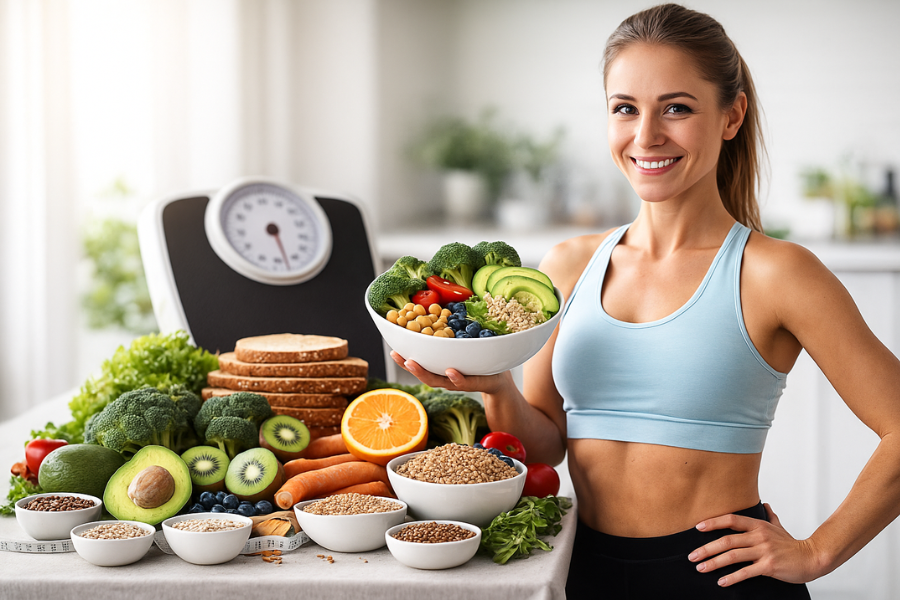
A practical way to think about a fat loss diet is to build most meals from three building blocks: protein, fiber‑rich carbs, and healthy fats.
You could aim for plates that look like this most of the time:
- Half the plate non‑starchy vegetables such as leafy greens, peppers, broccoli, carrots
- One quarter lean protein like chicken breast, fish, beans, tofu, Greek yogurt
- One quarter fiber‑rich starch like quinoa, brown rice, beans, lentils, or a small baked potato
- A small amount of added fat from olive oil, avocado, nuts, or seeds
Breakfast is particularly important. Skipping it can increase hunger and push you to overeat later in the day, while a breakfast that is rich in protein and fiber is linked with better appetite control and healthier weight over time (WebMD).
Watch the “hidden” calories in drinks and snacks
You can build a great fat loss diet on paper and still stall if you overlook liquid calories and mindless snacking.
Specialty coffee drinks and cocktails can easily top 500 calories each. If you have several each week, the calories add up quickly and may erase your deficit (WebMD). Swapping some of these for water, unsweetened tea, or black coffee can have a big effect without changing your actual meals.
Mindless snacking on high calorie foods while you work or watch TV is another common roadblock. On the other hand, mindful snacking on small portions of protein rich foods, like a handful of nuts, can help control hunger and keep your metabolism steady without pushing you over your calorie budget (WebMD).
Calcium rich foods such as nonfat or low fat dairy might also support your fat loss. Inadequate calcium intake appears to encourage more fat production, while getting enough from food can help the body burn fat more effectively. Calcium supplements alone do not seem to have the same effect, so lean dairy foods are a better choice (WebMD).
Avoid crash dieting and other common mistakes
It is tempting to cut calories extremely low to see quick results. Very low calorie crash diets, such as plans that drop you to under 1,000 calories per day, usually backfire. They can slow your metabolism and set you up to regain the weight once you go back to normal eating (WebMD).
Other pitfalls to watch for:
- Assuming the scale tells the whole story. Your weight can shift by 2 to 4 pounds over just a few days because of changes in fluid, digestion, or menstrual cycle. This means you might be losing fat even when the number on the scale barely moves (Healthline).
- Overdoing calorie dense “healthy” foods. Nuts, seeds, and fatty fish are good for you, but they add up quickly if portions are large. People often underestimate calories from meals, so being mindful of portion sizes still matters, even with nutritious foods (Healthline).
Support your fat loss diet with movement
Nutrition does most of the work in creating a deficit, but your activity level shapes how your body responds.
Resistance training is one of the most effective ways to increase muscle mass, raise metabolic rate, and encourage fat loss, especially when paired with aerobic exercise. A large review of 32 studies in people with obesity found that combining these forms of exercise improves fat loss outcomes (Healthline).
Higher protein intake of about 0.6 to 0.8 grams of protein per pound of body weight, which is the same 1.2 to 1.6 grams per kilogram range mentioned earlier, also helps reduce appetite, increase fullness, and support a higher metabolism when paired with activity (Healthline).
Finally, focus your overall pattern on whole, minimally processed, single‑ingredient foods as much as you reasonably can. These foods are harder to overeat and are associated with better weight loss results than highly processed foods, which may influence gut health and inflammation in ways that promote obesity (Healthline).
A fat loss diet that works for you is not about perfection. It is about repeating mostly smart choices, most of the time, in a way you can live with.
If you start by adding protein to each meal, filling half your plate with fruits and vegetables, and trimming obvious liquid calories, you will already be following the core of a realistic fat loss diet. From there, you can adjust portions and activity week by week to keep your progress moving in a direction that feels healthy and sustainable.