A strong set of quads does more than power you through squats at the gym. Effective quadriceps strengthening exercises help you walk, climb stairs, get out of a chair, and keep your knees healthy as you age. Whether you are rehabbing an injury, building muscle, or simply trying to stay mobile, focusing on your quads pays off for the long term.
Below, you will learn what your quadriceps actually do, how to train them safely, and which exercises are worth your time at home or in the gym.
Understand your quadriceps
Your quadriceps femoris is a group of four muscles on the front of your thigh. Together, they straighten your knee and help flex your hip, which means they are involved in almost every step you take.
These four muscles are:
- Rectus femoris
- Vastus lateralis
- Vastus intermedius
- Vastus medialis
The vastus medialis, especially the inner part often called the VMO, helps stabilize your kneecap as you move, according to a 2024 patient guide by Frank Gilroy Physiotherapy in Glasgow. When this area is weak, your knee can feel wobbly or painful during stairs, squats, or running.
Strong quadriceps support your entire body weight, which reduces how hard your knee joint has to work. Over time that can lower your risk of mobility loss and even help you avoid becoming wheelchair dependent as you get older.
Start safely after pain or injury
If you are dealing with recent quadriceps trauma or a flare up of knee pain, your first step is not heavy leg day. It is calming things down.
A 2024 protocol from Frank Gilroy Physiotherapy emphasizes the PRICE approach in the first 24 to 48 hours:
- Protection
- Rest
- Ice for about 20 minutes at a time
- Compression with an elastic bandage
- Elevation to reduce swelling
This phase is about pain control and limiting inflammation. You avoid intense stretching or loaded exercises and focus instead on gentle movement that does not increase your symptoms.
Once pain and swelling begin to settle, you can gradually add very light quadriceps strengthening exercises like simple straight leg raises or seated knee extensions, always staying within a pain free or low pain range. If you have had a significant injury or surgery, follow your doctor or physical therapist’s specific protocol.
Build a foundation with simple quad exercises
When you are ready to strengthen, think of your training in phases. You start with low load, controlled movements, then increase resistance as your quads get stronger.
Straight leg raises and short arcs
Straight leg raises are a classic starting point, especially if bending your knee is uncomfortable. They target the quadriceps, including the inner thigh area, with minimal knee movement.
A typical progression, outlined in the 2024 Frank Gilroy Physiotherapy guide, looks like this:
- Begin in long sitting with your leg straight.
- Tighten your thigh, then slowly lift your leg a few inches off the ground.
- Hold for a few seconds, then lower with control.
You can start without resistance, then add a Theraband, and later 2 kg ankle weights as you improve. The guide suggests working up to 4 repetitions daily, 5 days a week in early rehab.
Short arc quads are another gentle option. Fitness trainer Kieran Knight describes them as lying on your back with a rolled towel under your knee. You then straighten your leg by lifting the heel, hold for about 5 seconds, and lower slowly. Because the knee moves only a little, these are often prescribed after severe leg injuries to build quad strength without aggravating pain.
Dr. Nick Salinas notes that to get the most out of these kinds of exercises, you should:
- Engage the VMO and rectus femoris, not just swing the leg
- Keep your core stable so your hips do not rock
- Move slowly so the muscle, not momentum, does the work
These details help you actually strengthen the muscle that stabilizes your knee.
Simple chair based movements
Seated knee extensions and basic sit to stand movements bridge the gap between rehab and everyday function.
From a firm chair, you can:
- Perform seated knee extensions by slowly straightening one knee until your leg is out in front of you, hold for about 5 seconds, then lower with control. A variation uses an elastic band around your ankle for added resistance.
- Practice sit to stand without using your hands. Lean forward slightly, keep your knees aligned with your toes, stand up slowly, then sit down under control.
The American Academy of Orthopaedic Surgeons (AAOS) knee conditioning program recommends about 3 sets of 10 repetitions, 4 to 5 days per week for quadriceps strengthening exercises like half squats, leg extensions, and straight leg raises. They also emphasize proper technique, such as avoiding bending forward at the waist during squats and not using momentum during leg extensions, to get the benefits without extra stress on your joints.
Progress to at home bodyweight quad work
Once your knees tolerate everyday movements comfortably, you can build more strength and endurance with bodyweight training. Many effective quadriceps strengthening exercises can be done at home with no equipment, and you can add dumbbells or household objects later to increase difficulty.
Key at home quad exercises include:
- Bodyweight squats
- Walking lunges
- Step ups
- Bulgarian split squats
- Lateral lunges
- Reverse lunges
- Single leg raises
- Partial wall squats
Beginner friendly guidelines are to start with 2 sets of 10 to 12 repetitions per exercise, then increase sets or reps as they become easier.
Partial wall squats are especially useful if you have sensitive knees. You lean against a wall, step your feet about 30 centimeters away, slide down to a comfortable depth, keep your knees over your feet and heels on the floor, hold for about 5 seconds, then slide back up slowly. This position spreads the load and reduces pressure while still challenging your quads.
Weighted step ups are another everyday friendly option. You place your working foot on a step, hold support if needed, and stand tall by driving through that leg. A 2024 patient guide suggests adding 2 kg weights when you can manage the motion smoothly, which increases the strengthening effect for people with arthritis.
Use gym exercises to maximize quad strength
If you have access to a gym and no major injury restrictions, you can use more targeted exercises to build serious quad strength and muscle.
A June 2024 Gymshark article explains that strong quadriceps:
- Improve performance in compound lifts like squats and deadlifts
- Enhance knee joint stability
- Support sports such as soccer, American football, and basketball
- Make everyday activities easier and may even reduce overall mortality risk
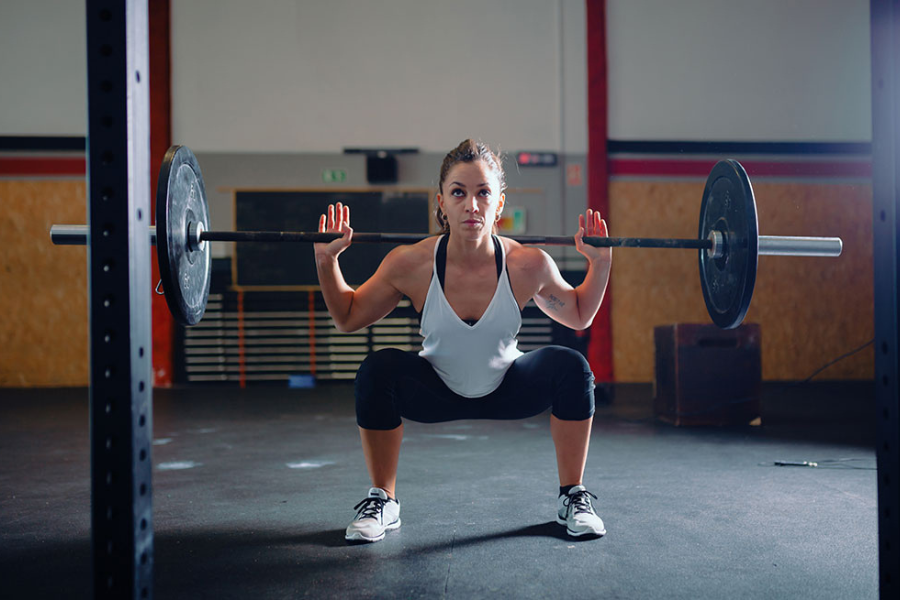
To really focus on your quads, choose squat variations that keep your torso more upright and let your knees travel forward over your toes. According to the same Gymshark guide, quad focused options include:
- Barbell front squats
- Heel elevated goblet squats
- Hack squats
- Sissy squats
Changing the angles in this way shifts more of the load to the front of your thigh.
Unilateral exercises, such as lunges with the front foot elevated and Bulgarian split squats with a shorter stance and sometimes an elevated front heel, help correct strength imbalances and increase quad engagement. They also challenge your balance and core stability at the same time.
For muscle growth, the Gymshark training guide recommends training your quads about twice per week, using at least two quad focused exercises per session, and aiming for a minimum of 10 sets per week in the 8 to 12 repetition range.
Protect your knees while you strengthen
Effective quadriceps strengthening exercises should support your knees, not irritate them. Paying attention to form and exercise selection is key.
The AAOS knee conditioning program stresses:
- Controlled movements instead of fast, jerky reps
- Bending only within a comfortable range, especially in squats
- Avoiding sudden increases in weight
Some variations are especially joint friendly. Seated leg extensions, for example, isolate the quads and are generally easier on the body, so they are common in rehab settings. The AAOS recommends 3 sets of 10 repetitions, starting with about 5 pound weights and increasing up to 10 pounds as tolerated.
If you struggle with pain during traditional squats, banded Spanish squats are worth exploring. With a resistance band wrapped behind your knees and anchored in front of you, the band helps stabilize your knees and prevents excessive forward movement during the squat. This setup still works the quads hard but is often more comfortable for sore knees.
TRX assisted chair or bench squats offer similar benefits. Dr. Jerry Yoo, a doctor of physical therapy, notes that using TRX straps lets you offload some body weight, which allows you to train within a pain free range of motion while gradually strengthening your quads.
Terminal knee extensions, performed with a resistance band around your calf just below the knee, are another option that focuses on quad contraction without putting much stress on the joint, as recommended by Jeff Parke of Top Fitness Magazine.
Add stretching for balance and comfort
Strength without flexibility can leave your legs tight and your lower back unhappy. Regular quadriceps stretching helps keep your muscles supple and your posture upright.
A simple standing quad stretch involves holding your ankle behind you and gently pulling your heel toward your glutes while keeping your knees close together. Doing this regularly can:
- Improve your balance
- Encourage better posture
- Reduce lower back discomfort caused by tight quads
The AAOS suggests that quadriceps exercises be both preceded and followed by gentle stretching as part of a 4 to 6 week conditioning program, ideally under medical supervision if you have existing knee issues. Stretching helps reduce muscle soreness, lowers your injury risk, and keeps your progress more comfortable.
Know what results to expect
The benefits of quadriceps strengthening exercises are not just theoretical. Several studies highlight what you can realistically hope to gain if you stay consistent.
An eight week program in São Paulo, Brazil, looked at people aged 50 to 75 with knee osteoarthritis. The group that performed quadriceps strengthening exercises twice weekly improved:
- Pain levels
- Functional mobility, based on the Timed Up and Go test
- Quality of life, especially in functional capacity, pain, physical aspects, general health, and vitality
These improvements were statistically significant, with p values less than 0.0001 for pain and functional mobility measures. The protocol in this study included warm up on a stationary bike, stretching the back of the thigh, and three sets of 15 repetitions of seated knee extensions at 50 to 60 percent of the 10 repetition maximum load in 30 to 40 minute group sessions.
The control group that only received educational guidance without exercise did not see meaningful changes in pain, mobility, or quality of life. That strongly suggests it is the physical exercises themselves, not just information or encouragement, that drive the improvement.
Research reviewed by Frank Gilroy Physiotherapy in 2014 and 2015, which included work by Bolton et al. (2012), Basat et al. (2013), and Stolzenberg et al. (2013), found similar results. Resistive training that targets the quadriceps increases strength and the number of repetitions people can perform, with typical sets in the 12 to 15 repetition range.
A practical summary: if you train your quads consistently 2 to 5 times per week with controlled, well chosen exercises, you are likely to notice less pain, better walking speed, easier stair climbing, and more confidence on your feet over the course of several weeks.
Put it all together for lasting leg power
You do not have to overhaul your entire workout program to benefit from quadriceps strengthening exercises. Start with where you are now:
- If you are in pain or just coming off an injury, focus on PRICE, gentle straight leg raises, short arcs, and seated knee extensions under professional guidance.
- If you are feeling stable but not strong, add at home moves like partial wall squats, step ups, and sit to stand practice a few times per week.
- If your knees feel good and you have gym access, layer in quad focused squats, lunges, and split squats, aiming for 8 to 12 repetitions and about 10 total sets per week.
Over time, these small, consistent efforts help you build legs that not only look strong but also carry you comfortably through daily life, from walking and running to trekking and stair climbing well into older age.