A strong lower body starts with strong glutes. When you focus on the best glute exercises, you not only build a more defined backside, you also support your hips, lower back, and knees so everyday movement feels easier and more powerful.
Below, you will learn which glute moves deserve a spot in your workouts, how to combine them into an effective routine, and how to progress safely without wasting effort.
Understand your glute muscles
Before you load up a barbell, it helps to know what you are actually training. Your glutes are a group of three muscles that work together but have different jobs.
- Gluteus maximus is the largest. It drives hip extension, like when you stand up from a squat or push your hips up in a bridge. This is the main muscle people think of for size and power. A 2019 guide from Gymshark notes that it is crucial for both aesthetics and athletic performance.
- Gluteus medius sits on the outer side of your hip. It handles hip abduction and keeps your pelvis stable when you walk or balance on one leg.
- Gluteus minimus is the smallest and lies under the medius. It helps with hip rotation and pelvic stability, which matters for posture and joint health, as explained by Planet Fitness in a 2025 overview of glute function.
When you pick glute exercises that hit all three, you build balanced strength and reduce your risk of pain and injury in daily life.
Why strong glutes matter for you
Training your glutes is about much more than how your jeans fit. According to Planet Fitness, strong glutes can:
- Improve posture by supporting your pelvis and spine
- Boost athletic performance in running, jumping, and lifting
- Reduce injury risk in your knees, hips, and lower back
- Help with functional tasks like climbing stairs, lifting groceries, and standing up from the floor
Weak or underactive glutes are linked to back pain, hamstring strains, and knee issues, especially if you sit a lot during the day, as highlighted in a 2023 article from ISSA. Glute training acts as both performance work and preventive care.
Best compound glute exercises
Compound movements work multiple muscle groups at once. These are the best glute exercises to build overall strength and muscle efficiently.
Squats (including sumo squats)
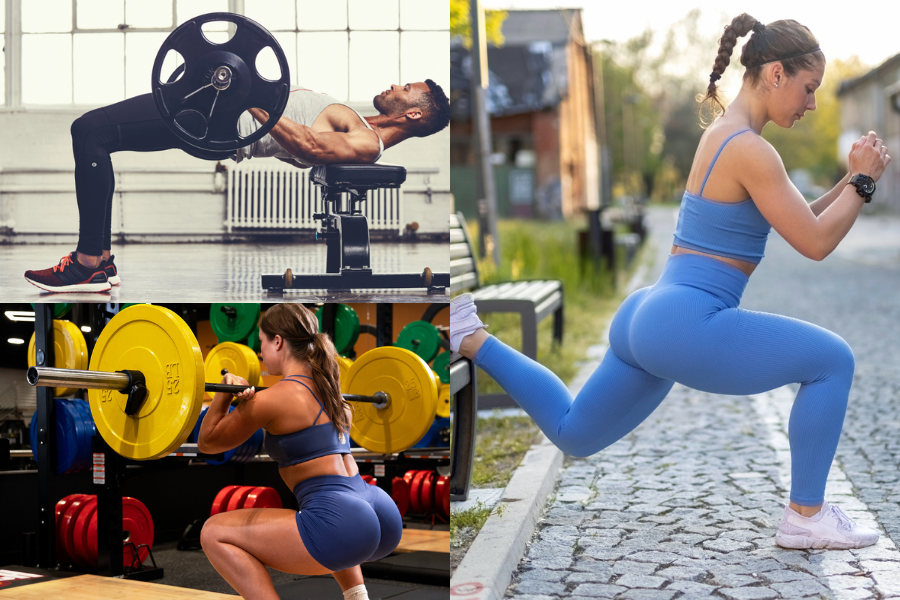
Squats are a lower body classic for a reason. They hit your glutes, quads, and hamstrings in one move. Sumo squats, where your feet are wider and toes turn out, place extra emphasis on your glutes, especially the inner and outer portions.
A 2017 study referenced by Gymshark found that back squats significantly increase glute engagement, particularly at heavier loads between 90 and 100 percent of your one rep max.
Form pointers:
Focus on keeping your chest lifted, knees tracking over your toes, and sitting your hips back as if into a chair. Depth and stance width change how hard your glutes work. A slightly wider stance with a full but controlled range of motion generally increases glute activation, according to a 2020 systematic review of gluteus maximus activity.
Romanian deadlifts
Romanian deadlifts (RDLs) target your glutes and hamstrings through a hip hinge. You lower the weight by pushing your hips back while keeping a neutral spine and a slight bend in your knees.
RDLs stretch your glutes under load, which is excellent for muscle growth. They also teach you to hinge properly, which protects your lower back in both training and daily activities.
Bulgarian split squats
Bulgarian split squats are a single leg squat with your back foot elevated on a bench or step. They heavily work the glute of the front leg and also demand balance and core control.
Research summarized by Gymshark and ISSA shows that split squats are effective for unilateral glute training and can place less strain on the knee joint than heavy back squats, making them a smart option if your knees are sensitive.
Tip: Lean your torso slightly forward and drive through your front heel to emphasize the glutes rather than the quads.
Step ups
Step ups look simple, but they are one of the most powerful glute builders. You step onto a box or bench, driving through the working leg without pushing off too much with the trailing leg.
A 2020 systematic review found that step up variations produced some of the highest gluteus maximus activation levels, averaging over 100 percent of maximal voluntary contraction. Peloton trainers also highlight step ups as a top choice for bodyweight glute activation in 2024 content.
To progress, slowly increase box height or add dumbbells while maintaining control.
Best isolation glute exercises
Isolation movements hone in on your glutes more directly. They pair well with compound lifts in the same session.
Hip thrusts and glute bridges
If you are only going to add one isolation move, make it the hip thrust. Studies cited by Gymshark and ATHLEAN X show that barbell hip thrusts outperform many other lifts for gluteus maximus activation.
In a hip thrust, your upper back rests on a bench and a barbell or weight rests across your hips. You drive your hips up until they are fully extended and your glutes are squeezed hard at the top.
Key details:
Keep your ribs down, chin slightly tucked, and shins roughly vertical in the top position. The 2020 systematic review noted that small changes like turning your toes slightly outward or abducting the hip to about 30 degrees can increase glute activation even with relatively light loads.
Glute bridges, where your back stays on the ground, are a great starting point if you are newer to training or working out at home.
Glute kickbacks and resistance band kickbacks
Glute kickbacks focus on aggressive hip extension. You can perform them on all fours, standing on a cable machine, or with a loop band around your ankles.
A 2023 ISSA guide and a 2024 Peloton resource both highlight banded kickbacks as effective for building the gluteus maximus because the band keeps constant tension on the muscle throughout the movement.
Move slowly, keep your core braced, and avoid arching your lower back so the work stays in your glutes.
Good mornings
Good mornings are another hip hinge exercise, similar in feel to a Romanian deadlift, but usually done with a lighter barbell across your upper back.
They emphasize the gluteus maximus and hamstrings and can help you pattern the hinge movement with more control. Start light and focus on keeping your spine neutral while you push your hips back and then drive them forward.
Glute exercises for medius and minimus
To keep your hips stable and your knees happy, you need to target the side and deep glutes, not just the big maximus.
Clamshells and lateral band walks
Clamshells and band walks are simple but potent. Both are recommended by ISSA and Peloton as top choices for the gluteus medius and minimus.
- Clamshells: Lie on your side with knees bent, feet together, then open and close your top knee like a clamshell while keeping your hips stacked.
- Lateral band walks: Place a loop band around your ankles or just above your knees, bend slightly into an athletic stance, and step sideways while keeping tension on the band.
Use these as warm ups before heavier lower body sessions so your glutes are awake and ready to work.
Curtsy lunges and single leg work
Curtsy lunges cross one leg behind the other diagonally. This crossover pattern increases the demand on your gluteus medius and minimus, as noted in the ATHLEAN X guide.
Single leg moves like single leg squats, single leg deadlifts, and single leg glute bridges are also excellent for these smaller stabilizing muscles. ISSA and Peloton both point out that single leg exercises can isolate the medius and minimus more effectively than many two legged movements.
If your knees tend to cave inward during squats or you feel wobbly on one leg, these should be a priority.
Activation moves before heavy training
If you sit a lot, you might feel like your glutes are “asleep.” That is where activation exercises come in.
Glute activation drills lightly wake up the muscles and improve your mind muscle connection so they actually fire when you lift. Experts from ISSA and Peloton recommend including them before:
- Running or cycling
- Heavy lower body strength sessions
- HIIT or plyometric workouts
Effective activation options include:
- Toe down hip lifts
- Stability ball hip drop and lift
- Banded lateral walks
- Clamshells
- Bodyweight glute bridges or hip thrusts
- Step ups on a low box
Spend 5 to 10 minutes here. You should feel your glutes working but not fatigued.
Sets, reps, and training frequency
To make progress, you need the right mix of volume and intensity. Research from Gymshark, Planet Fitness, and ATHLEAN X suggests these guidelines for glute growth and strength:
- Train your glutes 2 to 3 times per week with at least one rest day between sessions.
- For hypertrophy, prioritize 8 to 12 reps per set at around 60 to 80 percent of your one rep max.
- Include some heavy sets of 4 to 8 reps to build strength and recruit more muscle fibers.
- Add higher rep work, 12 to 15 reps, with lighter loads or bands for extra metabolic stress.
- Take your sets close to muscular failure while keeping your form solid.
The key principle is progressive overload. Over time, gradually increase weight, reps, sets, or difficulty so your body has a reason to adapt.
Sample glute focused workout
Use this simple structure 2 to 3 times per week. Adjust sets, reps, and weights based on your experience level.
- Activation (5 to 10 minutes)
- Glute bridges, 2 sets of 12
- Lateral band walks, 2 sets of 10 steps each direction
- Compound lifts (strength and size)
- Squats or sumo squats, 3 to 4 sets of 6 to 10 reps
- Romanian deadlifts, 3 sets of 8 to 10 reps
- Bulgarian split squats, 3 sets of 8 to 10 reps per leg
- Isolation work (finishers)
- Hip thrusts, 3 sets of 8 to 12 reps
- Glute kickbacks or banded kickbacks, 3 sets of 12 to 15 reps per leg
- Optional: Clamshells or curtsy lunges, 2 sets of 12 per side
Aim for controlled movement, full range of motion, and a noticeable glute squeeze on each rep.
If you have existing pain or injury, check in with a medical professional or qualified trainer before starting a new routine.
Recovery and consistency
Glutes are large muscles, so they respond well to regular training, but they still need recovery. Planet Fitness recommends working them 2 to 3 times weekly with rest days in between and including mobility and stretching to maintain flexibility.
On your non glute days, gentle walking, light cycling, or mobility work can help with blood flow and reduce soreness.
Building stronger glutes does not happen overnight, but when you choose the best glute exercises and stick with them, you will notice:
- More power in your legs
- Better balance on one leg
- Less discomfort in your lower back and knees
- And yes, a more lifted, defined shape
Start by adding one or two of the exercises above to your next lower body day. Once those feel comfortable, build out the full routine and keep nudging up the challenge. Your glutes, and the rest of your body, will thank you.