Strength training for quads can be simple, joint friendly, and even fun when you focus on a few smart movements. You do not need a squat rack at home or an intense gym routine to build stronger thighs, protect your knees, and feel more powerful in everyday life. With the right quad exercises and a bit of consistency, you can see and feel a difference quickly.
Below you will learn what your quads do, how to train them safely, and a mix of easy and challenging workouts you can try right away.
Understand what your quads actually do
Your quadriceps are the big muscles on the front of your thighs. They are made up of four key muscles that work together to straighten your knee and help flex your hip. According to a Gymshark training guide updated in 2024, these are: Rectus Femoris, Vastus Lateralis, Vastus Medialis, and Vastus Intermedius, and you want to target all four for balanced development.
You use your quads every time you stand up from a chair, climb stairs, or walk up a hill. Strong quadriceps support your knees, improve your balance, and make strength moves like squats and deadlifts feel more stable. Muscle & Fitness notes that leg strength is a foundation for almost every standing exercise, not just leg day itself.
There is also an interesting brain benefit. A study that analyzed older adults found that higher quadriceps strength was linked with better scores on a common cognitive test, even after adjusting for other health factors. This does not prove that quad strength directly improves memory, but it does suggest that keeping your legs strong is valuable for healthy aging.
Why quad strength training matters
When you focus on strength training for quads, you are doing more than chasing toned legs. You are building a base that helps your whole body move better.
Strong quads can help you:
- Climb stairs and hills with less effort
- Sit and stand more easily, especially if you have knee stiffness
- Improve performance in sports like running, cycling, or court games
- Protect your knees by supporting the joint during daily activities
If you have ever felt your lower back fatigue before your legs during heavy squats, you are not alone. Traditional barbell back squats place high demands on your lower back muscles, which can get tired before your quads are fully trained. The good news is that there are many quad focused exercises that reduce strain on your back while still challenging your thighs.
Basic form tips for safe quad training
Before you jump into specific exercises, it helps to understand a few simple technique cues. These small tweaks make a big difference in how much your quads actually work.
Let your knees move forward
To target your quads, your knees need to bend and move forward over your toes. Research summarized by Gymshark explains that increasing the forward shin angle in squats, lunges, and leg presses significantly increases quad involvement. This is normal and safe for most healthy knees as long as you control the movement.
If your ankles feel tight, you can place your heels on small plates or a low wedge. Heel elevation increases knee bend and makes it easier to stay upright, which again shifts more work to your quads.
Use a full, controlled range of motion
A common mistake is doing only half reps on squats, leg presses, or leg extensions. Muscle & Fitness notes that a shortened range of motion limits quad growth because the muscles never fully engage throughout the movement. Instead, lower until you feel a clear stretch in your thighs and then stand back up with control.
You do not have to go as deep as a powerlifter. Work within a depth that feels strong and pain free, and gradually increase your range as your strength and mobility improve.
Pick weights that let you focus on tension
Going too heavy on quad exercises often leads to ego lifting, poor form, and partial reps. That mostly tires your joints rather than your muscles. Both Gymshark and Muscle & Fitness recommend using loads that allow you to perform 8 to 12 or even 15 good reps with control, stopping only when you are about 2 to 3 reps away from failure.
You should feel a strong burn in your thighs on the last few reps, but you should not lose alignment or feel pain in your knees or lower back.
Easy bodyweight quad exercises to start with
If you are new to strength training for quads, you can start with bodyweight moves. These require no equipment and can be done at home in a small space.
1. Sit to stand from a chair
This is one of the simplest ways to train your quads in a very familiar movement.
- Sit in a sturdy chair with your feet flat on the floor, about hip width apart.
- Lean your torso slightly forward and push through the middle of your feet to stand up.
- Slowly sit back down with control, lightly touching the chair before standing again.
If standing with your arms crossed is difficult, place your hands lightly on your thighs for support. To make it harder, choose a lower chair or hold a light weight at your chest.
2. Wall squat hold
Static holds build endurance in your quads without any impact.
- Stand with your back against a wall and feet about 1 to 2 feet forward.
- Slide down until your knees are bent roughly 90 degrees, or slightly higher if that feels easier.
- Keep your knees tracking over your toes and press your lower back gently into the wall.
- Hold for 20 to 40 seconds, then stand up and rest.
Start with 2 to 3 rounds and add time gradually. You should feel your thighs working hard, but your knees should not feel sharp pain.
3. Split squat
The split squat builds strength and balance on each leg individually. It also stretches the hip of your back leg.
- Stand in a staggered stance, one foot forward and one back, about hip width apart.
- Drop straight down by bending both knees, keeping your torso upright.
- Aim for your front thigh to approach parallel to the floor.
- Push through the front foot to return to the starting position.
If you notice knee discomfort, shorten your stance slightly or hold on to a wall or chair for balance. Over time, you can hold dumbbells or a weight at your chest for more challenge.
Fun and effective gym quad exercises
Once you are comfortable with bodyweight movements, you can explore more targeted strength training for quads using common gym equipment. You do not need to use all of these at once. Think of them as options you can rotate into your routine.
4. Heel elevated goblet squat
This squat variation strongly emphasizes your quads while reducing strain on your lower back.
- Place your heels on small plates or a low wedge, toes on the floor.
- Hold a dumbbell or kettlebell close to your chest.
- Keep your chest tall and sit straight down, allowing your knees to travel forward over your toes.
- Descend until you feel a stretch in your quads, then push through your mid foot to stand.
Gymshark notes that heel elevated squats increase knee flexion and quad activation, and they are friendly for people with limited ankle mobility.
5. Bulgarian split squat
This is a powerful unilateral exercise for building strength and correcting imbalances.
- Stand about two feet in front of a bench, with your back to it.
- Place the top of one foot on the bench behind you.
- Hop the front foot forward or back until you can drop straight down without your knee caving in.
- Lower until your front thigh is close to parallel and your back knee is near the floor.
- Push through the front foot to return to standing.
To focus on your quads, Gymshark suggests using a slightly shorter stance and keeping your torso more upright. This shifts the work away from the glutes and into the front of your thigh.
6. Leg press with full range
The leg press is a beginner friendly machine, as long as you use a manageable load and full motion.
- Sit with your back flat against the pad and your feet about shoulder width apart on the platform.
- Unlock the safety bars and lower the platform by bending your knees, keeping your heels planted.
- Go as low as you comfortably can without your lower back lifting off the pad.
- Press the platform away until your legs are almost straight, but do not lock your knees forcefully.
Avoid loading the leg press so heavily that you can only move the sled a few inches. That kind of partial rep does not help your quads much and mostly stresses your joints.
7. Leg extension machine
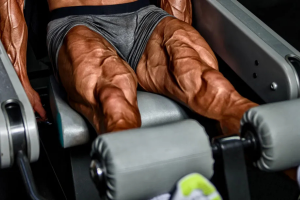
Leg extensions are one of the best isolation exercises for your quads, especially the rectus femoris, which often does not grow as well from squats alone. A 2021 study found that this muscle responded strongly to direct movements like leg extensions and sissy squats, while squats by themselves did not stimulate it as effectively.
- Adjust the backrest so your knees line up with the machine’s pivot point.
- Place the pad just above your ankles.
- Grip the handles, brace your core, and straighten your legs smoothly.
- Pause for a second at the top, then lower slowly.
If you have a history of knee injury, start with very light weight and a smaller range of motion, and consider checking with a physical therapist before going heavy.
Sample quad focused workouts you can try
You can train your quads in different ways depending on your experience and time. Below is a simple guide you can follow 1 to 2 times per week.
Aim to train your quads about twice a week with at least two quad exercises per session and a total of around 10 sets per week in the 8 to 12 rep range, with 48 hours of recovery between sessions, as summarized by Gymshark in 2024.
Beginner home workout
Do this routine 2 times per week with a rest day in between.
- Sit to stand from chair
- 3 sets of 8 to 12 reps
- Wall squat hold
- 3 sets of 20 to 40 seconds
- Split squat
- 2 to 3 sets of 8 to 10 reps per leg
Rest 60 to 90 seconds between sets. When this feels easy, you can hold a backpack or dumbbell to add resistance.
Intermediate gym workout
Try this if you have access to basic equipment and a bit of lifting experience.
- Heel elevated goblet squat
- 3 sets of 8 to 12 reps
- Bulgarian split squat
- 3 sets of 8 to 10 reps per leg
- Leg extension
- 3 sets of 10 to 15 reps
Pick weights that bring you close to failure on the last 2 or 3 reps, while keeping your form smooth. As Muscle & Fitness notes, pushing sets near failure with lighter weights and higher reps can drive excellent quad growth and intensity.
Small tweaks that make quad workouts more fun
You are more likely to stick with strength training for quads if you actually enjoy the process. A few simple changes can help.
Switch up your tools. Try bands for Spanish squats or terminal knee extensions if machines bother your knees. Banded Spanish squats use a looped band behind your knees and let you sit back while your quads work hard, which can feel more joint friendly than heavy barbell squats.
Play with time instead of just reps. For example, do a 30 second wall sit followed by 10 slow squats, or hold the top of a leg extension for 2 seconds each rep. Isometric holds are a low impact way to increase difficulty without more weight.
Track progress in small wins. Add one rep, hold a squat 5 seconds longer, or move to a slightly deeper range. These tiny improvements keep training satisfying, even if you are not lifting very heavy.
Bringing it all together
Strength training for quads does not have to be complicated, painful, or reserved for athletes. When you let your knees bend, use a full and comfortable range of motion, and choose loads you can control, you give your legs exactly the kind of challenge they need to grow stronger.
Start with one or two of the exercises that feel approachable, such as sit to stands and wall squats, then layer in options like heel elevated goblet squats or leg extensions as your confidence grows. With just a couple of focused sessions each week, you can build powerful quads that support your joints, your daily life, and your long term health.