A stationary bike can be one of the easiest ways to boost your daily calorie burn without leaving home. With a few simple tweaks, you can turn the same 20 or 30 minutes of pedaling into a more effective workout that supports weight loss and overall health. The tips below focus on realistic changes you can make today to increase your exercise bike calorie burn, without needing advanced gear or a professional training plan.
Understand how exercise bike calorie burn really works
Before you change your routine, it helps to know what actually affects the number of calories you burn on an exercise bike.
Your calorie burn depends on several factors, including your weight, age, gender, fitness level, and how hard you are working. Heavier bodies and those with more muscle mass tend to burn more calories during the same workout than lighter bodies, because moving more mass requires more energy (PureGym).
Many calculators and fitness tools use METs, or Metabolic Equivalent of Task, to estimate how intense your ride is. Sitting still is 1 MET, and cycling at about 100 watts is around 6 METs, so it uses roughly six times more energy than resting (runbundle). That MET number, combined with your weight and ride duration, gives an estimate of total calories burned.
You do not need to memorize formulas, but it is helpful to remember one key idea. The harder you work and the more resistance you use, the more energy your body uses, and the higher your exercise bike calorie burn climbs.
Use intensity wisely for bigger results
You might think you need to pedal all out for an hour to burn more calories. In reality, a smart mix of intensities often works better and feels more sustainable.
A person who weighs around 150 pounds can burn about 480 calories during a moderate 60 minute stationary bike workout (PureGym). For many people, the main challenge is staying consistent enough to reach that hour, and then repeating that routine several times a week.
Instead of trying to do everything at one speed, try this structure:
- Start with a gentle warm up. Pedal easily for 5 minutes so your muscles and joints feel ready.
- Move into a steady moderate pace. This should feel like a 6 or 7 out of 10 on a personal effort scale. You can still talk, but you would rather not.
- Add short high intensity bursts. Every few minutes, increase resistance and speed for 20 to 60 seconds, then return to moderate effort.
Research suggests that higher intensity intervals like HIIT can increase total calorie burn by up to 30 percent compared with steady state cardio of the same duration, partly because your body continues to burn more calories after you finish exercising (MerachFit, CarolBike).
If you are newer to exercise or coming back after a break, start gently. Your intervals can simply be “slightly harder pedaling” rather than full sprints. The goal is to create small waves of effort, not to push yourself to the limit on day one.
Turn resistance into your secret weapon
On an exercise bike, resistance is what makes your legs work. Pedaling fast with very light resistance may make you feel busy, but it does not challenge your muscles enough to maximize calorie burn.
Increasing resistance recruits more muscle fibers in your legs and glutes, and using more muscle requires more energy. That is why higher resistance hill-style rides can burn far more calories in the same amount of time, sometimes approaching 1,000 calories per hour for very intense efforts in trained individuals (CarolBike).
A simple way to use resistance better is to create “climbs” during your workout:
- Start on a comfortable base resistance.
- Every minute or two, turn the resistance up a notch until pedaling feels strong and controlled, not jerky.
- Hold that harder resistance for 1 to 3 minutes.
- Gradually reduce resistance back to your base level to recover.
Magnetic resistance systems, which many modern bikes use, allow small, precise changes so you can fine tune your effort and avoid sudden jumps that feel too difficult (MerachFit).
Pay attention to your form. Your pedal stroke should stay smooth, your hips should not rock on the seat, and your knees should track in line with your feet. If you have to stand just to turn the pedals, that setting is probably too high for now. You can always work up to it.
Try simple interval workouts that fit your schedule
You do not need a long session to benefit. Well structured short workouts can be very effective for calorie burning and fat loss.
Some bikes and programs use REHIT, or reduced exertion high intensity training. Workouts as short as 15 minutes that include just 2 short maximum intensity sprints can significantly raise your metabolic rate for up to 48 hours afterward. About two thirds of the total calories burned from these workouts happen in the hours after you get off the bike, thanks to the EPOC effect or excess post exercise oxygen consumption (CarolBike).
You can create your own gentle version of this idea:
- 5 minutes easy warm up
- 8 to 10 rounds of:
- 20 seconds harder pedaling at higher resistance
- 70 to 100 seconds easy pedaling
- 3 to 5 minutes relaxed cool down
Keep the hard efforts controlled at first. Over time, as your fitness improves, you can increase resistance, speed, or the number of intervals.
If you prefer a more traditional ride, a 30 to 45 minute session at moderate to high intensity can also burn a significant number of calories. For example, an average person weighing 70 kilograms can burn around 400 calories in a 45 minute moderate to high intensity ride (MerachFit).
Choose the right bike style for your goals
Not all exercise bikes feel the same, and they do not all burn calories at the same rate. Picking a style that suits your body and your goals can make it easier to work harder without feeling miserable.
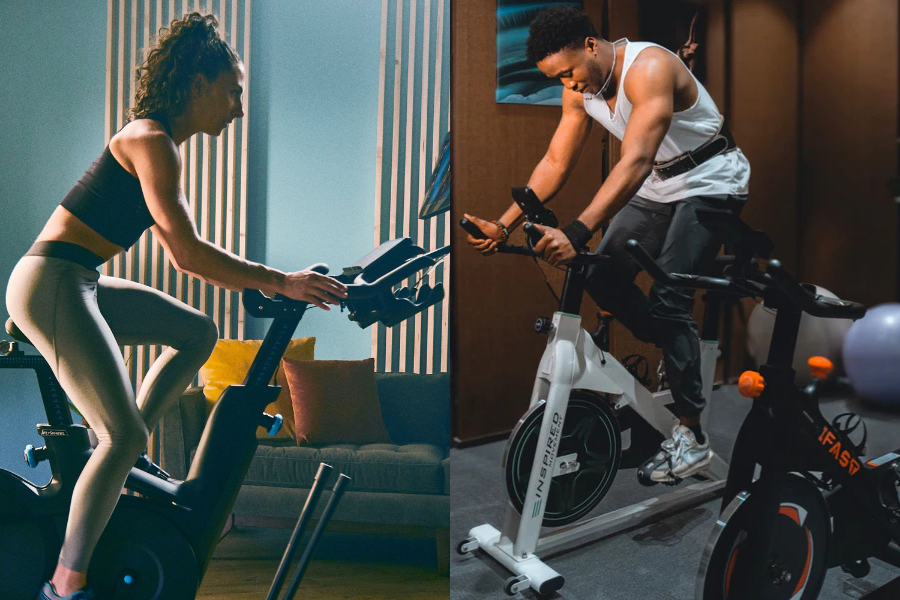
According to recent guidance, spin bikes generally burn the most calories because they support high intensity riding that engages your entire lower body and core. Upright bikes come next, followed by recumbent bikes, which usually burn the fewest calories due to the more supported, reclined position (MerachFit).
That does not mean a recumbent bike is a bad choice. If you have back or joint issues, or if you simply feel more comfortable in a reclined seat, a recumbent bike may allow you to ride more often and for longer, which matters more over time than small differences per workout.
Try to match the bike to how you like to move:
- If you enjoy intense, class style workouts, a spin bike may keep you engaged.
- If you want a familiar feel similar to an outdoor bike, an upright may be best.
- If comfort and joint friendliness are your top priority, consider a recumbent.
The right bike is the one you will actually use regularly.
Consistency beats perfection. A comfortable 20 minute ride several days a week usually leads to more progress than a single “perfect” workout you dread and avoid repeating.
Stand up and move more muscles
Sitting is not your only option on a bike. Pedaling standing up, or riding out of the saddle, can increase your metabolic cost because your core and upper body have to work harder to support you. Studies suggest that out of saddle sprints and hill efforts burn more calories than similar efforts while seated, especially during intense repetitions (CarolBike).
To use this safely, start with short segments:
- Stay seated for most of your ride.
- During some of your harder intervals, stand up for 15 to 30 seconds.
- Keep your weight centered over the pedals, not leaning heavily on the handlebars.
- Sit back down if you feel unstable or your knees feel strained.
Over time, you can extend these out of saddle segments or reserve them for your hardest efforts. There is no need to stand the entire time. Short, focused bursts are enough to make a difference in your exercise bike calorie burn.
Track calories burned without obsessing
Many people rely on the bike’s built in display to check calories burned. While this is convenient, it is not always accurate.
Stationary bike displays can vary a lot from one model to another. Some overestimate calorie burn because they do not account for your individual weight, age, or body composition. Newer models tend to be a bit better because they use more data, but they can still be off (We R Sports).
Power based estimates, which rely on watts, are more precise. A simple formula sometimes used by cyclists is:
Calories burned = watts x hours x 3.6
Using that formula, riding at 100 watts for 15 minutes burns about 90 calories, and 200 watts for the same 15 minutes burns about 180 calories (Reddit Fitness).
If your bike does not show watts, a fitness tracker or heart rate monitor can offer a more personalized estimate than the bike’s default number, since these devices often factor in your age, weight, gender, and resting heart rate (We R Sports).
The key is not to chase a perfect number. Instead, use the same method over time so you can compare one ride to another. If your estimated calories burned are going up for the same duration, you know your intensity is improving.
Build habits that make higher calorie rides easier
Small behavior tweaks can quietly raise your weekly exercise bike calorie burn without feeling like a huge effort.
Here are a few ideas you can experiment with:
- Schedule your rides. Treat them like appointments, not “optional if you have time.”
- Keep your bike ready. Store it in a visible spot with shoes and a towel nearby so there is less friction when you want to ride.
- Start with time, then add intensity. Commit to a set duration, such as 20 minutes, then gradually increase resistance or intervals as you feel stronger.
- Mix up your sessions. Alternate easier recovery rides with tougher interval days so your legs get a break while you keep your routine going.
Over time, even modest sessions add up. An average person might burn around 150 calories in a 30 minute moderate ride, and that number climbs with higher efforts or longer durations (We R Sports). Spread over the week, those calories can play a real role in weight loss and heart health, especially when combined with balanced eating and regular movement off the bike.
Putting it all together
You do not have to overhaul everything at once to get more from your exercise bike workouts. You can start small.
For your next ride, pick just one change. Maybe you add two short intervals, gently increase your resistance, or stand up for a few seconds during a climb. Once that feels normal, layer in another change.
By understanding what affects exercise bike calorie burn and adjusting your intensity, resistance, bike style, and tracking tools, you turn every ride into a more efficient step toward your goals.